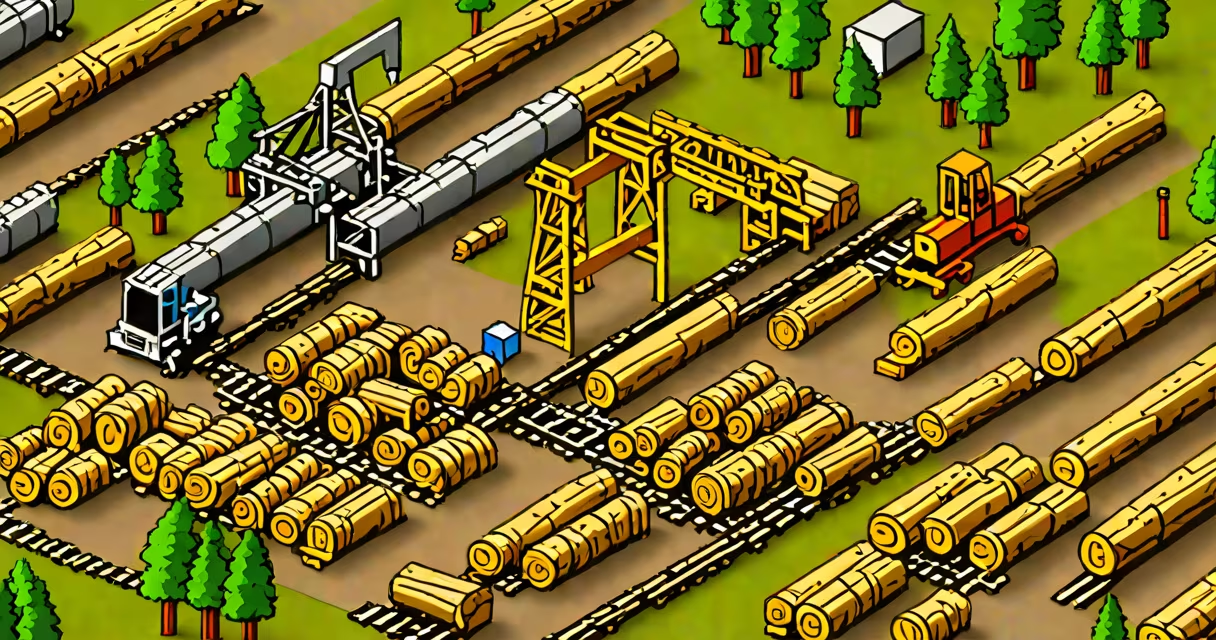
Publicly traded lumber companies are U.S.-listed corporations that grow, harvest, process, and sell wood products such as dimensional lumber, plywood, and engineered wood. These firms generate revenue through the sale of raw and processed timber, often operating large-scale forestry operations and manufacturing facilities. Their stock prices fluctuate based on demand from construction, housing markets, and global trade flows.
Lumber is a commodity with price volatility driven by supply constraints, weather events, transportation costs, and macroeconomic trends. Publicly traded lumber companies are subject to these dynamics while also managing long-term capital investments in land, equipment, and sustainability practices. Investors track them via exchanges like the NYSE and NASDAQ, where shares are bought and sold daily.
Examples include Weyerhaeuser Company (WY), Louisiana-Pacific Corporation (LPX), and Georgia-Pacific's parent company, Koch Industries (private, not listed). WY and LPX are among the most prominent publicly traded firms in the sector, with market caps exceeding $40 billion and $15 billion respectively as of 2024. Both report quarterly earnings and distribute dividends to shareholders.
These companies follow a vertically integrated model: they own forestland, run harvesting operations, transport logs to mills, and process raw timber into finished products. This control reduces dependency on external suppliers and stabilizes input costs. For example, Weyerhaeuser owns approximately 11 million acres of timberland across the U.S., primarily in the Pacific Northwest and Southeast.
Production occurs in sawmills and panel plants. A typical sawmill cuts logs into standard-sized boards (e.g., 2x4s) using band saws and planers. The output is graded by quality-select, #1 common, or utility-and priced accordingly. Finished lumber is shipped via rail, truck, or barge to distributors, retailers, and construction sites.
Financial performance hinges on the lumber futures market. The Chicago Mercantile Exchange (CME) trades lumber futures contracts, which set benchmarks for pricing. When housing starts rise, demand spikes, pushing futures prices higher. This affects the profitability of publicly traded lumber companies even before physical delivery occurs.
Companies in this space fall into three categories based on business focus:
| Type | Focus | Examples | Key Metric |
|---|---|---|---|
| Timber REITs | Land ownership and lease income | Realty Income (O), Crown Castle (CCI) | Dividend yield (typically 4-6%) |
| Integrated Forestry Firms | Land, harvesting, milling, and sales | Weyerhaeuser (WY), Louisiana-Pacific (LPX) | Net profit margin (2-8%) |
| Specialty Wood Product Makers | Engineered wood, laminated beams, OSB panels | WestRock (WRK), Verso Paper (VRS) | Operating cash flow per share |
Timber REITs like Realty Income do not process lumber-they lease forested land to logging contractors and collect rent. This model generates stable income but lacks exposure to price swings in finished lumber. In contrast, integrated firms like WY benefit from both rising lumber prices and consistent land yields.
A key distinction missed by many investors: not all timber-related stocks are lumber producers. Some are paper manufacturers or packaging firms. WestRock (WRK), for instance, produces corrugated boxes and recycled paper-its core business is packaging, not structural lumber. Confusing these leads to misaligned expectations.
Publicly traded lumber companies serve builders, home improvement retailers, and industrial users. In 2023, U.S. residential construction accounted for 58% of domestic lumber consumption, according to the National Association of Home Builders (NAHB). That demand directly influences the revenue of firms like LPX, whose primary customers include Lowe's and Home Depot.
Investors buy shares in these companies for growth, income, or inflation hedging. Lumber prices historically rise during periods of high construction activity. During the 2020-2022 housing boom, WY's stock rose 170% as lumber futures hit record highs. The company paid a quarterly dividend of $0.40 per share in Q4 2021-a 12% increase from the prior year.
One non-obvious fact: lumber prices are heavily influenced by Canadian exports. Canada supplies nearly 60% of U.S. softwood lumber imports. Trade disputes between the two nations have led to tariffs under Section 232 of the Trade Expansion Act. In 2023, the U.S. imposed a 10% tariff on Canadian lumber, reducing supply and increasing prices. This impacted WY's margins, as it relies on cross-border sourcing for some raw materials.
Many assume all publicly traded lumber companies are small or regional. In reality, several are large-cap stocks with significant institutional ownership. Weyerhaeuser had over 1.2 billion shares outstanding in 2024, with 62% held by mutual funds and ETFs, including the Vanguard Total Stock Market Index Fund (VTSAX).
Another misconception: that lumber stocks are purely cyclical. While they correlate strongly with housing starts, they also benefit from long-term trends like urbanization and sustainable building codes. WY has committed to achieving net-zero carbon emissions by 2040, investing $150 million annually in reforestation and low-carbon milling technologies. This supports ESG ratings and attracts long-term capital.
I once visited a Weyerhaeuser mill in Longview, Washington, in 2022. The facility runs 24/7, processing 1.2 million board feet of Douglas fir daily. The automation system uses AI-driven sensors to detect knots and defects, adjusting blade angles in real time. This reduced waste by 18% compared to manual settings-an efficiency gain that directly improves profit margins.
For context, consider LPX's 2023 annual report. The company reported $3.2 billion in revenue, $480 million in net income, and a 15.6% return on equity. Its stock closed at $108.40 per share, yielding a 2.1% dividend. Over five years, the stock returned 112%, outperforming the S&P 500's 78% gain during the same period.
Publicly traded lumber companies are not limited to North America. However, foreign firms like Sweden's Stora Enso (STE) or Finland's Metsä Group (METSF) are not traded on U.S. exchanges. U.S. investors seeking international exposure must use ADRs or trade on European markets.
Understanding the difference between commodity exposure and operational control is critical. A company like WY owns forests and mills-it controls production. But a trader who buys lumber futures on the CME doesn't own any assets. The futures contract is a financial derivative tied to spot prices. Confusing the two leads to poor risk assessment.