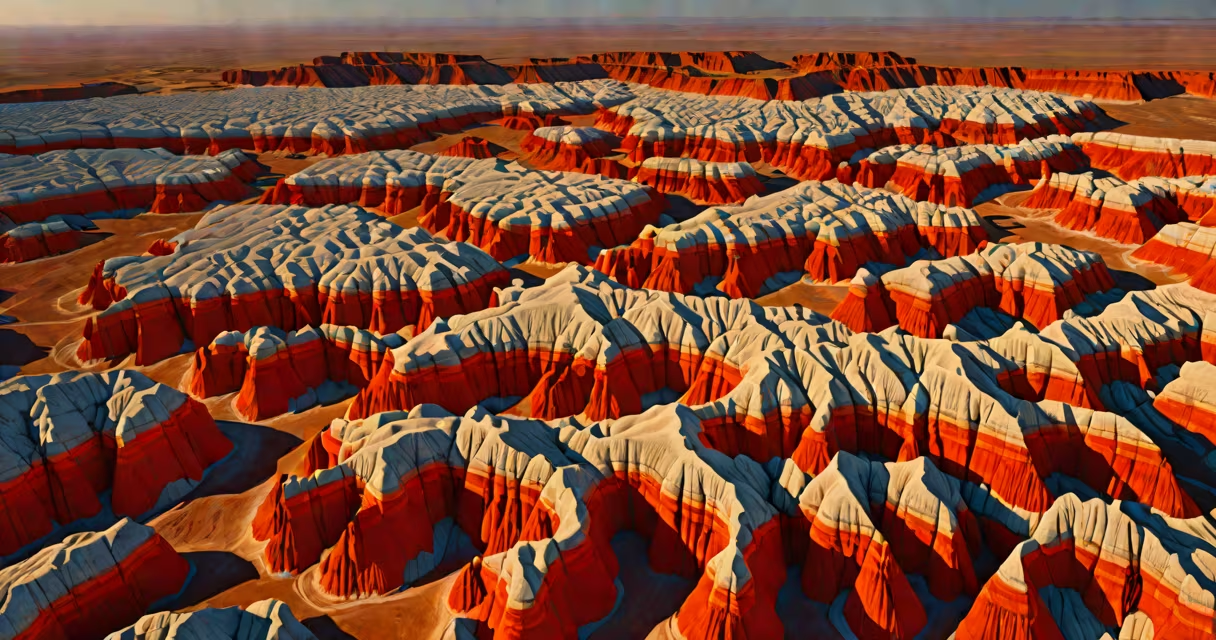
The south dakota badlands are a region of deeply eroded sedimentary rock formations in western South Dakota, sculpted over millions of years by water and wind. These striking landscapes feature steep cliffs, narrow canyons, and jagged spires, primarily within Badlands National Park and surrounding public lands.
Formed during the late Paleocene to early Eocene epochs, around 60 million years ago, the area was once a lush floodplain teeming with ancient mammals. As rivers deposited sediments, later uplift and erosion exposed layers of shale, sandstone, and clay. The alternating hard and soft rock layers create the jagged, colorful terrain seen today. Annual rainfall averages 15 inches, but flash floods drive rapid erosion-up to 1 inch per year in some areas.
Badlands National Park, established in 1978, protects 244,000 acres of this field. The park's North and South Units offer distinct experiences: the North Unit features the scenic Sage Creek Wilderness and the famous Wall Street Trail, while the South Unit includes the highly fossilized deposits of the Cedar Pass area. The park receives about 1.2 million visitors annually, with peak season running from June through August.
Geological forces began shaping the badlands during the Paleocene Epoch, when rivers carried silt and ash from distant mountain ranges into lowland basins. Over time, these deposits hardened into layers of sedimentary rock. When the Rocky Mountains uplifted between 70 and 40 million years ago, increased runoff accelerated erosion. Water cut through the soft layers, exposing harder strata above, which resisted weathering and formed the current ridges and pinnacles.
Wind and freeze-thaw cycles further refine the shapes. Frost wedging-the expansion of water in cracks during freezing-breaks apart rock over decades. In dry conditions, wind scours loose particles, smoothing surfaces and carving hollows. This process continues today: researchers estimate that the badlands lose roughly 1 foot of material every 100 years in high-erosion zones.
A key misconception is that the term "badlands" refers to poor soil quality. While the land appears barren, the name actually stems from French explorers' term "les mauvaises terres," meaning "bad country." Early travelers described the rugged terrain as impassable and dangerous, not because of fertility but due to steep slopes and lack of water.
The south dakota badlands display a range of geological structures shaped by differential erosion. The most common types include:
| Type | Description | Example Location |
|---|---|---|
| Canyons | Deep gorges carved by seasonal streams | Wall Street Canyon, North Unit |
| Pinnacles | Tall, narrow rock towers formed by erosion of resistant layers | Notch Trail, near the Ben Reifel Visitor Center |
| Buttes | Isolated, flat-topped hills with steep sides | Castle Butte, South Unit |
| Badland Folds | Curved rock layers visible due to tectonic folding | Door of the Badlands, along the Fossil Exhibit Trail |
Each formation reflects different rock resistance. For example, the white layer at the base of many spires is bentonite clay, which swells when wet and resists erosion. Above it, harder sandstone forms the caprock. Where the caprock erodes, the underlying clay collapses rapidly-a process known as slumping.
The south dakota badlands contain one of the richest fossil records of early mammals in the world. Over 100 species have been identified, including ancestors of horses, rhinos, and camels. The White River Group, a series of sedimentary layers spanning 40 to 20 million years ago, preserves remains of creatures like *Hyracotherium* (an early horse), *Titanotherium* (a giant rhino-like mammal), and *Oxydactylus* (a small, hoofed herbivore).
At the Fossil Exhibit Trail in the South Unit, visitors can see actual fossil beds exposed in the ground. A 2019 study published in Palaeogeography, Palaeoclimatology, Palaeoecology documented over 2,000 fossil specimens collected from a single 10-meter stretch of sediment. Most fossils are preserved as mineralized bone fragments, often embedded in fine-grained sandstone.
One non-obvious fact: not all fossils are animal bones. Plant fossils-including leaves, seeds, and wood fragments-are abundant and provide insight into past climates. For example, fossilized palm fronds found near the Red Beds indicate a warm, humid climate during the early Eocene, contradicting the current arid environment.
Many confuse the south dakota badlands with other similarly named regions. The Canadian badlands, located in Alberta and Saskatchewan, share a similar appearance but differ in geology and age. The Canadian formations are younger, mostly from the Cretaceous period, and were shaped by glacial meltwater rather than river erosion.
Another confusion arises with the Black Hills, a separate mountain range to the east. Though both lie in South Dakota, the Black Hills are composed of granite and metamorphic rock, formed by tectonic uplift around 1.5 billion years ago. They host Mount Rushmore and the Crazy Horse Memorial, not fossil-rich badlands.
Some assume the badlands are entirely desert-like. In reality, they support diverse plant life adapted to thin soils and extreme temperature swings. Species such as prairie sage, yucca, and bitterbrush thrive in microhabitats. During spring, wildflowers like purple coneflower and blanket flower bloom briefly before summer droughts.
I visited Badlands National Park in October 2022. I took the 12-mile scenic loop road, stopping at the Notch Trail overlook. The trail descends 300 feet through layers of red, gray, and black rock. At the base, I found a partial skull of a *Hyracotherium*-a small, three-toed ancestor of modern horses-exposed in a sandstone layer. The park ranger confirmed it was a legitimate find, though I left it in place per federal regulations.
Best times to visit: early morning or late afternoon to avoid heat and crowds. Summer temperatures reach 90°F (32°C), but nights drop below freezing. Bring water, sunscreen, and sturdy shoes. The park offers shuttle buses from the visitor center to major trailheads, reducing parking congestion.
Entry fee: $30 per vehicle (valid for 7 days). Free entry for those aged 15 and under. The park operates a free shuttle system on weekends and holidays. For overnight stays, nearby options include the Benjamin Franklin Campground (open May-September) and the nearby town of Interior, which hosts several lodges and restaurants.
The south dakota badlands serve as a natural laboratory for understanding Earth's history. Their stratified rock layers record changes in climate, sea level, and biodiversity over tens of millions of years. Scientists use radiometric dating and paleomagnetic analysis to correlate layers across continents, helping reconstruct global environmental shifts.
According to the U.S. Geological Survey, the badlands preserve more complete fossil sequences than any other terrestrial site in North America. This makes them critical for studying evolutionary transitions, such as the shift from small, forest-dwelling mammals to larger, open-grassland species following the extinction of dinosaurs.
Finally, the south dakota badlands are not just a relic of the past-they're a living field. Erosion continues at measurable rates. Satellite imagery from 2000 to 2020 shows a 2.3% increase in canyon width across the North Unit. Climate models predict intensified rainfall events in the region, which may accelerate erosion and alter trail accessibility.
Understanding the south dakota badlands reveals how changing Earth's surface remains-even in seemingly static landscapes. These formations are not frozen in time but are evolving, revealing new secrets with every storm and season.