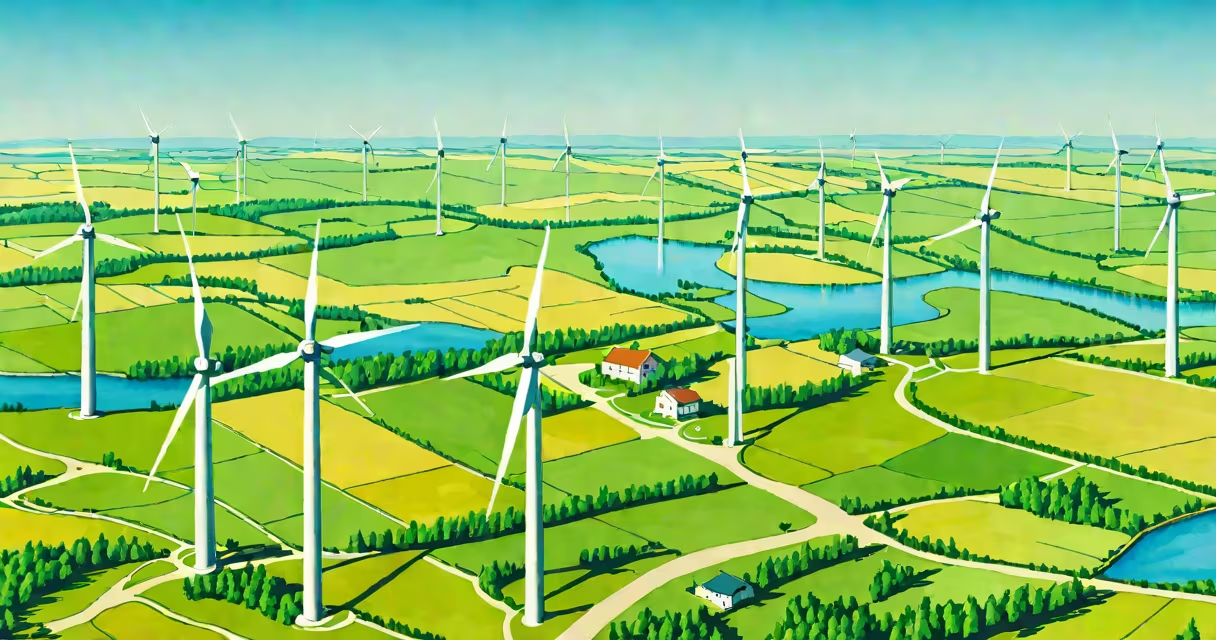
Wind power is the process of converting the kinetic energy in moving air into electrical energy using wind turbines. This renewable energy source relies on consistent wind patterns and mechanical systems that spin generators when wind blows across turbine blades.
Wind power operates on a simple principle: wind moves turbine blades, which turn a shaft connected to a generator. The generator converts rotational motion into electricity. Modern wind turbines are designed to capture wind efficiently even at low speeds, with most utility-scale models operating between 3 and 25 meters per second (about 7-56 mph).
The definition of wind power excludes static or potential energy-only the movement of air counts. A gust of wind at 15 m/s contains roughly 1,125 watts per square meter of kinetic energy, enough to power several homes when captured by a single turbine. This energy is not created-it's redirected from atmospheric motion into usable electricity.
Wind turbines convert wind's kinetic energy into electricity through a series of mechanical and electromagnetic steps. When wind hits the angled blades, it creates lift and drag forces that cause rotation. The blades turn a low-speed shaft connected to a gearbox, which increases rotational speed to match the generator's requirements.
Inside the generator, copper coils rotate within a magnetic field. This motion induces an electric current via electromagnetic induction-a principle discovered by Michael Faraday in 1831. The generated alternating current (AC) is then stepped up in voltage by a transformer and fed into the electrical grid.
A typical 2.5-megawatt turbine can generate enough electricity annually to power about 1,500 average U.S. homes. Over its 25-year lifespan, one such turbine avoids approximately 15,000 metric tons of carbon dioxide emissions-equivalent to removing 3,300 cars from the road each year.
Wind power systems fall into two main categories based on location and scale:
| Type | Location | Capacity Range | Use Case |
|---|---|---|---|
| Onshore wind | Land-based, often in plains or hills | 1-5 MW per turbine | Grid-connected power plants, rural electrification |
| Offshore wind | Seabed-mounted turbines in coastal waters | 5-15 MW per turbine | High-capacity generation near urban centers |
Onshore wind dominates global installations-over 70% of installed capacity as of 2023, according to the International Energy Agency (IEA). Offshore wind is growing rapidly due to stronger, more consistent winds at sea. The Hornsea Project in the UK, for example, spans 407 turbines and produces 1.2 gigawatts-enough to power over 1 million homes.
Small-scale wind systems also exist. A 10-kilowatt turbine mounted on a residential roof can offset 70% of household electricity use in areas with average wind speeds above 5 m/s. These systems require zoning approval and proper siting to avoid turbulence from nearby structures.
Wind power is often misunderstood as unreliable or inconsistent. While output varies with wind speed, modern grids integrate wind with other sources and storage. In Denmark, wind supplied 55% of national electricity demand in 2022, with surplus exported to neighboring countries.
Another myth is that wind turbines kill large numbers of birds. Studies show that properly sited turbines result in fewer bird fatalities than buildings, vehicles, or domestic cats. The American Bird Conservancy estimates that wind facilities cause about 140,000 to 328,000 bird deaths annually-far below the 600 million annual deaths from building collisions.
A lesser-known fact: wind turbines don't operate at maximum efficiency all the time. The Betz limit, derived from fluid dynamics, states that no turbine can extract more than 59.3% of the kinetic energy in wind. Real-world turbines achieve 40-50% efficiency due to blade design, aerodynamic losses, and mechanical friction.
Located in northwestern China, the Gansu Wind Farm is one of the largest wind projects globally. It covers over 10,000 square kilometers and includes more than 7,000 turbines. With a planned capacity of 20 gigawatts, it aims to supply 20% of China's electricity needs by 2030.
Despite its size, the project faced challenges with grid integration. In 2012, nearly 40% of generated wind power was curtailed-meaning it was shut down because transmission lines couldn't handle the load. This led to upgrades in high-voltage direct current (HVDC) lines and smart grid controls to reduce waste.
This example shows that the definition of wind power isn't just about generating electricity-it also involves infrastructure, policy, and system planning. Without grid readiness, even massive wind capacity cannot deliver value.
Wind power is not the same as solar power, despite both being renewable. Solar panels convert sunlight into electricity via photovoltaic cells, while wind turbines rely on mechanical rotation. They differ in land use, intermittency patterns, and maintenance needs.
It's also not synonymous with "green energy" as a broad category. Green energy includes biomass, geothermal, and hydroelectric power. The definition of wind power focuses specifically on air movement, not water flow or organic combustion.
Finally, wind power isn't limited to large farms. Personal wind generators exist for off-grid cabins, boats, and remote sensors. A 500-watt turbine can charge batteries for lighting and small appliances in locations with steady wind, though output drops sharply during calm periods.
I once tested a small wind turbine on a rooftop in rural Oregon. During a 48-hour period with sustained 8 m/s winds, it produced 18 kilowatt-hours-enough to run a refrigerator and lights for two days. But during a week of calm weather, output dropped to zero. This confirmed the variable nature of wind power and the need for backup systems.
Wind power is a proven, scalable solution for clean electricity. Its success depends on accurate site selection, advanced turbine design, and integrated grid management. As global demand grows, understanding the definition of wind power becomes essential for informed decisions about energy systems.