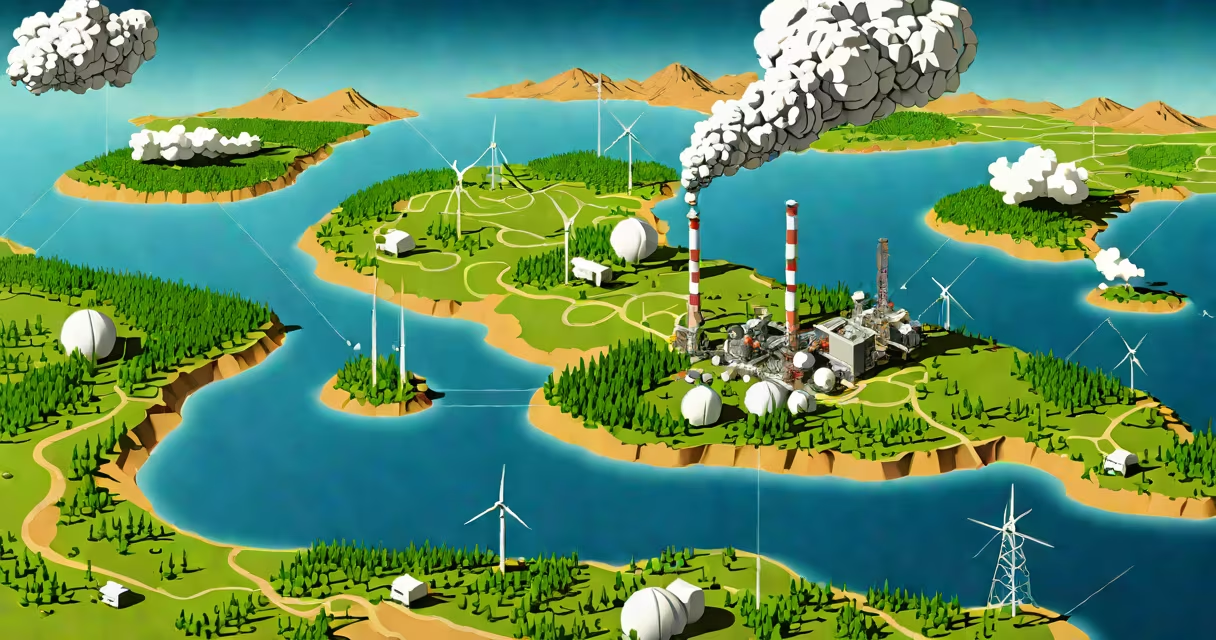
Too much CO2 refers to elevated levels of carbon dioxide in the atmosphere that exceed natural equilibrium, disrupting Earth's climate system and accelerating global warming. When CO2 concentrations rise beyond pre-industrial levels-around 280 parts per million (ppm)-they trap more heat, leading to long-term changes in temperature, weather patterns, and ocean chemistry.
Carbon dioxide is a greenhouse gas produced through fossil fuel combustion, deforestation, and industrial processes. Natural sources like volcanoes and respiration release CO2 too, but human activity has increased atmospheric CO2 by over 50% since the late 1800s. The current concentration exceeds 420 ppm, a level not seen in at least 800,000 years, according to ice core data from the National Oceanic and Atmospheric Administration (NOAA).
The Intergovernmental Panel on Climate Change (IPCC) states that stabilizing global temperatures below 1.5°C of warming requires reducing CO2 emissions to net-zero by 2050. Exceeding this threshold increases risks of irreversible environmental damage, including sea-level rise, coral bleaching, and intensified storms.
CO2 molecules absorb infrared radiation emitted by Earth's surface. Instead of escaping into space, this energy is re-radiated back toward the planet, warming the lower atmosphere. This process is known as the greenhouse effect. While the effect is natural and necessary for life, excessive CO2 amplifies it beyond safe thresholds.
Each molecule of CO2 can remain in the atmosphere for centuries. About 20% of emitted CO2 persists for over 1,000 years, meaning past emissions continue influencing climate even if new emissions stop. The rate of accumulation is now about 2.5 parts per million per year, driven primarily by coal-fired power plants, transportation, and cement production.
A 2023 study published in *Nature* found that atmospheric CO2 growth slowed slightly between 2020 and 2022 due to pandemic-related economic downturns, but rebounded sharply in 2023 as global energy demand surged. This demonstrates that short-term disruptions don't reverse long-term trends unless structural changes occur.
CO2 emissions fall into three categories: energy generation, land use, and industrial processes. Energy accounts for roughly 73% of global CO2 emissions, with coal and oil dominating power and transport sectors. Land use changes-especially tropical deforestation-contribute about 12%, releasing stored carbon from trees and soil.
| Source | Share of Global CO2 Emissions (2022) | Example Activity |
|---|---|---|
| Energy Production | 54% | Burning coal for electricity |
| Transportation | 16% | Gasoline-powered vehicles |
| Industrial Processes | 12% | Cement manufacturing, steel refining |
| Land Use Changes | 12% | Clearing rainforests for agriculture |
Deforestation in the Amazon Basin released approximately 1.5 billion tons of CO2 annually between 2010 and 2020, according to Brazil's National Institute for Space Research (INPE). This loss of forest cover reduces the planet's capacity to absorb CO2, creating a feedback loop that worsens atmospheric buildup.
High CO2 levels affect air quality, ocean chemistry, and human health. In urban areas, elevated CO2 correlates with higher rates of respiratory illness and reduced cognitive performance. A 2021 Harvard study showed that indoor CO2 levels above 1,000 ppm impair decision-making and attention span-common in poorly ventilated offices and schools.
Ocean acidification results from CO2 dissolving in seawater to form carbonic acid. Since the Industrial Revolution, surface ocean pH has dropped by 0.1 units-a 30% increase in acidity. This harms shell-forming organisms like oysters and corals. The Great Barrier Reef lost over half its coral cover between 1995 and 2017 due to warming and acidification, per research from the Australian Institute of Marine Science.
Climate impacts are already measurable. The 2023 European heatwave, which killed over 60,000 people, was made 10 times more likely by climate change linked to CO2 emissions, according to a World Weather Attribution analysis.
Many assume CO2 is only harmful because it causes warming. But CO2 is also essential for plant photosynthesis. Without it, most life on Earth would collapse. The issue isn't CO2 itself-it's the imbalance caused by rapid emission increases.
Another myth is that individual actions have no impact. While systemic change is required, personal choices influence aggregate behavior. For example, switching from a gasoline car to an electric vehicle reduces annual CO2 emissions by 4.5 metric tons per driver, based on U.S. Environmental Protection Agency (EPA) data.
Some confuse CO2 with other pollutants like nitrogen oxides or particulate matter. These affect air quality and health differently. CO2 doesn't cause smog or immediate respiratory distress, but its long-term effects are more severe and harder to reverse.
In May 2023, Mauna Loa Observatory in Hawaii recorded a daily average CO2 concentration of 426.8 ppm-the highest monthly average in the 66-year record. This surpassed the 420 ppm threshold that scientists consider a critical warning sign.
Atmospheric CO2 rose 2.7 ppm that month alone, exceeding the 2.0 ppm average annual increase over the past decade. NOAA attributes this surge to El Niño conditions, increased fossil fuel use in Asia, and reduced carbon uptake by oceans and forests during dry seasons.
This spike illustrates how quickly CO2 accumulates. Even if emissions were halved tomorrow, existing concentrations would still drive warming for decades. The window to avoid catastrophic outcomes is narrowing.
In 2022, I helped install a low-cost CO2 sensor in a high school science lab in Portland, Oregon. Over one semester, we tracked indoor levels during class hours. When 30 students occupied the room with windows closed, CO2 reached 2,100 ppm within 45 minutes-over double outdoor levels.
When windows opened, levels dropped to 600 ppm within 10 minutes. This demonstrated how ventilation directly controls indoor CO2. Poor airflow in classrooms may impair learning, as shown in a 2020 Stanford study linking high CO2 to lower test scores.
Too much CO2 is often conflated with "carbon footprint," but they differ. A carbon footprint measures total greenhouse gas emissions from an individual, organization, or product-expressed in metric tons of CO2 equivalent. Too much CO2 refers specifically to atmospheric concentration, not emissions volume.
Also, while CO2 is the primary driver of current warming, methane (CH₄) has a stronger heat-trapping ability per molecule. However, methane breaks down in about 12 years, whereas CO2 persists for centuries. Reducing CO2 is therefore essential for long-term climate stability.
For context, the Paris Agreement aims to limit warming to well below 2°C, preferably 1.5°C. Current national pledges under the agreement would result in 2.5°C warming by 2100, according to UN Environment Programme (UNEP) modeling. This gap underscores the urgency of addressing too much CO2.
Understanding too much CO2 is not about fear-it's about clarity. The science is clear: human-driven CO2 emissions are altering planetary systems. Solutions exist-renewable energy, reforestation, carbon capture-but they require coordinated action at scale.
Reducing CO2 emissions is not optional. It is a prerequisite for stable climates, healthy ecosystems, and resilient communities. The path forward demands policy, innovation, and accountability. Ignoring too much CO2 means accepting escalating risk.