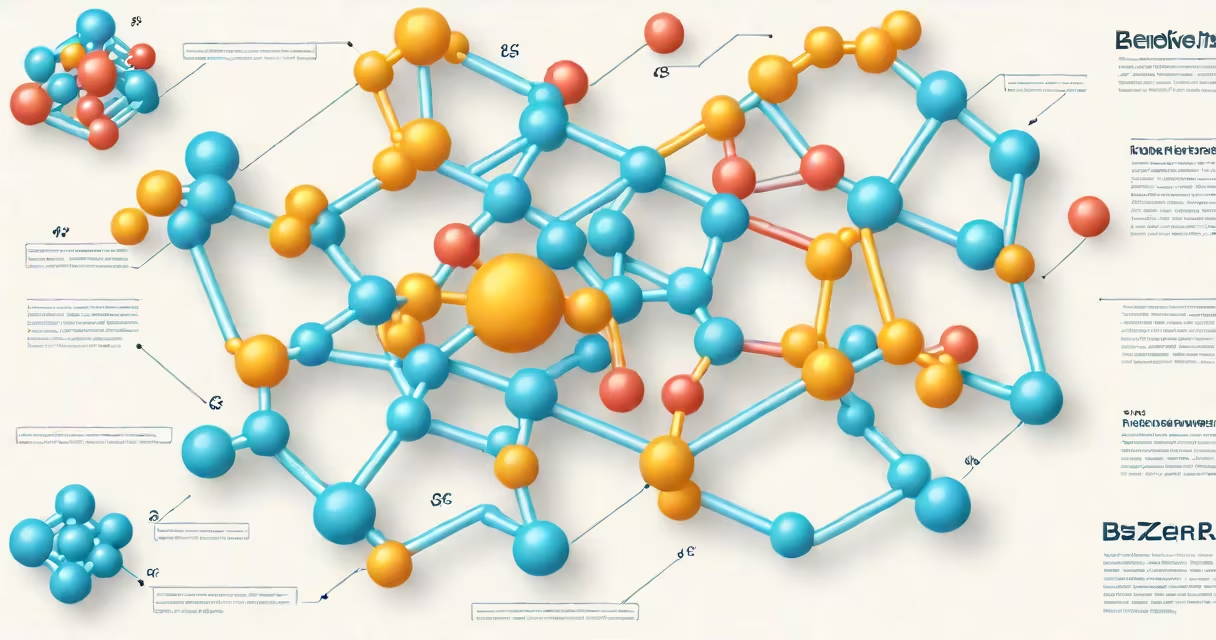
Organic chemistry explained is the study of carbon-based molecules, their structures, properties, and reactions. It centers on compounds containing carbon-hydrogen bonds, which form the foundation of life and synthetic materials.
Carbon's unique ability to form four stable covalent bonds enables complex structures like chains, rings, and branched networks. These structures define the behavior of organic molecules-from methane in natural gas to DNA in living cells. The field traces its roots to early 19th-century observations that organic compounds derived from living systems had distinct properties unlike inorganic ones.
Modern organic chemistry applies principles of bonding, stereochemistry, and reaction mechanisms to design pharmaceuticals, polymers, and agrochemicals. For example, the synthesis of aspirin involves acetylation of salicylic acid-a classic organic transformation studied since the late 1800s.
At its core, organic chemistry relies on electron sharing between atoms. Carbon forms single, double, or triple bonds with itself and other elements like hydrogen, oxygen, nitrogen, and halogens. Bond types determine molecular geometry and reactivity.
Reactions proceed through intermediate species such as carbocations, carbanions, and radicals. Reaction pathways are often predictable based on electronegativity differences and steric effects. For instance, nucleophiles attack electrophilic carbon centers in substitution reactions-common in drug metabolism and industrial synthesis.
A key concept is functional group reactivity. Groups like alcohols (-OH), ketones (>C=O), and amines (-NH₂) dictate how a molecule behaves. A hydroxyl group makes ethanol polar and water-soluble; a ketone group in acetone allows it to dissolve plastics and clean surfaces.
Organic compounds fall into categories based on their functional groups and carbon frameworks. The following table outlines major classes:
| Class | Functional Group | Example | Common Use |
|---|---|---|---|
| Alkanes | C-C single bonds | Methane (CH₄) | Fuel, natural gas |
| Alkenes | C=C double bond | Ethene (C₂H₄) | Plastic production (polyethylene) |
| Alcohols | -OH | Propanol | Solvent, disinfectant |
| Carboxylic Acids | -COOH | Acetic acid (vinegar) | Food additive, industrial chemical |
| Amines | -NH₂ | Ammonia derivatives | Pharmaceutical intermediates |
Each class exhibits characteristic physical and chemical behaviors. Alkanes are relatively inert due to strong C-C and C-H bonds. Alkenes undergo addition reactions with halogens-used in testing unsaturation via bromine water decolorization.
Ring structures add complexity. Benzene (C₆H₆) features resonance-stabilized delocalized electrons, making it less reactive than typical alkenes. This stability underpins the design of aromatic dyes and pharmaceuticals like ibuprofen.
Organic chemistry powers industries ranging from medicine to agriculture. Over 90% of known drugs contain carbon-based scaffolds. Aspirin, developed in 1897, is a modified salicylate-an ester formed by reacting salicylic acid with acetic anhydride.
Polymers like polyethylene and nylon originate from organic monomers. Polyethylene forms when ethene undergoes catalytic polymerization-repeating units linked by addition reactions. This process produces millions of tons annually for packaging and containers.
Environmental science uses organic chemistry to track pollutants. DDT, a persistent organic pollutant, resists degradation due to its chlorine-substituted aromatic structure. Its long half-life in ecosystems led to global bans under the Stockholm Convention.
Many assume organic chemistry applies only to biological systems. But synthetic compounds like Teflon (polytetrafluoroethylene) are organic despite being man-made and non-living. The term "organic" refers to carbon content-not origin.
Another error is equating complexity with importance. Not all biologically relevant molecules are large. Glucose (C₆H₁₂O₆), a simple sugar, drives cellular energy production. Conversely, some complex molecules have minimal function-like certain metabolites in rare metabolic disorders.
A lesser-known fact: carbon can form stable bonds with metals in organometallic compounds. These are important in catalysis-such as palladium-catalyzed cross-coupling reactions used in synthesizing complex drugs. Nobel laureates Richard Heck, Ei-ichi Negishi, and Akira Suzuki were awarded for developing these methods.
Ibuprofen, a widely used NSAID, demonstrates multiple organic chemistry concepts. The synthesis begins with 2-methylpropylbenzene, which undergoes Friedel-Crafts acylation using acetyl chloride and aluminum chloride catalyst.
The resulting ketone is reduced to a secondary alcohol via sodium borohydride. A final oxidation step converts the alcohol to a carboxylic acid-using chromium trioxide in sulfuric acid. This sequence illustrates regioselectivity, reduction, and oxidation mechanisms.
Each step requires precise control of temperature, solvent, and stoichiometry. Industrial-scale production uses continuous flow reactors to improve yield and safety-reducing waste by up to 60% compared to batch processes.
As someone who once synthesized ibuprofen in a university lab, I recall the frustration of poor yields due to side products. Only after adjusting the catalyst ratio and cooling rate did the reaction produce pure material-proof that theory and practice differ in subtle but critical ways.
Understanding organic chemistry explained helps decode everything from food additives to climate-changing gases. It's not just about memorizing reactions-it's about predicting outcomes based on structure and energy.