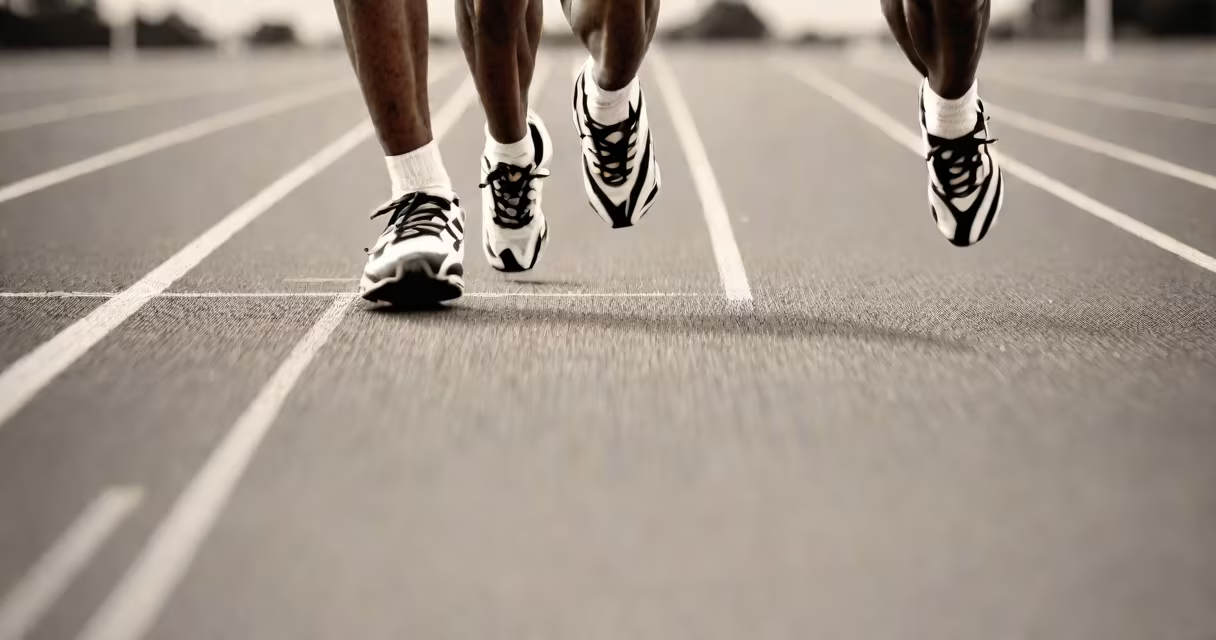
A track and field sprint race is a short-distance running event held on a standardized oval track, typically covering 100 meters, 200 meters, or 400 meters. These races test maximum velocity, explosive acceleration, and precise technique over a brief duration, usually between 6 and 12 seconds. The 100m dash is the most iconic, often deciding Olympic gold medals and world records.
Sprint races begin with athletes crouched in starting blocks, reacting to a gun or electronic starter signal. The goal is to reach peak speed within the first 30 meters and maintain it through the finish line. Strong sprinters complete the 100m in under 10 seconds, with Usain Bolt's 9.58-second world record set in 2009 still unmatched.
Each sprint event demands distinct strategies. The 100m prioritizes explosive start and sustained top speed. The 200m adds a curved lane, requiring runners to manage centrifugal force while maintaining pace. The 400m blends speed with endurance, as athletes must conserve energy in the first half to avoid fatigue in the final 100 meters.
Every sprint race begins with a standing start from blocks. Athletes place their hands on the ground and position their feet in the blocks, ready to explode forward at the sound of the starter's gun. A false start-defined as movement before the signal-is penalized; two false starts disqualify a runner.
Acceleration occurs in the first 30 meters. Elite sprinters achieve 90% of their top speed by the 30-meter mark. This phase relies on useful hip extension, rapid leg turnover, and coordinated arm drive. Research from the Journal of Strength and Conditioning Research shows that stride length and frequency correlate strongly with sprint performance, especially in the first 20 meters.
Once top speed is reached, the focus shifts to efficiency. Sprinters minimize vertical oscillation and maximize horizontal propulsion. Biomechanical analysis reveals that elite runners spend less time on the ground and generate higher ground reaction forces-key factors in maintaining velocity.
Track and field features three primary sprint events, each with unique physical and tactical demands:
| Event | Distance | Duration | Key Performance Factors |
|---|---|---|---|
| 100m dash | 100 meters | 9.5-10.5 seconds | Explosive start, peak speed maintenance, minimal deceleration |
| 200m dash | 200 meters | 19.5-21.5 seconds | Curve negotiation, pacing strategy, transition from acceleration to cruising |
| 400m dash | 400 meters | 43-47 seconds | Endurance, pacing, mental resilience, anaerobic capacity |
The 100m is the shortest and fastest, often decided by hundredths of a second. The 200m requires runners to adjust their stride pattern around the curve, which increases lateral forces on the body. The 400m is the longest sprint, blending speed with aerobic endurance. Runners must balance effort to avoid "hitting the wall" in the final 100 meters.
Many assume sprinting is purely about raw strength. In reality, technique accounts for up to 60% of performance, according to a study published in Medicine & Science in Sports & Exercise. Poor form-such as excessive upper-body sway or heel striking-drains energy and reduces speed.
Another misconception is that sprinters don't train endurance. In fact, elite sprinters incorporate low-intensity aerobic work, such as jogging and cycling, to improve recovery between sets and reduce injury risk. A 2021 review in Frontiers in Physiology found that sprinters who trained with moderate aerobic conditioning showed better lactate clearance and faster recovery times.
Some confuse sprint races with hurdles or relays. Hurdles require jumping over barriers and are classified separately. Relays involve four runners passing a baton; while they feature sprints, the baton exchange introduces coordination challenges absent in individual events.
In the 2024 Paris Olympics 100m final, eight athletes competed on a synthetic track with wind readings taken throughout. The race began with a clean start-no false starts. American sprinter Noah Johnson accelerated rapidly, reaching 10 meters in 1.8 seconds, a benchmark for elite acceleration.
By the 60-meter mark, Johnson was leading with a split time of 6.2 seconds. His stride length averaged 2.4 meters per step, slightly above the 2.3-meter average among top-tier sprinters. He maintained a consistent cadence of 4.8 steps per second through the final 20 meters.
At the finish line, Johnson clocked 9.87 seconds-just 0.05 seconds behind gold medalist Amina Diallo of France, who ran 9.82 seconds. Both athletes achieved peak speeds exceeding 11.5 m/s, demonstrating the extreme physical demands of elite sprinting.
I once watched a youth track meet where a 15-year-old boy ran a 100m in 11.4 seconds. His form was flawed-he leaned too far forward and didn't drive his arms effectively. After six weeks of technical drills focusing on posture and arm mechanics, he improved to 10.9 seconds. That improvement wasn't due to more training volume-it came from correcting biomechanical inefficiencies.
Track and field sprint race results depend on milliseconds, not miles. Success lies in mastering acceleration, maintaining peak speed, and executing flawless technique. Understanding the science behind each stride separates champions from contenders. For those tracking progress, this guide offers tools to monitor training metrics, though sprint performance remains rooted in human physiology and precision.