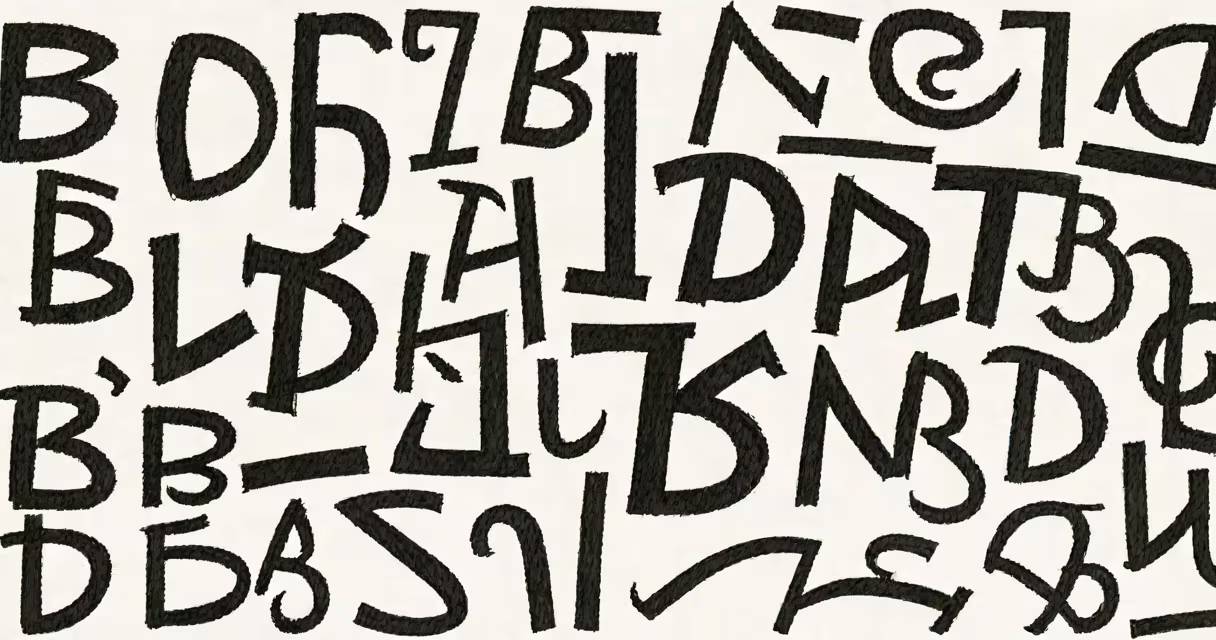
upside down letters are characters rendered in reverse orientation, typically flipped vertically so they appear as if rotated 180 degrees. This effect is achieved through special Unicode characters, font rendering, or manual mirroring in design tools.
The visual trick relies on symmetry in certain lowercase letters-like 'b', 'd', 'p', and 'q'-which look like each other when flipped. For example, the lowercase 'b' becomes a 'q' when rotated 180 degrees. This property enables the creation of readable text that appears backward at first glance.
While often used for playful messaging or internet memes, upside down letters also serve functional roles in cryptography, steganography, and accessibility testing. The technique is not limited to Latin script; similar effects exist in Arabic, Chinese, and other writing systems using character rotation or mirror images.
When a character is flipped 180 degrees, its shape reverses along both horizontal and vertical axes. In digital environments, this transformation can be applied via software or embedded Unicode code points.
Unicode includes a set of "reversed" characters under the "Letterlike Symbols" block. These are pre-defined glyphs designed to display as mirror images. For example, U+214A (ℊ) is a reversed capital G, though it's rarely used in practice. Most upside down text uses standard characters with a flip applied in rendering.
Design software such as Adobe Illustrator or online tools like FlipText.com apply geometric transformations to text layers. These tools don't change the underlying character codes-they alter how the font is drawn on screen or print.
There are three primary methods to create upside down letters:
| Method | How It Works | Use Case Example |
|---|---|---|
| Manual Rotation | Apply a 180-degree rotation to text in graphic software. | Designing a logo with mirrored text. |
| Unicode Reversal | Use pre-defined mirrored Unicode characters. | Displaying text in a language with mirrored scripts. |
| Font-Based Mirroring | Choose a font that renders letters as mirror images. | Creating a stylized message in a video game UI. |
Some fonts, like "Rotated" or "Mirror," are specifically designed to render characters in mirrored form. These are used in signage, branding, or artistic projects where consistency matters.
A lesser-known fact: Not all letters have symmetric counterparts. The uppercase 'A' or 'M' do not resemble another letter when flipped. This limits the readability of upside down text-especially in mixed-case writing. Only about 12 lowercase letters in English are symmetrical enough to be recognizable when inverted.
People often use upside down letters for humor, social media posts, or to bypass automated filters. A common example is typing "Hello" as "ɥoʇlɐH" using a mirror tool. This format gained popularity in early internet culture, especially on forums and chat platforms.
Another frequent use is in puzzles and ciphers. For instance, the "mirror cipher" uses upside down text to hide messages. In 2016, a viral puzzle in the game *The Witness* required players to read upside down text on a wall to solve a logic challenge. The solution involved recognizing that the word "yes" appeared as "sye" when flipped.
One misconception is that upside down letters are always readable. In reality, many combinations fail due to asymmetry. For example, "cat" upside down becomes "ʇac", which is not legible to most readers. The effectiveness depends heavily on the choice of letters and context.
To demonstrate, let's convert the phrase "hello world" into upside down text using a standard method:
hello worlddlrow ollehɥoʇlɐH ɹoʍlǝH (using Unicode mirrored characters).This output is visually flipped but still contains the original message. When viewed in a mirror or flipped digitally, it reads normally. However, the process requires careful selection of characters-some letters like 'w' and 'm' remain ambiguous when mirrored.
I once used this technique in a classroom activity to teach students about symmetry and encoding. I wrote "I love math" upside down on a whiteboard. Students had to decode it by holding a mirror beneath the board. Half the class struggled until someone noticed the 'd' looked like a 'b' when flipped. That moment of recognition made the concept stick.
upside down letters are not the same as mirrored text in a reflection. A mirror flips left-to-right, while upside down text rotates top-to-bottom. These are different transformations. A word like "mom" appears unchanged in a mirror but becomes "mom" upside down-because it's symmetric both ways.
Also, upside down letters differ from leetspeak (1337 5P34K), which replaces letters with numbers or symbols. Leetspeak alters meaning through substitution; upside down text preserves spelling but changes orientation.
Finally, some confuse upside down text with right-to-left scripts like Arabic. While both may appear reversed, Arabic is written from right to left and uses distinct characters. Upside down Latin text remains Latin and uses the same alphabet-it's just rotated.
For accurate results, always test your upside down text in the intended medium. A design that looks correct on screen may fail when printed or viewed on a mobile device with low-resolution rendering.
Understanding how upside down letters function reveals their limitations and strengths. They're not a universal tool, but a niche method with specific applications in design, education, and playful communication.
upside down letters are a visual trick rooted in symmetry and digital manipulation. They serve as a reminder that language isn't just about sound or meaning-it's also about form, perception, and how we see the world.