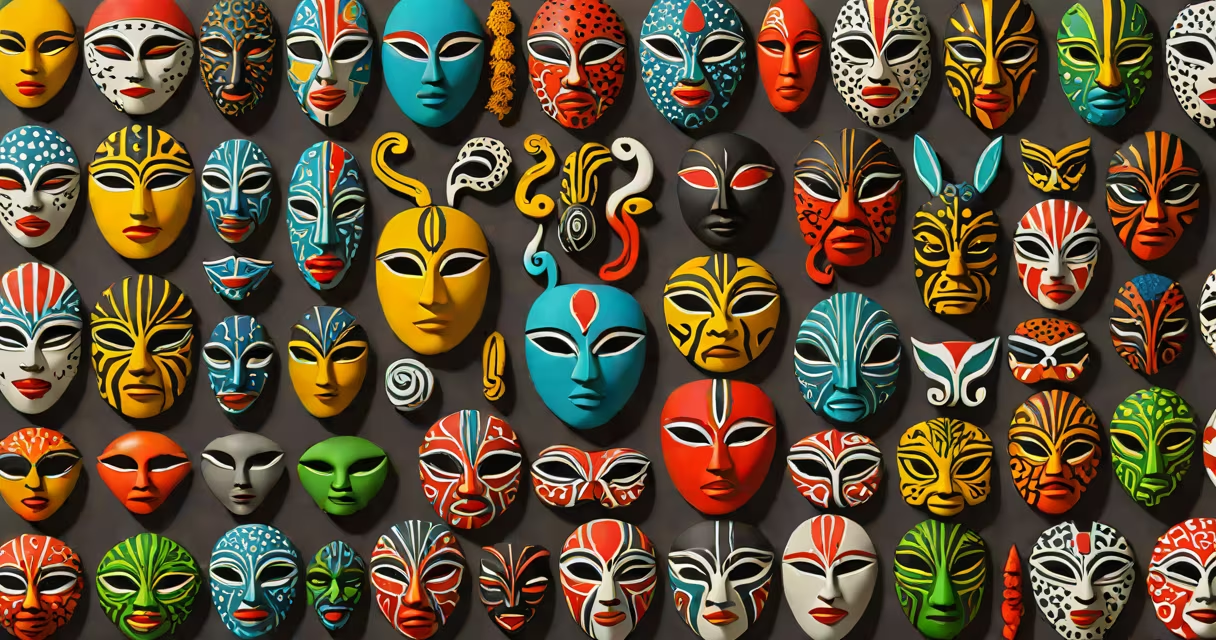
variety in art refers to the broad range of forms, styles, materials, and cultural meanings expressed across human societies through visual and performative creation. It encompasses differences in technique, subject matter, symbolism, and context, shaped by geography, history, and identity.
Artistic variety emerges from how people interpret the world using visual language. A single theme-like the sun-can appear as a radiant circle in Māori carving, a geometric pattern in Navajo weaving, or a stylized face in ancient Egyptian frescoes. These differences aren't random; they reflect distinct worldviews, religious beliefs, and environmental conditions. The variation exists not just between cultures but within them, as artists adapt traditions across generations.
Artists use different media-paint, clay, textiles, digital tools-to convey ideas. A 16th-century Japanese ink wash painting may emphasize negative space and spontaneity, while a 21st-century Nigerian digital artwork might layer historical references with contemporary social commentary. The medium shapes the message, and the message demands a form. This interplay defines variety in art.
variety in art functions as both a mirror and a map. It reflects local values-such as reverence for ancestors in Indigenous Australian art-or documents historical events, like the murals in Mexico City depicting the 1910 Revolution. It also maps relationships: trade routes introduced new pigments, colonialism spread stylistic motifs, and migration reshapes urban street art.
For example, the use of ochre in Aboriginal dot paintings from Central Australia is not decorative-it's symbolic. Red ochre represents blood and life; yellow signifies the sun and energy. These colors carry ancestral knowledge passed down through generations. In contrast, Western Renaissance art often used color to simulate natural light and volume, focusing on perspective and anatomical accuracy.
Even within a single tradition, variety persists. The Ndebele people of South Africa paint homes with bold geometric patterns in red, blue, and yellow. While the designs follow strict rules, each household chooses unique combinations based on family identity, seasonal cycles, or community events. This variation is not deviation-it's adherence to a living system.
Artistic variation appears in several categories, each rooted in purpose and context:
| Type | Description | Example |
|---|---|---|
| Material-based | Differences due to available resources-clay, stone, metal, plant fibers. | Andean textile weavers in Peru use alpaca wool; Pacific Island carvers use coconut wood. |
| Symbolic | Use of imagery to represent spiritual or social concepts. | Yoruba beaded crowns in Nigeria symbolize royal lineage and divine connection. |
| Stylistic | Distinct visual grammar-line weight, composition, color use. | Japanese ukiyo-e prints feature flat planes and bold outlines; Baroque paintings use chiaroscuro and changing movement. |
| Functional | Art created for ritual, utility, or performance. | Navajo sand paintings are temporary, made for healing ceremonies and then destroyed. |
These categories are not mutually exclusive. A single piece may combine material-based craftsmanship, symbolic meaning, and functional ritual use. The complexity of such works reveals that variety in art is not about difference for its own sake-it's about depth of intention.
People often assume that variety in art means "many styles" or "different looks." But variety is not just surface-level diversity. It includes how meaning is constructed and shared. A painting may look similar to another in form but carry entirely different significance depending on context.
For instance, a circular motif in a Maori carving represents the concept of whakapapa-the genealogical connection between people, land, and sky. In a Celtic knot, the same shape expresses eternity and unity. The same visual element, different cultural logic. This is why labeling art as "abstract" or "modern" without context misrepresents its intent.
A common error is equating variety with novelty. Not all innovation is new. Many Indigenous art practices have remained unchanged for centuries because their form is tied to spiritual continuity, not trend. The absence of change doesn't imply stagnation-it signals endurance. As anthropologist Margaret Mead noted, "Culture is not a static thing. It is a process of adaptation."
Consider the Aboriginal dot paintings from the Western Desert region of Australia. These works use small dots applied with sticks or brushes to create complex maps of sacred sites, ancestral journeys, and Dreamtime stories. Each dot placement follows precise rules governed by community law.
One painting might depict the process of the Rainbow Serpent across the desert. The artist uses red for waterholes, black for rock formations, and white for dry riverbeds. The layout is not random-it encodes navigation instructions, ecological knowledge, and moral teachings. A non-Indigenous viewer might see only "patterns," but the work is a living document of place and memory.
This is variety in art at its most meaningful: not just visual difference, but cognitive and ethical depth. The same set of symbols-dots, lines, circles-can tell vastly different stories depending on who makes them and why.
I once stood in a gallery in Alice Springs where a senior Anangu woman explained her son's painting. She pointed to a cluster of dots near the center and said, "This is where our people gathered during the drought. The spacing shows how far we walked to find water." Her voice didn't rise. The emotion was in the silence. That moment taught me that variety in art is not about aesthetics-it's about survival, memory, and belonging.
Understanding variety in art prevents cultural flattening. When museums display artifacts without context, they risk turning sacred objects into decor. When schools teach only European art history, they erase the contributions of others. Recognizing variety fosters respect for alternative ways of knowing.
According to UNESCO, "cultural diversity is as necessary for humanity as biodiversity is for nature." Art is one of the primary ways humans express identity. Without variety, art loses its power to challenge, heal, and connect.
Art institutions increasingly acknowledge this. The Smithsonian's National Museum of the American Indian curates exhibitions that center Native voices-not as "exotic" subjects but as authors of their own stories. Similarly, the Tate Modern in London now includes rotating displays of African, Asian, and Latin American contemporary art, not as sidebars but as core components of its collection.
variety in art is not a luxury. It is essential to understanding ourselves and each other. From the earliest cave drawings to AI-generated installations, art continues to evolve-but its roots remain in human experience, shaped by place, time, and culture.
By studying variety in art, we learn to see beyond appearance. We recognize that a mask from the Congo may look "primitive" to Western eyes, yet it holds centuries of ritual precision. A child's drawing in a refugee camp may lack technical skill, but it speaks of loss and hope. The value lies not in perfection, but in authenticity.
When you encounter a new artwork, ask not just "What is it?" but "Who made it? Why? For whom?" The answer reveals the depth of variety in art-and the richness of human expression.