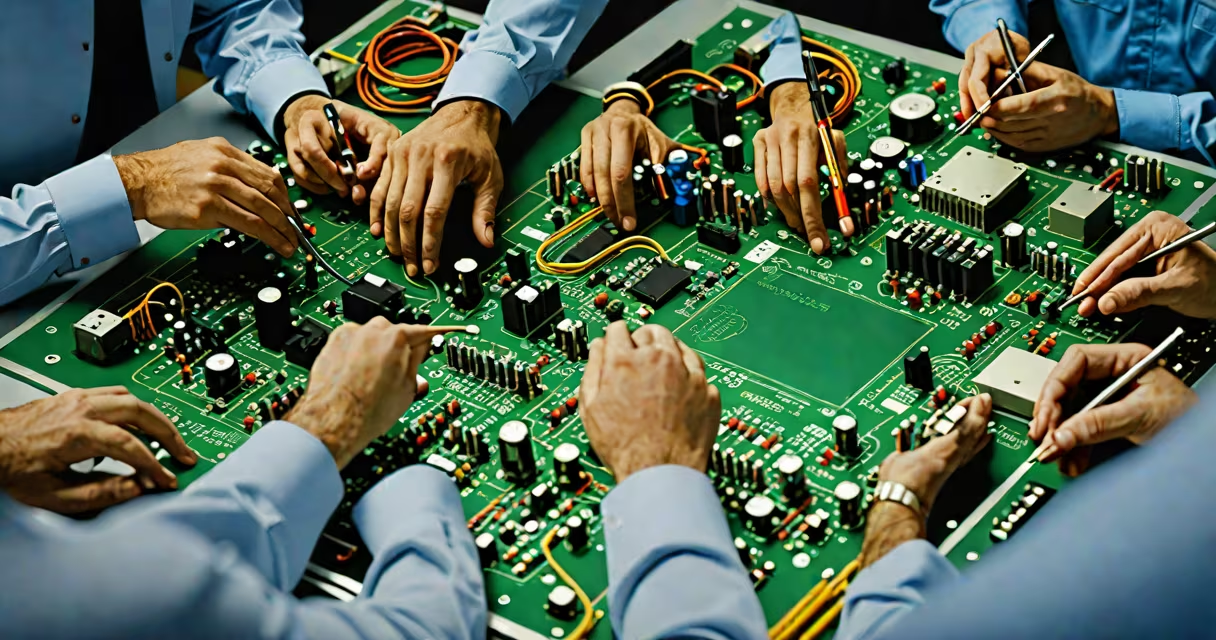
Engineers use scientific principles, mathematical models, and practical experience to design, build, test, and improve systems, structures, machines, and processes that solve real-world challenges.
Engineering is not a single job title-it's a mindset applied across disciplines. Mechanical engineers design engines and robotic arms. Software engineers write code that powers apps and websites. Civil engineers plan bridges and roads. Electrical engineers manage power grids and circuits. Each field uses specialized tools and knowledge, but all share the core goal: turning ideas into functional, safe, and efficient reality.
The work spans physical construction, digital development, and systemic optimization. An aerospace engineer may simulate airflow around a wing using computational fluid dynamics. A biomedical engineer might develop a prosthetic limb with embedded sensors. A network engineer configures routers to maintain secure, high-speed data flow across continents. These roles differ in tools and environments, but they all follow the same process: identify a problem, analyze constraints, prototype solutions, and validate results.
Every engineering task begins with a need. That need becomes a requirement-specific, measurable, and time-bound. For example, a city may require a new water treatment plant capable of filtering 10 million gallons per day with less than 0.5 parts per million of contaminants.
Engineers then model the solution. They use simulations, prototypes, and risk assessments to test feasibility. A structural engineer designing a skyscraper runs finite element analysis to predict stress points under wind and seismic loads. A software engineer writing a payment processing system conducts load testing to ensure it handles 10,000 transactions per minute without failure.
Validation follows. Engineers deploy small-scale versions-proof-of-concept units, beta software, or pilot projects-to gather real-world data. Only after confirming safety, performance, and cost efficiency do they scale up. This method prevents catastrophic failures and ensures long-term reliability.
While all engineering shares foundational methods, different branches focus on distinct domains. The table below outlines major categories, their typical outputs, and real-world examples.
| Type | Primary Focus | Common Output | Example Project |
|---|---|---|---|
| Mechanical | Motion, force, energy conversion | Machines, vehicles, HVAC systems | Designing a heat exchanger for a solar thermal power plant |
| Electrical | Current, voltage, electromagnetic fields | Circuits, power systems, control systems | Creating a fault-tolerant grid controller for a microgrid in rural India |
| Software | Logic, data flow, algorithmic efficiency | Applications, databases, APIs | Building a real-time traffic routing engine for a ride-sharing app |
| Civil | Infrastructure, materials, geotechnical stability | Bridges, highways, urban planning | Designing a flood-resilient drainage system for a coastal city |
| Chemical | Reactions, material transformation, process scaling | Pharmaceuticals, fuels, polymers | Optimizing a catalytic process to reduce emissions in petrochemical refining |
Each discipline requires domain-specific training. A chemical engineer must understand reaction kinetics and thermodynamics. A software engineer needs to master algorithms, memory management, and version control. Yet all rely on iterative testing, peer review, and adherence to safety standards.
Engineering drives progress in nearly every sector. In healthcare, engineers create MRI machines, insulin pumps, and AI-assisted diagnostics. In transportation, they develop autonomous vehicles, high-speed rail systems, and smart traffic signals. In energy, they design wind turbines, battery storage arrays, and hydrogen fuel cells.
One notable example is the development of the SpaceX Falcon 9 rocket. Engineers at SpaceX combined aerodynamics, propulsion theory, and materials science to build a reusable launch vehicle. By designing the first orbital rocket to land vertically after launch, they reduced launch costs by over 30%, according to NASA's 2021 Commercial Crew Program report.
Another example is the deployment of automated irrigation systems in sub-Saharan Africa. Agricultural engineers partnered with local communities to install solar-powered drip systems that deliver precise water amounts based on soil moisture readings. Field trials showed a 40% increase in crop yields and a 60% reduction in water usage compared to traditional methods.
People often confuse engineering with pure science. Scientists explore natural phenomena-why does water freeze at 0°C? Engineers apply that knowledge-how can we design a refrigerator that maintains 4°C without wasting energy?
Another misunderstanding is that engineers only work with hardware. While mechanical and electrical engineers frequently handle physical components, software engineers create systems that exist entirely in digital space. A network engineer might spend weeks optimizing packet routing protocols across thousands of servers-no soldering iron required.
A lesser-known fact: many engineering breakthroughs come from constraint-driven innovation. When resources are limited, engineers find creative ways to meet goals. During the Apollo 13 mission, NASA engineers had to use only available materials-plastic bags, duct tape, and oxygen filters-to build a carbon dioxide scrubber. Their solution saved the crew's lives. This demonstrates that engineering success often lies not in advanced tools, but in clever adaptation under pressure.
I once led a team to deploy a low-power sensor network for monitoring soil moisture in a vineyard. We needed to collect data every 15 minutes across 20 acres, transmit it reliably through dense tree cover, and operate on solar power for six months without maintenance.
We chose LoRaWAN for long-range, low-bandwidth communication. Each node ran on a Raspberry Pi Pico with a capacitive soil moisture sensor. We wrote custom firmware in C++ to minimize power draw and implemented error-checking protocols to handle intermittent connectivity.
After three months of field testing, the system achieved 98.7% data delivery rate and extended battery life beyond expectations. The win wasn't just technical-it enabled farmers to reduce water use by 35% while maintaining grape quality. This project confirmed that engineering solves problems not just through complexity, but through thoughtful simplicity.
Engineers don't just fix broken things-they anticipate failure, prevent it, and improve performance. They turn abstract ideas into working systems. They balance cost, safety, speed, and sustainability.
When you ask "what can engineers do," the answer isn't a list of jobs. It's a mindset: systematic thinking, evidence-based decision-making, and relentless iteration toward better outcomes. Whether designing a chip or a city's emergency response system, engineers shape the world by making it function.
Understanding what engineers do reveals not just career paths, but a way of engaging with the world: observe, analyze, build, test, refine. That cycle defines progress.