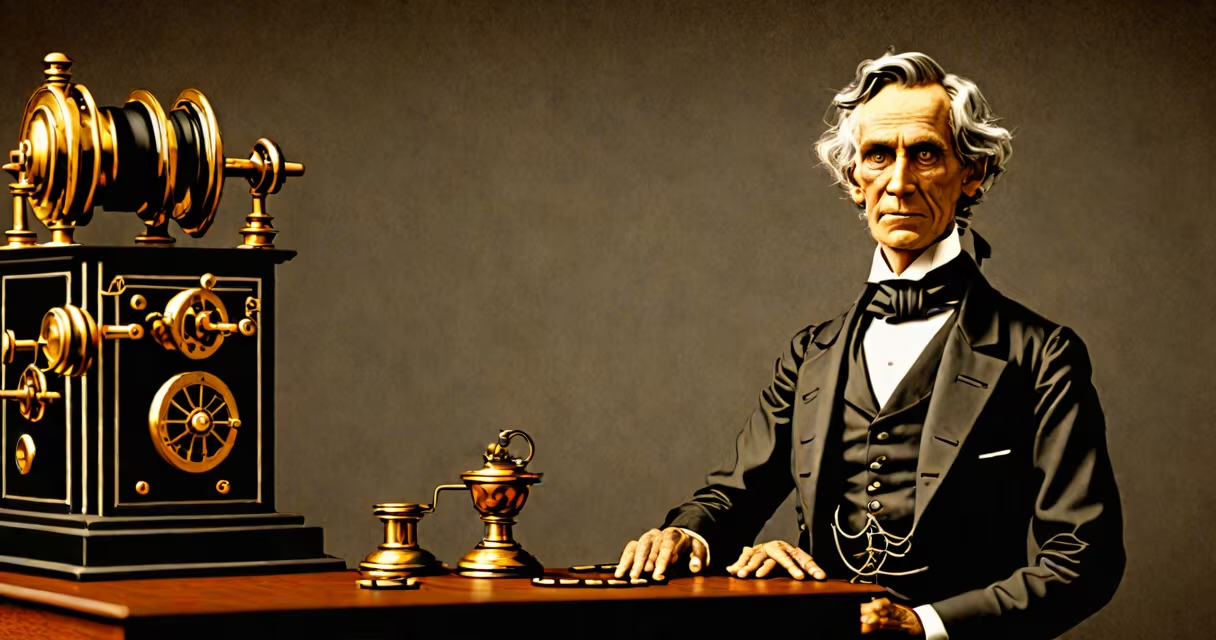
Samuel Morse invented morse code in the 1830s as a system to send messages over telegraph wires using short and long electrical pulses-dots and dashes.
Morse code is a method of encoding text characters as standardized sequences of two different signal durations: short (dot) and long (dash). These signals were transmitted through wired telegraph systems, enabling rapid long-distance communication before radio or the internet.
The system was developed alongside Morse's work on the electromagnetic telegraph. He collaborated with Alfred Vail, who refined the code's structure and helped build early telegraph equipment. By 1844, Morse sent the first official message-"What hath God wrought"-from Washington, D.C., to Baltimore, marking the beginning of practical telegraphy.
Morse code assigns unique sequences of dots (•) and dashes (−) to each letter, number, and punctuation mark. A dot lasts one unit of time; a dash lasts three units. Gaps between elements are one unit, between letters are three units, and between words are seven units.
For example, the letter "S" is represented as ••• (three dots), and "O" is −−− (three dashes). The word "SOS" becomes ••• −−− •••-a sequence instantly recognizable worldwide as a distress signal.
Transmission speed varied based on operator skill. Skilled telegraphers could send and receive at 20-30 words per minute. The International Morse Code standard, adopted in 1938, replaced earlier versions and remains in use today for aviation, maritime, and amateur radio communications.
Two primary forms of morse code exist: American Morse and International Morse. American Morse was used in the U.S. during the 19th century and had longer codes for common letters. International Morse, standardized by the International Telecommunication Union (ITU), became the global norm.
| Character | American Morse | International Morse |
|---|---|---|
| A | •− | •− |
| E | • | • |
| S | ••• | ••• |
| O | −−− | −−− |
International Morse is more efficient, especially for frequently used letters. For example, "E" is a single dot in both systems, but "T" is a single dash in International Morse-shorter than its American counterpart.
Despite being designed for wire-based telegraphs, morse code adapted well to radio transmission. Its simplicity allows clear reception even under poor signal conditions, making it valuable in emergency scenarios.
Though largely replaced by digital systems, morse code persists in niche applications. Aviation and maritime sectors still use it for emergency signaling. Pilots and sailors trained in morse code can communicate distress signals when other systems fail.
Amateur radio operators, known as "hams," regularly use morse code in contests and emergency drills. The Federal Communications Commission (FCC) in the U.S. requires proof of morse code proficiency for certain amateur radio licenses, though the requirement has been relaxed since 2007.
In 2017, the ITU reaffirmed morse code's role in international emergency communication standards. The organization notes that morse code remains effective due to its low bandwidth and high noise immunity-features unmatched by many modern protocols.
Many assume that Samuel Morse created the code alone. In reality, he developed the concept, but Alfred Vail implemented the actual encoding scheme and built the first working telegraph machines. Vail's contribution was critical-the code's efficiency and structure owe much to his engineering insight.
Another misconception is that morse code was used widely during World War II. While it played a role in military communications, most wartime transmissions relied on encrypted radio signals and later digital systems. Morse code was used primarily for backup or in situations where equipment failed.
A lesser-known fact: morse code was once used in space. NASA included morse code in the Voyager Golden Record, launched in 1977. The record contains sounds and images representing Earth, including a greeting in morse code: "Hello from the children of planet Earth."
I once attended a ham radio convention where a group demonstrated morse code using handheld keyers. One operator sent "SOS" using only a hand-cranked buzzer and a paper strip. The sound was slow, rhythmic-each dot and dash distinct. After five minutes, someone in the crowd recognized the pattern and responded in kind. The silence afterward felt heavier than the signal itself.
That moment revealed something deeper: morse code isn't just a system-it's a shared language of urgency and clarity. Even without understanding the meaning, the rhythm conveyed intent.
Samuel Morse invented morse code as a solution to the problem of fast, reliable long-distance messaging. His invention reshaped global communication and laid groundwork for modern telecommunications. Though outdated in daily use, the system endures in emergencies, hobbies, and historical contexts.
Understanding who invented morse code reveals not just a name, but a moment in technological history-a bridge between human intention and mechanical precision. The legacy lives on in every dot and dash sent across airwaves and wires.