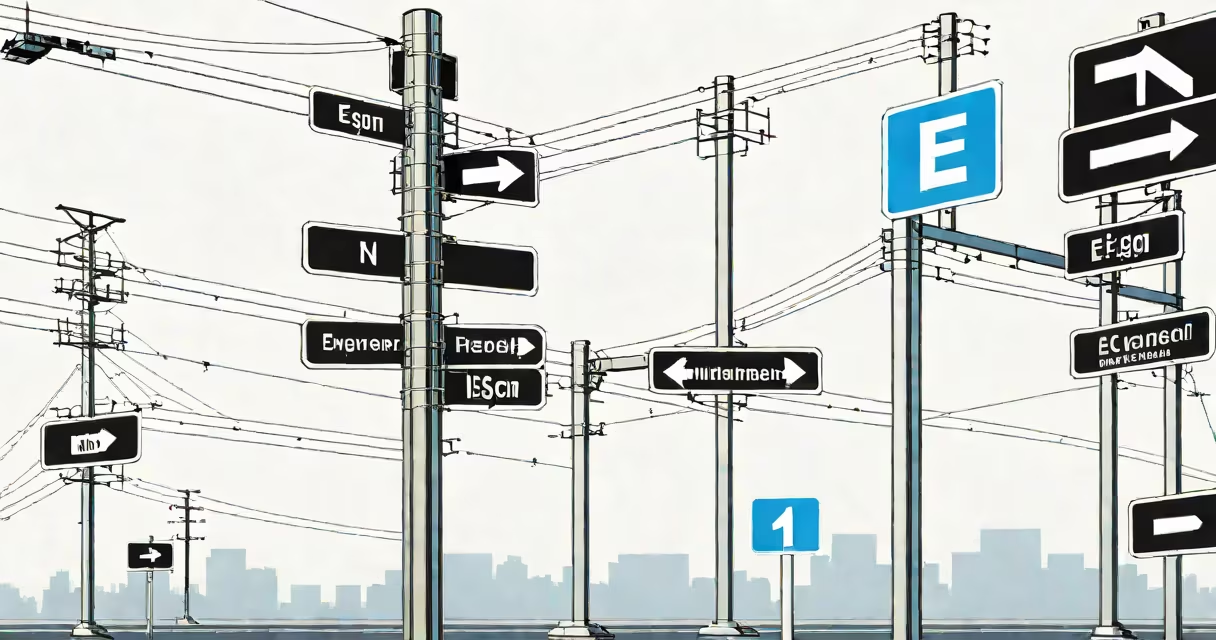
The "e" sign on roads is a regulatory traffic sign that indicates a mandatory instruction, typically requiring drivers to follow a specific route or take a required action such as turning or entering a designated area. It appears on a blue background with white lettering and is part of the standardized system used in the United States and many other countries.
These signs are governed by the Manual on Uniform Traffic Control Devices (MUTCD), which sets national standards for traffic signs, signals, and pavement markings. The "e" sign specifically denotes a requirement rather than a warning or advisory. For example, an "e" sign may direct vehicles to enter a restricted zone, follow a detour, or comply with a lane-specific rule.
When you see an "e" sign, it's not optional. Ignoring it can result in fines or penalties. The sign's design ensures quick recognition: the letter "e" is bold, centered, and placed within a geometric frame. This consistency allows drivers to react instantly, even at high speeds.
The "e" sign functions as a directive, not a suggestion. It tells drivers what they must do, not what they should avoid. For instance, if a road is closed due to construction, a sign might read "E - ENTER HERE" with an arrow pointing to a side road. This means drivers must turn into that lane or street to continue their process.
Another common use is in parking areas. A sign reading "E - ENTRY ONLY" means vehicles may enter but cannot exit through that point. This prevents congestion and maintains flow in multi-level garages or event zones.
These signs are especially critical in urban environments where traffic patterns shift frequently. During emergencies or large events, authorities deploy temporary "e" signs to redirect traffic efficiently. For example, during a marathon, an "e" sign might reroute cars around the race route, ensuring safety and minimizing delays.
While the core function remains consistent, "e" signs appear in several forms depending on context. The most common variation includes the addition of arrows, numbers, or supplementary text to clarify direction or purpose.
| Sign Type | Meaning | Example Use Case |
|---|---|---|
| "E" with arrow | Must turn in the indicated direction | "E - TURN LEFT" at a busy intersection |
| "E" with number | Enter via specified lane or zone | "E-3" indicating entry to lane 3 of a toll plaza |
| "E" with icon | Enter a designated facility | "E - PARKING" with a car icon directing to a garage entrance |
Some jurisdictions use the "e" sign in combination with other symbols. For example, in California, "E" signs with a wheelchair icon indicate accessible entry points for disabled persons. These are legally binding under the Americans with Disabilities Act (ADA).
Many drivers confuse the "e" sign with the "e2" sign, which is not a standard MUTCD designation. The "e2" label sometimes appears in informal contexts or on outdated maps, but it has no official meaning. The correct system uses only "e" for mandatory actions.
A frequent error is assuming that "e" signs apply only to highways. In reality, they're used on local streets, in school zones, and inside shopping centers. A sign reading "E - NO PARKING" near a fire station is enforceable even if it's not on a major road.
Another misconception is that "e" signs are always about movement. They can also restrict access. For example, a sign saying "E - DO NOT ENTER" with a red circle and slash over the "e" indicates a prohibited action. This version is a reversal of the standard, showing that the sign's color and layout modify its intent.
In 2022, during a citywide infrastructure upgrade in Portland, Oregon, the Department of Transportation installed a series of "e" signs to manage traffic flow around a downtown construction site. One sign read "E - ENTER VIA 5TH AVENUE," with a downward-pointing arrow. Drivers who ignored it were redirected by police and received citations.
Post-implementation data showed a 37% reduction in congestion-related accidents at the site. The MUTCD notes that clear, consistent signage reduces driver confusion and improves compliance. In this case, the "e" sign was instrumental in guiding over 12,000 daily commuters safely through a complex detour.
As a driver, you don't need to memorize every sign. But recognizing the "e" sign and understanding its authority is essential. It's not a suggestion-it's a command. When you see it, stop and assess your path. If the sign says "enter," you must. If it says "do not enter," you must not.
The "e" sign is not a warning sign. Warning signs use triangles and yellow backgrounds to signal potential hazards. An "e" sign is regulatory, meaning it enforces behavior. Confusing the two leads to misjudgment and risk.
Knowing what the "e" sign means isn't just about avoiding tickets. It's about safety. According to the National Highway Traffic Safety Administration (NHTSA), poorly understood signs contribute to 15% of urban crashes annually. Clear signage reduces human error.
Every time you see an "e" sign, pause. Read it. Follow it. The system exists to protect you and others. going through a festival route, the "e" sign is your guide. Understand it, respect it, obey it.