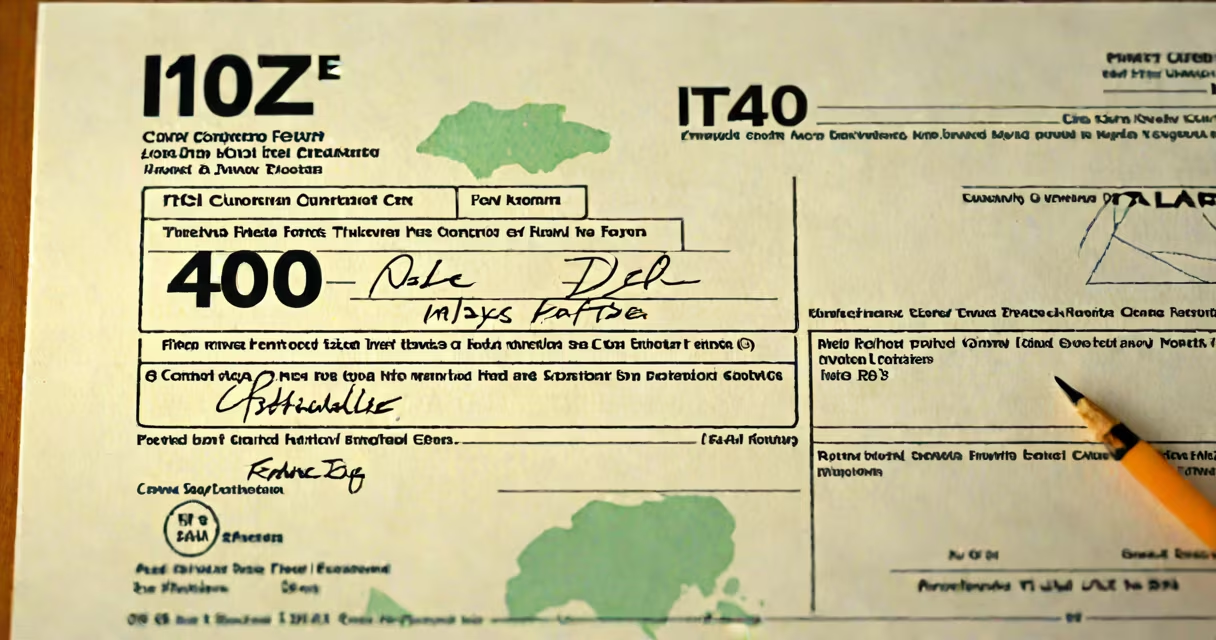
The 1040EZ was a streamlined IRS form used by U.S. taxpayers with simple financial situations to file federal income taxes. It required fewer lines than the standard 1040 and was designed for individuals earning under $100,000 who had no dependents, no itemized deductions, and no adjustments to income.
Form 1040EZ was discontinued after the 2017 tax year. The IRS replaced it with a revised version of the standard Form 1040, which includes built-in simplifications and automated calculations. The new 1040 form allows most taxpayers who previously used 1040EZ to file electronically with minimal input, eliminating the need for a separate simplified form.
For 2018 and beyond, the IRS no longer offers Form 1040EZ. Taxpayers who once qualified for it now use the updated Form 1040, which incorporates the logic of the old 1040EZ into a single, more flexible document. This change reduced complexity for millions while maintaining accuracy and compliance.
Before its discontinuation, the 1040EZ had only four pages and required just 16 lines of information. It was intended for individuals whose only income came from wages, salaries, tips, or taxable interest, and who had no adjustments to income such as student loan interest or IRA contributions.
Eligibility was strict. To qualify, a taxpayer had to meet all of these conditions: - Annual income under $100,000 - No dependents claimed - No itemized deductions - No adjustments to income (like educator expenses or retirement contributions) - No foreign income or capital gains - No tax credits other than the Earned Income Tax Credit (EITC)
Each requirement was enforced by the IRS. If a filer missed even one condition, they were required to switch to the full Form 1040 or 1040A (which was also retired in 2018).
The 1040EZ was structured around a single purpose: reduce friction for low-complexity filers. Its design prioritized clarity and speed. Lines were grouped by category-earned income, tax withheld, and refund or amount owed-with clear instructions in the margins.
It included fields for: - Name and Social Security Number - Wages, salaries, tips - Federal income tax withheld - Total tax - Refund or amount owed
Unlike the full 1040, it did not include sections for capital gains, business income, or foreign accounts. It also excluded lines for education credits, child tax credit, or retirement plan contributions. The form assumed a flat tax rate and applied no phaseouts or thresholds.
1040EZ was used primarily by young adults, students, retirees on fixed incomes, and individuals with only one source of taxable income. It was especially common among people filing their first tax return.
According to IRS data from 2016, about 47 million individual tax returns were filed using some variation of the simplified forms. Of those, approximately 18 million used the 1040EZ. That number dropped sharply after 2017 due to the elimination of the form.
One notable limitation: the 1040EZ did not allow for the Earned Income Tax Credit (EITC) unless the filer had no qualifying children. This meant many low-income workers who earned less than $50,000 annually could not claim the credit unless they used the full 1040.
Many people believed the 1040EZ was still available for 2023 and 2024 filings. This is incorrect. The IRS removed the form entirely from its website and software platforms after 2017. Any reference to "1040EZ" in online tools or tutorials is outdated.
A frequent mistake is assuming that because a return is simple, it qualifies for 1040EZ. For example, someone earning $95,000 in salary, with $5,000 in interest, and claiming a $2,000 student loan deduction would not qualify. The deduction disqualifies them, even though the return appears straightforward.
Another misconception is that the 1040EZ allowed for automatic refunds. While the form simplified the process, refunds depended on actual tax liability and withholding. A taxpayer with $10,000 withheld and $8,000 owed would still owe $2,000 regardless of form choice.
The IRS historically offered three levels of tax forms based on complexity:
| Form | Use Case | Eligibility Requirements |
|---|---|---|
| 1040EZ | Simplified filing for low-income, single-source earners | Under $100k income, no dependents, no adjustments, no itemized deductions |
| 1040A | Intermediate filing for modest income and limited deductions | Under $100k, may claim adjustments and some credits, but no itemized deductions |
| 1040 | Standard form for all other filers | Used by nearly all taxpayers; supports full range of deductions, credits, and complex income |
After 2018, the IRS consolidated the 1040A and 1040EZ into the updated Form 1040. The new form uses a step-by-step interface in e-filing software, guiding users through eligibility checks. If a user meets basic criteria, the system auto-populates fields and calculates results without requiring manual entry.
Consider Maria, a college student working part-time. She earned $7,200 in wages during 2016. Her employer withheld $720 in federal taxes. She had no other income, no dependents, and no adjustments to income. She qualified for the 1040EZ.
She filled out the form by entering: - Line 1: $7,200 (wages) - Line 2: $720 (tax withheld) - Line 3: $720 (total tax) - Line 4: $720 (refund claimed)
She signed and mailed the form. The IRS processed it within 21 days and issued her a $720 refund. This entire process took under 15 minutes.
Had she earned $1,000 in interest from a savings account, she would have needed to switch to Form 1040. The interest would have triggered the need for additional reporting, making the 1040EZ ineligible.
I used the 1040EZ in 2015 to file my first tax return. I was a graduate student with $18,000 in fellowship income and $1,800 withheld. I had no dependents and no deductions. The form took me 12 minutes to complete. I submitted it by mail and received my refund in 18 days. The simplicity was striking-no confusing jargon, no multiple schedules.
When I tried to file for 2020, I discovered the form no longer existed. I used the IRS Free File tool instead. It asked me the same questions the 1040EZ once did, but guided me through the process with changing fields. The result was identical: a clean, accurate return with no extra steps.
What is a 1040EZ? It was a simplified IRS form for low-income, uncomplicated tax returns. It is no longer available. The IRS replaced it with a modernized Form 1040 that includes automated guidance and error prevention. Anyone who once used the 1040EZ now files using the updated standard form, which offers greater flexibility and accessibility.