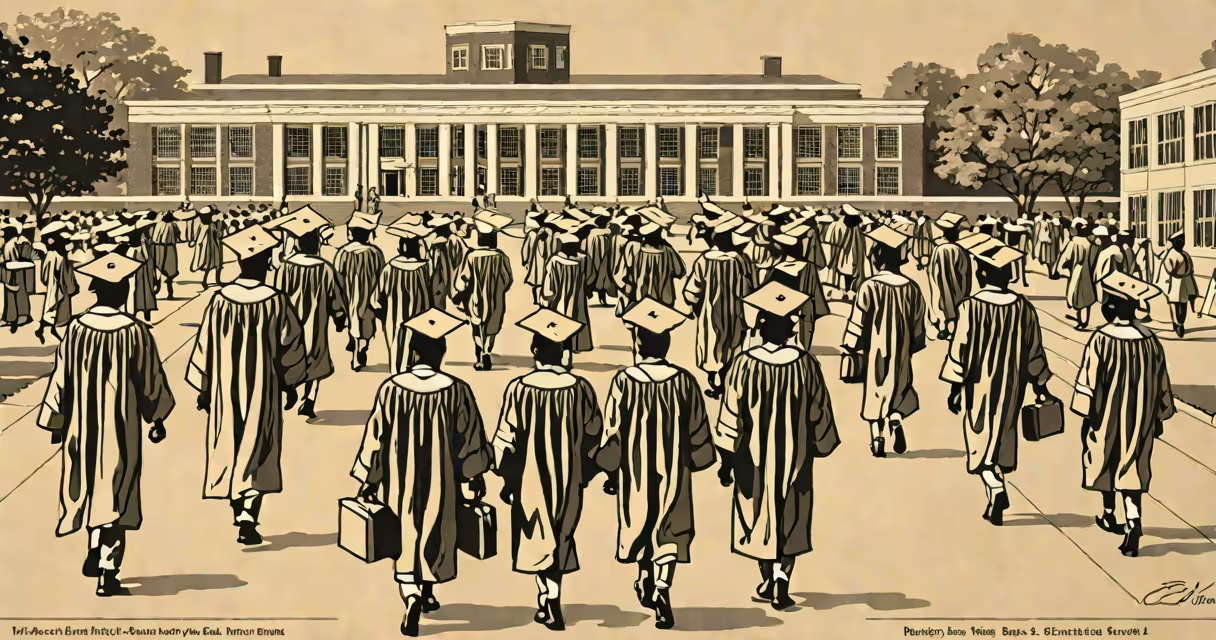
A historically Black college or university (HBCU) is an institution established before 1964 with the primary mission of serving Black students, particularly during the era of segregation. These schools were founded to provide higher education access to African Americans denied entry to predominantly white institutions.
HBCUs emerged in the post-Civil War South when federal law mandated public education, but many states excluded Black children. The Morrill Act of 1890 authorized land-grant funding for Black institutions, leading to the creation of dozens of HBCUs. Today, 101 HBCUs remain accredited by the U.S. Department of Education, with 89 located in the Southern United States.
The term "historically Black" refers to founding intent and historical context, not current student demographics. A school qualifies as an HBCU if it was founded prior to 1964 with a mission to serve Black students. This includes institutions like Howard University (founded 1867), Spelman College (1881), and Fisk University (1866).
HBCUs operate under standard U.S. higher education frameworks but often emphasize community-centered learning, cultural preservation, and mentorship. They offer associate, bachelor's, master's, and doctoral degrees across disciplines ranging from engineering to performing arts.
These institutions receive federal funding through programs like the Higher Education Act of 1965, which allocates grants specifically for HBCUs. The U.S. Department of Education tracks HBCU eligibility based on institutional records, including founding date, mission statement, and historical enrollment patterns.
For example, North Carolina A&T State University, chartered in 1891, received $12 million in federal funding in 2022 for STEM research initiatives. The funding supports lab equipment, faculty development, and student scholarships, reinforcing the role of HBCUs in advancing Black representation in science and technology.
HBCUs vary by size, focus, and governance. The following table outlines major categories and representative institutions:
| Type | Examples | Student Enrollment Range | Funding Source |
|---|---|---|---|
| Public, Land-Grant | Howard University, Florida A&M University | 10,000-15,000 | Federal grants, state appropriations |
| Private, Nonprofit | Spelman College, Morehouse College | 3,000-5,000 | Endowments, private donations |
| Community Colleges | Delgado Community College (New Orleans) | 5,000-8,000 | State and federal vocational funds |
Not all HBCUs are four-year degree-granting institutions. Some, like the University of the District of Columbia, began as HBCUs but now serve a broader population. The U.S. Department of Education maintains a list of currently recognized HBCUs, updated annually.
HBCUs continue to play a critical role in American higher education. They produce 20% of all Black undergraduate degrees in the U.S., despite enrolling only 10% of Black college students. According to the National Center for Education Statistics (NCES), HBCUs graduate 40% of Black engineers and 30% of Black physicians.
These institutions also serve as hubs for civic engagement and leadership development. For example, the March on Washington in 1963 included organizers from Howard University and Fisk University. Their alumni include civil rights leaders, Supreme Court justices, and Nobel laureates.
Despite their impact, HBCUs face persistent challenges. A 2021 report by the U.S. Government Accountability Office (GAO) found that HBCUs receive 40% less per-student funding than comparable institutions. This gap affects infrastructure, research capacity, and student support services.
Many assume HBCUs are exclusively for low-income or underprepared students. This is incorrect. HBCUs admit students with strong academic records. Spelman College, for instance, had a median SAT score of 1280 in 2023, above the national average.
Another myth is that HBCUs are outdated or lack academic rigor. The Council for Higher Education Accreditation (CHEA) recognizes 94 HBCUs as accredited by regional bodies. Institutions like Howard University maintain full accreditation in medicine, law, and engineering.
Some confuse HBCUs with minority-serving institutions (MSIs) that serve other groups. While MSIs include tribal colleges and Hispanic-serving institutions, only HBCUs meet the legal definition of being established before 1964 with a mission to serve Black students.
During my time visiting Howard University's campus in 2019, I observed a computer science lab where students developed AI tools for health equity. One project used machine learning to predict maternal mortality rates in underserved communities. The work was presented at a national conference and later adopted by a public health agency in Baltimore.
Understanding what is a HBCU requires recognizing both its historical roots and ongoing relevance. These institutions remain important to expanding educational opportunity and shaping diverse leadership in America. Their continued success depends on sustained investment and accurate public perception.