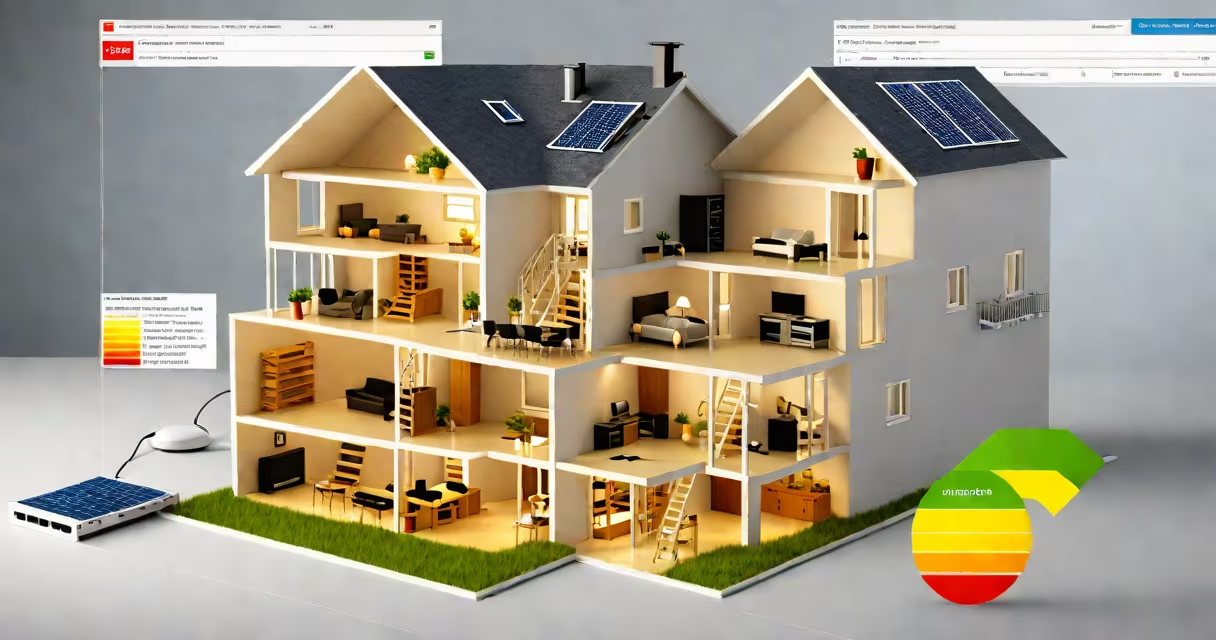
ResCheck is a free, web-based energy code compliance tool used to verify that residential buildings meet minimum energy efficiency standards set by the International Energy Conservation Code (IECC) and ASHRAE Standard 90.1. It generates a compliance report for new construction or major renovations, ensuring homes meet federal and state energy code requirements.
Developed by the U.S. Department of Energy's Building Technologies Office and maintained by the National Renewable Energy Laboratory (NREL), ResCheck automates the process of evaluating insulation levels, window performance, HVAC system efficiency, and air leakage. It supports compliance through either the prescriptive method (meeting specific material and equipment thresholds) or the performance method (demonstrating equivalent energy savings via simulation).
For example, a builder constructing a 2,200-square-foot home in California must show that wall R-values, window U-factors, and duct sealing meet or exceed the 2022 IECC standards. Using ResCheck, they input project details-such as climate zone, wall assembly, and furnace efficiency-and receive a pass/fail result with a detailed breakdown of each requirement. The tool outputs a formal compliance certificate accepted by most local building departments.
ResCheck operates by applying standardized energy modeling logic to residential projects. Users enter data such as building area, climate zone, wall and roof insulation values, window U-factors and SHGC (solar heat gain coefficient), and mechanical system specifications. The tool then compares these inputs against the applicable energy code tables.
It uses a simplified version of whole-building energy simulation. Instead of running complex changing models, ResCheck applies pre-calculated thresholds based on decades of field testing and laboratory data. This allows for rapid assessment-typically under five minutes-for standard designs. For non-standard configurations, users may switch to the performance path, which requires modeling annual energy use and comparing it to a baseline home designed to code minimums.
A key feature is its integration with the Residential Energy Services Network (RESNET) and the Home Energy Rating System (HERS) Index. A ResCheck report can serve as the foundation for a HERS rating, which is required for ENERGY STAR® certification and many utility rebate programs. For instance, a home in Florida that achieves a HERS score of 70 or lower qualifies for a $2,000 state rebate, and ResCheck provides the initial compliance data needed to start that process.
ResCheck supports two primary compliance paths: prescriptive and performance. The prescriptive method is faster and simpler, requiring adherence to specific material and equipment specs. The performance method allows design flexibility but demands more detailed input and analysis.
| Compliance Path | Use Case | Input Requirements | Pass/Fail Criteria |
|---|---|---|---|
| Prescriptive | Standard homes with common materials and systems | Insulation R-values, window U-factor & SHGC, duct sealing, HVAC SEER/EER | Meets or exceeds code-prescribed values in Table 301.1.1 of IECC |
| Performance | Custom designs, high-performance homes, or regions with unique climate challenges | Full building envelope data, equipment efficiency, lighting loads, occupancy patterns | Energy use intensity (EUI) ≤ 10% above baseline model |
For example, a custom home in Colorado with triple-glazed windows and a geothermal heat pump cannot rely solely on prescriptive rules due to their non-standard nature. The builder uses the performance path in ResCheck, entering actual equipment specs and simulated heating/cooling loads. The tool confirms compliance if the modeled annual energy use is within 10% of the baseline home's consumption.
ResCheck is widely adopted by builders, architects, contractors, and local code officials across all 50 U.S. states. It is required by many state energy codes, including California's Title 24, New York's NYCEC, and Texas' Texas Energy Code. These states mandate compliance documentation for permit issuance, and ResCheck reports are accepted as official proof.
Utility companies also require ResCheck results for incentive programs. Pacific Gas & Electric (PG&E) offers rebates up to $6,000 for homes that achieve a HERS score below 50. To qualify, applicants must submit a ResCheck report showing compliance with the 2022 IECC. Without this document, applications are rejected.
One common misconception is that ResCheck replaces the need for a licensed energy rater. It does not. While ResCheck provides a pass/fail outcome, a certified RESNET rater performs the full HERS rating, which includes blower door testing, duct leakage verification, and on-site inspection. ResCheck is a preliminary step, not a substitute.
Many assume ResCheck is a simulation engine capable of predicting long-term energy costs. It is not. ResCheck calculates compliance with code minimums, not actual utility bills. A home passing ResCheck may still have high energy use due to poor occupant behavior or inefficient appliances-not covered by the tool.
Another error is treating ResCheck as a design tool. It validates existing plans, not creates them. You cannot use it to determine optimal insulation thickness or window placement. Design decisions must be made before entering data into ResCheck. The tool checks whether your choices meet code, not what choices to make.
During a site visit to a new housing development in Austin, Texas, I reviewed 12 ResCheck reports submitted for permits. Eight were flagged for incorrect climate zone selection-using Zone 2 instead of Zone 3-leading to underestimation of required insulation. Correcting this changed the compliance status from "pass" to "fail." This illustrates a critical point: even small errors in input data invalidate results.
According to NREL's 2023 ResCheck User Survey, 78% of users reported that the tool reduced compliance review time by at least 40%. The American Council for an Energy-Efficient Economy (ACEEE) notes that consistent use of tools like ResCheck has contributed to a 15% average reduction in residential energy use since 2015 across participating states.
ResCheck is not a one-size-fits-all solution. It applies only to single-family homes, townhouses, and low-rise multifamily units (up to three stories). High-rise apartments, commercial buildings, and mixed-use developments fall outside its scope. Projects exceeding 3,000 square feet may require additional modeling via EnergyPro or eQUEST.
ResCheck is a standardized, free tool that verifies whether a residential building complies with national energy code requirements. It supports both prescriptive and performance compliance paths, generating reports accepted by local jurisdictions and utility programs. Understanding its limitations-such as not replacing on-site inspections or simulating real-world usage-is essential for accurate application.