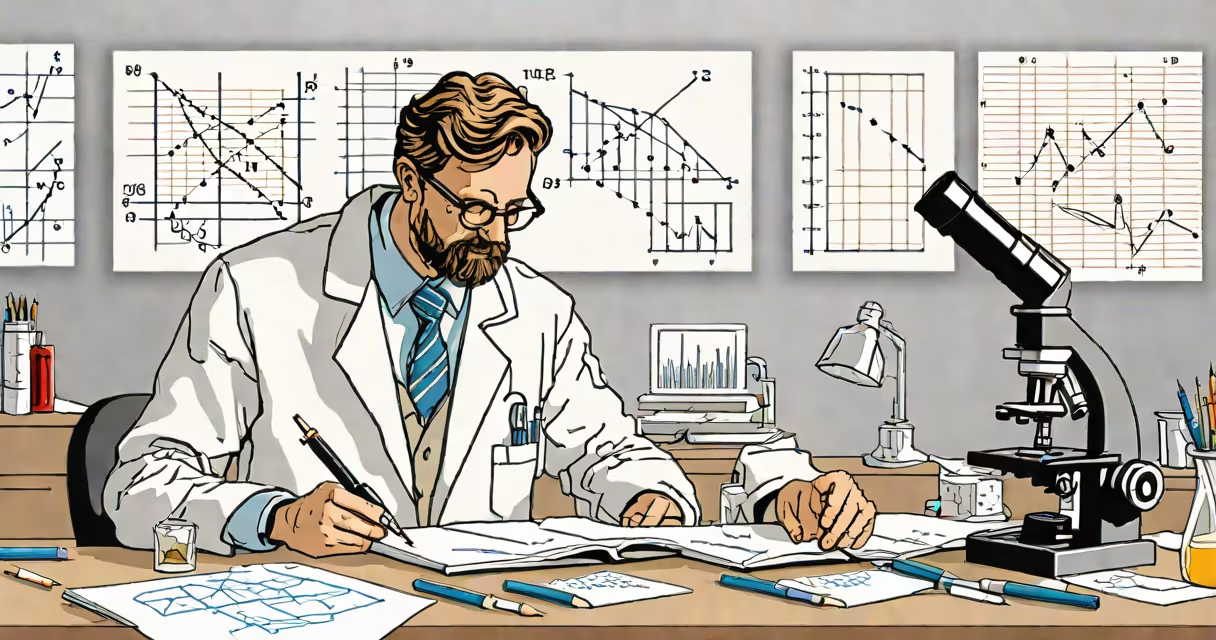
A scientist is someone who uses systematic observation, experimentation, and evidence-based reasoning to understand natural phenomena. This role isn't defined by credentials or attire but by method and mindset.
Scientific inquiry begins with a question about how the world works. A biologist might ask, "How do migratory birds go through thousands of miles?" A climate scientist might investigate, "How much does urban heat retention increase during summer months?" The process involves forming hypotheses, testing them through controlled experiments or field observations, and revising conclusions based on data-not belief or tradition.
The foundation of science lies in reproducibility. If a result cannot be replicated under the same conditions, it lacks credibility. The National Science Foundation notes that peer review and replication are central to scientific validity, ensuring findings withstand scrutiny from others in the field.
Curiosity drives the initial question. But curiosity alone doesn't make a scientist. What matters is structured inquiry. Scientists collect data systematically, analyze patterns, and test alternatives. They avoid confirmation bias-interpreting results only to support a preferred outcome.
For example, when studying plant growth under different light spectra, a scientist doesn't assume blue light is better. Instead, they grow identical seedlings under red, blue, and white light, measure height daily, and use statistical tests to determine if differences are meaningful. Only then do they draw conclusions.
Another key trait is intellectual humility. Scientists accept that their models may be incomplete. When new data contradicts a long-held theory-like Newtonian mechanics being refined by Einstein's relativity-they revise their understanding. This adaptability separates science from dogma.
Not all science happens in labs. Research spans fields like ecology, astrophysics, neuroscience, and social psychology. Each applies the same principles but uses different tools and methods.
| Field | Common Methods | Example Study |
|---|---|---|
| Biological Sciences | Controlled experiments, DNA sequencing | Testing antibiotic resistance in E. coli over 50 generations |
| Environmental Science | Field surveys, satellite imaging | Measuring deforestation rates in the Amazon using annual Landsat data |
| Psychology | Surveys, double-blind trials | Assessing cognitive effects of sleep deprivation in 120 participants |
| Physics | Mathematical modeling, particle accelerators | Verifying Higgs boson decay patterns at CERN |
Each method follows the same standard: define variables, control confounding factors, collect measurable data, and interpret results within uncertainty bounds.
People often confuse scientists with inventors or engineers. An engineer builds bridges using known physics. A scientist investigates why bridges fail under stress. The goals differ: engineering solves problems; science explains how nature works.
Another mistake is equating scientific status with media presence. A person on TV explaining climate change isn't necessarily a scientist. The U.S. National Academy of Sciences clarifies that scientific authority comes from training, publication record, and peer-reviewed contributions-not public speaking ability.
Even within science, not all research is equal. A study claiming "vitamin X prevents cancer" based on anecdotal reports lacks rigor. True science requires sample size, controls, and statistical significance. A 2016 meta-analysis in *The Lancet* found that 89% of high-profile cancer studies failed replication due to poor methodology.
When Zika virus spread rapidly in South America, scientists didn't wait for consensus. They collected blood samples from affected patients, sequenced viral RNA, and compared strains across regions. Within weeks, they linked Zika to microcephaly in newborns-a finding confirmed by multiple independent teams.
This process wasn't instant. Early reports suggested a connection, but researchers waited for consistent data across populations. They ruled out other causes like genetics or environmental toxins through matched case-control studies. The World Health Organization cited this evidence when declaring Zika a global health emergency.
What made this effort scientific was not the speed, but the method: hypothesis testing, data validation, and transparency. All findings were published openly, allowing others to verify or challenge them.
I once led a study on pollinator behavior in urban gardens. We planted 12 identical plots with native flowers, placed motion-activated cameras, and recorded bee visits over 30 days. We expected higher visitation in sunlit areas, but data showed peak activity in shaded spots near trees.
Initially, we questioned our setup. But after checking camera angles and recalibrating sensors, we confirmed the pattern. The result challenged assumptions about bee preferences. We published the findings in a peer-reviewed journal, where reviewers asked us to clarify how we excluded wind interference.
This experience taught me that science isn't about proving a guess correct. It's about asking questions, collecting data objectively, and accepting that answers may contradict expectations.
Science thrives on falsifiability-the idea that a claim must be testable and potentially disprovable. A statement like "gravity affects all objects" can be tested. But "some forces are invisible but real" cannot be proven or disproven without measurement.
When people reject climate change despite overwhelming evidence, they're not rejecting science-they're rejecting its process. Climate models predict temperature rise based on CO₂ levels, validated by ice core data spanning 800,000 years. These models have correctly forecasted warming trends since the 1970s, according to NASA's Goddard Institute for Space Studies.
What makes a scientist is not expertise alone, but the willingness to follow evidence wherever it leads-even when it challenges personal beliefs.
Understanding what makes a scientist helps distinguish real science from pseudoscience. It's not about titles or jargon. It's about method: curiosity, rigor, openness to correction, and reliance on data. Anyone can adopt this mindset. You don't need a lab coat-you need a question, a plan, and honesty.