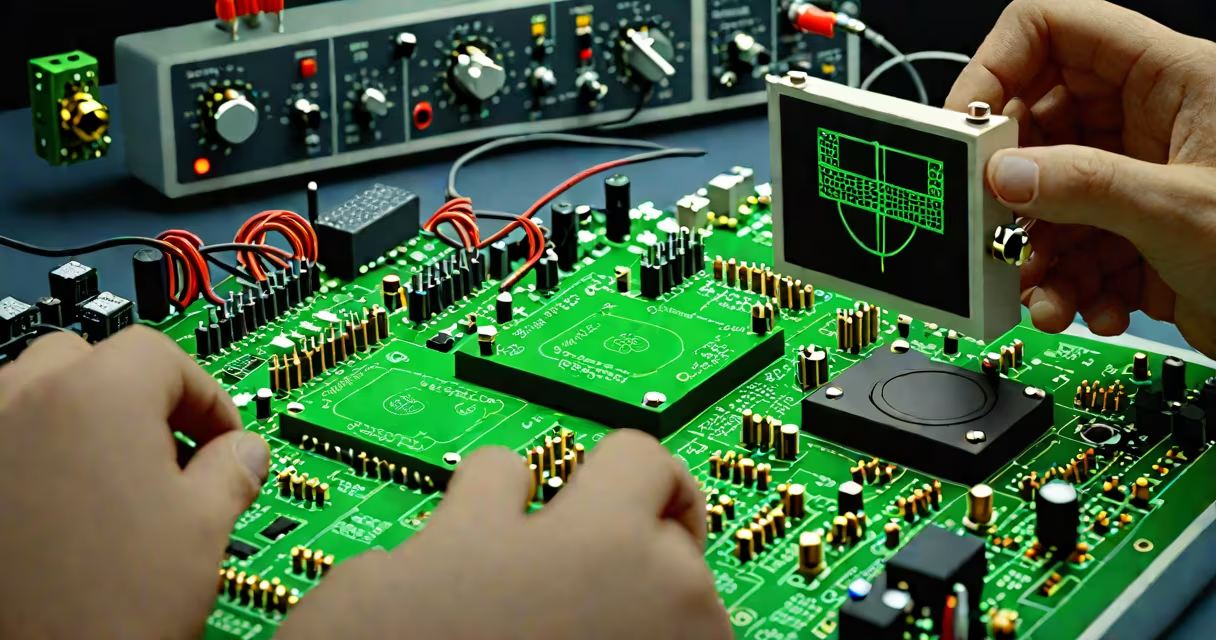
An embedded engineer designs, develops, and maintains software and hardware systems that run inside dedicated devices such as thermostats, automotive control units, and industrial sensors. These systems operate with strict timing, limited resources, and high reliability-often without user interaction.
Embedded engineers work at the intersection of electronics, programming, and system design. They ensure that microcontrollers and processors inside devices execute precise tasks under real-world constraints like power limits, temperature extremes, and physical space restrictions. Their work powers everything from pacemakers to factory robots.
According to the IEEE Computer Society, embedded systems now control over 90% of all new electronic devices produced worldwide. This dominance underscores the critical role embedded engineers play in shaping modern technology.
At its core, embedded engineering involves creating software that runs directly on small computing devices-microcontrollers or microprocessors-without relying on general-purpose operating systems like Windows or Linux. These systems often have minimal memory (as low as 16 KB) and processing power (under 100 MHz).
The process begins with selecting the right hardware platform based on performance, power consumption, and cost. Engineers then write firmware using languages like C or C++, sometimes assembly, to interface directly with sensors, motors, displays, and communication modules. The code must respond quickly and predictably-often within microseconds-to maintain safety and functionality.
For example, in a modern car's anti-lock braking system (ABS), an embedded engineer helps the brake control unit reads wheel speed sensors every 10 milliseconds and adjusts pressure instantly to prevent skidding. A delay of even 1 millisecond could compromise safety.
Embedded systems consist of three main layers: hardware, firmware, and sometimes a real-time operating system (RTOS). The hardware includes microcontrollers (like ARM Cortex-M series), analog-to-digital converters, and communication interfaces (UART, SPI, I2C).
Firmware is the low-level software that manages device startup, sensor input, actuator output, and error handling. It operates continuously, often waking from sleep mode to check conditions and responding within strict time windows.
Some systems use RTOSes such as FreeRTOS or Zephyr to manage multiple tasks efficiently. Others run bare-metal code-direct execution on hardware without an OS-when simplicity and speed are essential.
| Type | Use Case | Example Device | Typical Resources |
|---|---|---|---|
| Bare-metal | Simple, fast response | Door lock controller | 8-bit MCU, 4 KB RAM |
| With RTOS | Multiple concurrent tasks | Smartwatch | 32-bit ARM, 128 KB RAM |
| With Linux | Complex features, networking | Home security camera | Quad-core processor, 512 MB RAM |
While many people assume all embedded systems are tiny and simple, some modern ones rival desktop computers in capability. A drone flight controller may use a dual-core processor, GPS, IMU sensors, and wireless video transmission-all managed by a single embedded system.
Industries ranging from healthcare to aerospace depend on embedded engineers. Medical devices like insulin pumps require precise timing and fail-safe logic. A single miscalculation in dosage delivery could be fatal. Embedded engineers build these systems with rigorous testing and certification processes.
In manufacturing, programmable logic controllers (PLCs) automate production lines. An embedded engineer configures these systems to detect faults, adjust machine speeds, and trigger alarms-all without human oversight. According to the International Society of Automation, over 70% of industrial automation relies on embedded control systems.
Consumer electronics also depend heavily on embedded engineers. Smart thermostats like the Nest Learning Thermostat use embedded systems to learn user behavior, regulate heating cycles, and connect to Wi-Fi networks. The device runs on a custom firmware stack that balances energy efficiency with responsiveness.
Many confuse embedded engineers with general software developers. While both write code, embedded engineers focus on systems that interact directly with physical components. They must understand electrical principles, signal integrity, and power management-skills rarely needed in web or mobile app development.
A common misunderstanding is that embedded systems are always simple. In reality, modern embedded systems can be highly complex. For instance, autonomous vehicle perception systems process data from LiDAR, radar, and cameras in real time-requiring advanced algorithms and hardware acceleration.
Another misconception is that embedded engineers only work with older technologies. On the contrary, they are central to emerging fields like edge AI. Devices such as facial recognition doorbells run machine learning models directly on embedded chips-processing images locally instead of sending them to the cloud.
I once spent a week debugging a temperature sensor drift issue in a prototype environmental monitor. The problem wasn't in the code-it was electromagnetic interference from a nearby motor. After adding shielding and adjusting sampling timing, the readings stabilized. That experience taught me that embedded work demands hands-on troubleshooting beyond pure coding.
Core skills include proficiency in C/C++, understanding of digital logic, experience with debugging tools (logic analyzers, oscilloscopes), and familiarity with version control systems like Git. Knowledge of protocols such as CAN, Modbus, and MQTT is increasingly important.
Formal education typically includes a bachelor's degree in electrical engineering, computer engineering, or computer science. Many employers value practical experience through internships or personal projects-such as building a weather station with a Raspberry Pi and environmental sensors.
As demand grows for intelligent, connected devices, the U.S. Bureau of Labor Statistics projects a 6% increase in employment for software developers specializing in embedded systems between 2022 and 2032-faster than average for all occupations.
An embedded engineer is a specialist who creates the software and hardware systems that power dedicated electronic devices. They combine programming, electronics, and real-time logic to deliver reliable, efficient, and safe operation in environments where failure is not an option.
From life-saving medical devices to smart home systems, their work enables the invisible intelligence behind modern technology. Understanding what is an embedded engineer reveals not just a job title-but a foundational force in how our world functions.