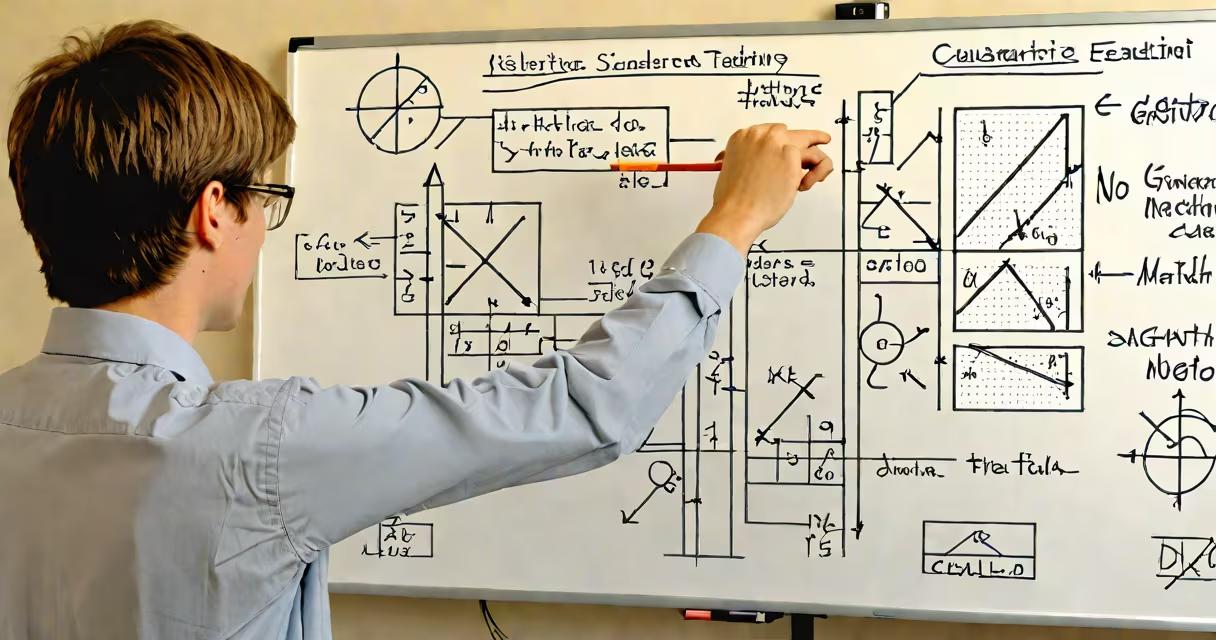
Math 2, commonly known as Algebra 2, is a high school mathematics course that extends algebraic concepts to include polynomial, rational, exponential, and logarithmic functions, complex numbers, and advanced problem-solving techniques. It serves as a bridge between basic algebra and precalculus, preparing students for college-level math.
Students typically take Math 2 after completing Algebra 1 and Geometry. The course emphasizes symbolic manipulation, function analysis, and real-world modeling using equations. Topics include solving systems of equations, graphing transformations, and working with matrices. Mastery of Math 2 is required for most college admissions and standardized tests like the SAT and ACT.
According to the National Council of Teachers of Mathematics (NCTM), Algebra 2 develops critical reasoning and abstract thinking needed for science, engineering, and economics. The College Board states that students who complete Algebra 2 are 40% more likely to enroll in STEM programs at four-year universities.
Math 2 operates through structured problem sets that require students to interpret symbols, apply formulas, and validate solutions. Each lesson builds on prior knowledge-students use linear equations from Algebra 1 to analyze quadratic patterns, then extend that understanding to exponential growth models.
For example, a typical Math 2 assignment asks students to model population growth using the function P(t) = P₀e^(kt), where P₀ is initial population, k is growth rate, and t is time in years. A student might be given P₀ = 10,000 and k = 0.03, then asked to calculate the population after 10 years. Substituting values yields P(10) = 10,000 × e^(0.3) ≈ 13,499. This shows how exponential functions predict real outcomes.
Classroom instruction combines direct teaching with collaborative work. Students solve problems in groups, explain their steps aloud, and critique each other's logic. This mirrors the NCTM's emphasis on mathematical discourse as a core learning method.
Math 2 covers five major content areas: functions, complex numbers, logarithms, sequences and series, and conic sections. Each area introduces new tools and expands analytical ability.
| Topic | Key Concepts | Example Problem |
|---|---|---|
| Functions | Domain, range, composition, inverse | Find f⁻¹(x) if f(x) = 2x + 5 |
| Complex Numbers | i² = -1, operations with imaginary numbers | Simplify (3 + 4i)(2 - i) |
| Logarithms | Change of base, solving log equations | Solve log₂(x) + log₂(x - 2) = 3 |
| Conic Sections | Equations of circles, ellipses, parabolas | Write the standard form of a circle centered at (-1, 3) with radius 5 |
| Sequences & Series | Arithmetic and geometric sequences, summation notation | Find the sum of the first 10 terms of the sequence: 3, 6, 12,... |
These topics are not isolated. For instance, when analyzing the trajectory of a projectile, students combine quadratic functions (parabolas), trigonometry, and physics principles-all rooted in Math 2 concepts.
Many students mistake Math 2 for "just harder algebra." That's incorrect. While it uses algebraic tools, the focus shifts from computation to conceptual understanding. A student may correctly solve 2x + 3 = 7 but fail to interpret why y = x² - 4 has two real roots and how that relates to the graph's x-intercepts.
Another error is assuming all functions behave like lines. Linear functions have constant rates of change. Quadratic functions accelerate. Exponential functions grow faster over time. Recognizing these differences is central to Math 2.
A non-obvious distinction: Math 2 does not introduce calculus. It lays groundwork for it. For example, finding the slope of a tangent line requires limits-a calculus concept. But Math 2 teaches students to estimate slopes using secant lines, which is a precursor to derivative thinking.
Math 2 is not optional for college-bound students. Most four-year institutions require at least three years of math, including Algebra 2, for admission. Community colleges accept students with only Algebra 1, but they often place them in remedial courses that delay degree progress.
In my experience teaching high school math, students who skip Math 2 struggle in physics and computer science. One student skipped the course during summer school and later failed a programming class because they couldn't interpret conditional statements involving inequalities-skills taught in Math 2.
Research from the University of California system shows that students who complete Algebra 2 are twice as likely to graduate with a STEM degree compared to those who stop at Algebra 1. The course builds persistence, logical reasoning, and pattern recognition-skills transferable across disciplines.
Math 2 follows Algebra 1 and Geometry in most U.S. high schools. It prepares students for Precalculus, which includes trigonometry and limits. After Precalculus, students may take Calculus AB or BC, depending on their goals.
Some schools offer dual enrollment options. A student taking Math 2 at a public high school can simultaneously earn college credit through a local community college course. These programs reduce future tuition costs and accelerate degree completion.
For students aiming for competitive majors-engineering, computer science, or finance-Math 2 is foundational. A student applying to MIT's electrical engineering program must demonstrate mastery of logarithmic identities, matrix operations, and complex number arithmetic-all covered in Math 2.
After Math 2, students typically move to Precalculus or Advanced Placement (AP) Statistics. Some schools offer Integrated Math 3, which blends algebra, geometry, and statistics into one year. However, AP Calculus AB still requires a solid foundation in Math 2 topics.
Math 2 is not just a course-it's a threshold. It transforms students from learners of arithmetic into analysts of relationships, patterns, and change. Success in Math 2 correlates strongly with long-term academic and career achievement in technical fields.