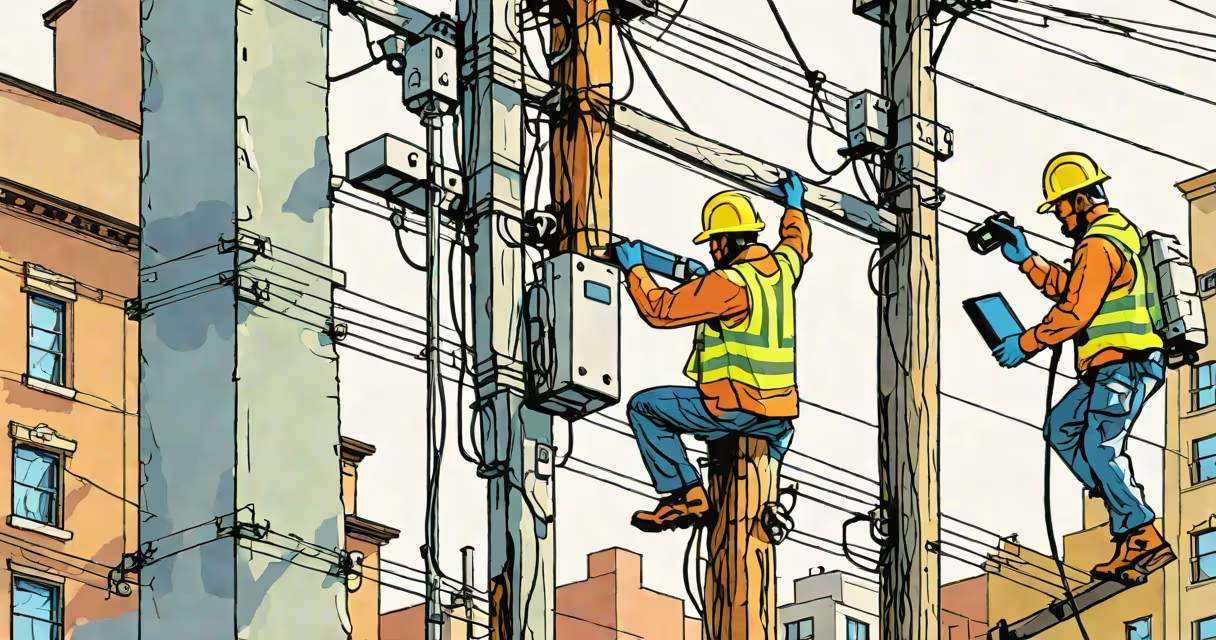
IoT in the telecommunication industry refers to the integration of internet-connected sensors, devices, and systems into telecom networks to enable real-time data collection, remote monitoring, and automated decision-making across infrastructure and services.
Telecom providers deploy IoT to monitor network health, manage traffic loads, and maintain equipment such as cell towers, fiber nodes, and base stations. These devices collect environmental data-temperature, humidity, power levels-and send alerts when anomalies occur. For example, a sensor on a 5G tower detects a sudden drop in voltage and triggers an automatic shutdown to prevent hardware damage, reducing downtime by up to 40% compared to manual checks.
IoT transforms traditional telecom operations from reactive to predictive. Instead of waiting for a failure, operators use continuous streams of device data to forecast issues. A study by Ericsson (2023) found that telecom operators using IoT-based monitoring reduced unplanned outages by 32% over 18 months. This shift enables faster response times, lower maintenance costs, and improved customer satisfaction.
At its core, IoT in telecom relies on low-power wide-area networks (LPWANs), 5G, and edge computing. Devices transmit small packets of data via cellular or satellite links to centralized platforms. These platforms process signals locally-near the source-to reduce latency and bandwidth usage.
For instance, a water level sensor installed in a buried fiber conduit sends data every 15 minutes. When moisture exceeds 5%, the system triggers a notification to field teams. The data travels through a 4G LTE-M connection, processed by an edge server within 100 milliseconds. This setup prevents costly repairs by catching leaks early.
Security is critical. Devices must authenticate before connecting. The GSMA's IoT Security Guidelines (2022) recommend end-to-end encryption, regular firmware updates, and unique device identities. Without these, attackers could spoof sensors or disrupt network functions. In 2021, a major European carrier reported a breach where falsified temperature readings led to incorrect cooling adjustments in a data center, causing a 2-hour outage.
Telecom companies use several forms of IoT based on use case and technical requirements:
| Type | Use Case | Technology | Latency |
|---|---|---|---|
| Remote Equipment Monitoring | Tracking power, temperature, and vibration on cell towers | LoRaWAN, NB-IoT | 1-10 seconds |
| Smart Grid Integration | Coordinating energy use between telecom sites and local grids | 5G, MQTT protocol | 50-200 ms |
| Network Traffic Optimization | Adjusting routing based on real-time congestion data | Edge AI, SDN | <10 ms |
| Customer Premises Equipment (CPE) Management | Automatically diagnosing home router failures | Wi-Fi 6, REST APIs | 1-5 seconds |
Each deployment type serves a distinct purpose. Remote monitoring uses low-cost, long-range protocols to track thousands of assets across rural areas. Smart grid integration requires higher precision and coordination with utility providers. Network optimization demands ultra-low latency for real-time routing decisions.
Many assume IoT in telecom is limited to consumer devices like smart thermostats or wearables. That's incorrect. While those fall under IoT, telecom-focused deployments prioritize industrial-grade reliability, not convenience. A sensor on a microwave relay station must operate for 10 years without maintenance-not because it's "smart," but because it's mission-critical.
Another error is equating IoT with 5G. While 5G enhances IoT capabilities-offering speeds up to 20 Gbps and sub-millisecond latency-it's not required. Many rural telecom sites still rely on 3G or NB-IoT for basic monitoring due to cost and coverage constraints. The key difference lies in application: 5G enables high-bandwidth video surveillance, while NB-IoT supports low-frequency sensor data.
A lesser-known fact: IoT devices in telecom often run on open-source software. The Linux Foundation's LF Edge project hosts reference architectures for edge gateways used in telecom. These gateways handle data filtering, protocol translation, and security enforcement before forwarding data to cloud platforms. Using open standards reduces vendor lock-in and allows interoperability across different network vendors.
In 2022, AT&T launched a pilot program deploying over 12,000 IoT sensors across 3,000 cell towers in Texas and California. Each tower received a weatherproof enclosure housing a microcontroller, battery backup, and multiple sensors measuring wind speed, solar radiation, and internal temperature.
Data streamed hourly to AT&T's central platform using LTE-M. The system flagged a tower in San Diego where internal temperature rose above 50°C during a heatwave. Maintenance crews were dispatched within 90 minutes. Without IoT, the issue would have gone unnoticed until a power surge caused a failure.
The program reduced site maintenance costs by $1.8 million annually across the pilot region. It also improved uptime by 27%. AT&T reported that 89% of flagged events were resolved before service degradation occurred.
IoT in the telecommunication industry drives resilience, scalability, and sustainability. By automating routine checks, human labor shifts from repetitive tasks to complex problem-solving. Field technicians now focus on root cause analysis rather than manual inspections.
Energy savings are significant. According to the International Telecommunication Union (ITU), IoT-enabled power management in telecom sites reduced global energy consumption by 14% between 2020 and 2023. One major Asian provider cut its carbon emissions by 12,000 tons annually after optimizing cooling systems using IoT data.
There's also a strategic advantage. As governments push for national broadband expansion, telecom providers use IoT to validate coverage maps in real time. A mobile team equipped with a portable 5G scanner and GPS logs signal strength across neighborhoods. Data feeds into a dashboard showing gaps in service-information used to justify infrastructure investment.
When I worked on a network upgrade project in 2021, we deployed IoT sensors to test signal propagation in dense urban zones. We discovered that buildings with reflective glass surfaces caused signal reflection patterns that degraded performance by up to 60% in certain directions. This insight led to antenna repositioning and saved $400,000 in unnecessary site expansions.
IoT in the telecommunication industry is not a trend-it's a foundational shift. It enables networks to adapt dynamically, respond proactively, and operate efficiently at scale. From preventing outages to optimizing energy use, connected devices are now embedded in the spine of modern communication systems.
Understanding this isn't about tech jargon. It's about recognizing how invisible sensors and automated responses keep your calls clear, your videos streaming, and your emergency services online. The next time your phone reconnects after dropping a call, it may be thanks to an IoT sensor detecting a failing node miles away.