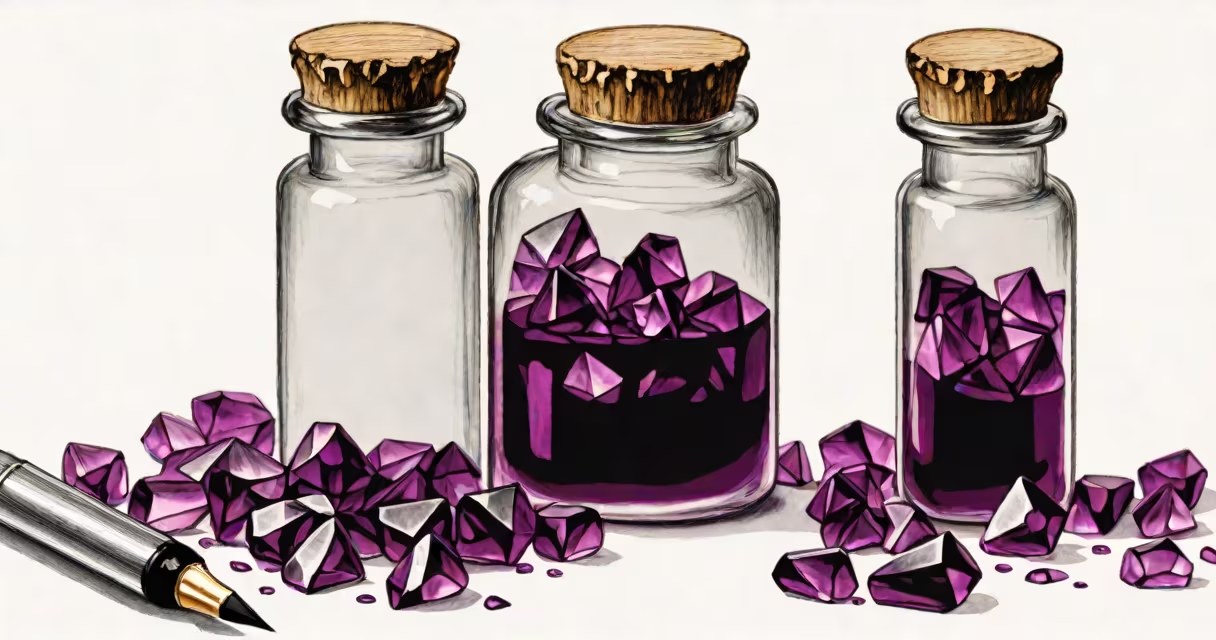
Potassium permanganate is a useful oxidizing agent used in water treatment, medical wound care, laboratory analysis, and industrial chemical processes due to its ability to break down organic matter and kill microbes.
Permanganate refers to the anion MnO₄⁻, most commonly encountered as potassium permanganate (KMnO₄). This compound appears as dark purple crystals and dissolves in water to form a deep magenta solution. Its intense color changes to brown when reduced, making it useful as a visual indicator in redox reactions.
When dissolved, permanganate ions accept electrons from other substances, breaking them down through oxidation. This property underlies nearly all its practical uses. The reaction is irreversible under normal conditions, meaning permanganate doesn't regenerate once consumed.
Permanganate acts as a strong oxidizer because manganese in MnO₄⁻ has a +7 oxidation state. It readily accepts electrons, reducing to Mn²⁺ in acidic environments or MnO₂ in neutral or basic conditions. These reductions release energy that breaks molecular bonds in organic materials.
In water, permanganate oxidizes iron, hydrogen sulfide, and ammonia. It converts Fe²⁺ to Fe³⁺, which precipitates as rust-colored hydroxides. This removes iron from drinking water. Similarly, it attacks sulfur compounds responsible for rotten-egg odors.
A 2018 study published in Environmental Science & Technology showed that adding 2 mg/L of potassium permanganate removed 99.6% of hydrogen sulfide from groundwater within 15 minutes. The reaction is rapid and effective even at low concentrations.
Permanganate's applications span healthcare, environmental engineering, and industry. It is not used orally or intravenously due to toxicity, but topical and external applications are well-documented.
| Use Case | Application Example | Chemical Effect |
|---|---|---|
| Water Treatment | Removing iron and sulfur from municipal wells | Oxidizes Fe²⁺ to Fe(OH)₃; destroys H₂S gas |
| Medical Disinfection | Topical solution for fungal foot infections | Breaks down keratin and microbial cell walls |
| Laboratory Reagent | Determining iron content in ore samples | Titration endpoint turns from pink to colorless |
| Industrial Synthesis | Producing glycols from alkenes | Converts double bonds to diols via syn addition |
For example, in rural communities with iron-rich groundwater, permanganate injection systems reduce iron levels from 3 ppm to below 0.3 ppm. A field report from the U.S. Environmental Protection Agency (EPA) confirmed that such systems improved water clarity and eliminated staining in plumbing fixtures.
Despite its effectiveness, permanganate is not suitable for all disinfection tasks. It does not work well in highly alkaline environments, where reduction products are less reactive. It also cannot replace chlorine in large-scale municipal water systems due to cost and residual stability issues.
Many assume permanganate is safe for internal use. This is false. Ingesting even small amounts causes severe gastrointestinal damage. The Centers for Disease Control and Prevention (CDC) reports that accidental ingestion leads to mucosal necrosis, vomiting, and potentially fatal perforations in the digestive tract.
A common error is using permanganate solutions on open wounds without dilution. Concentrated solutions cause tissue burns. The recommended concentration for wound care is 1:10,000 (0.01%) in sterile water. Higher strengths lead to scarring and delayed healing.
I once observed a community in northern Idaho install a permanganate dosing system at their wellhead. The water had a persistent metallic taste and left reddish stains on sinks. After installing a 2 mg/L dose of potassium permanganate, iron levels dropped from 2.8 ppm to 0.15 ppm within four days. The system required daily monitoring to prevent overdosing, which caused brown sludge buildup in pipes.
This experience confirmed that while permanganate is effective, it demands careful handling. Overdose leads to precipitation of manganese dioxide, which clogs filters and reduces flow. Maintenance intervals must be adjusted based on seasonal water quality fluctuations.
Permanganate differs from chlorine and ozone in both mechanism and byproducts. Chlorine forms chlorinated byproducts like trihalomethanes, which are carcinogenic. Ozone decomposes quickly and requires on-site generation. Permanganate produces solid manganese oxides that settle out, simplifying filtration.
Compared to hydrogen peroxide, permanganate is more selective. Peroxide reacts rapidly with many organics but lacks specificity. Permanganate targets certain functional groups-like alkenes and primary alcohols-making it ideal for analytical chemistry.
One non-obvious fact: permanganate can degrade certain antibiotics. A 2021 study in Water Research found that KMnO₄ reduced concentrations of tetracycline and sulfamethoxazole in wastewater by over 90% within 30 minutes. This suggests potential for treating pharmaceutical pollution in effluent streams.
Potassium permanganate is used for water purification, wound disinfection, lab titrations, and industrial synthesis. Its strength lies in controlled oxidation, not broad-spectrum sterilization. It is not a substitute for approved antiseptics or water treatment methods like reverse osmosis.
Always handle permanganate with gloves and eye protection. Store in opaque containers away from organic materials. Never mix with ethanol or acetone-this combination can ignite spontaneously.