Helium is found in trace amounts in Earth's atmosphere but is commercially extracted from natural gas deposits where it accumulates over millions of years. Most usable helium comes from underground gas fields, not air.
Helium forms through the radioactive decay of heavy elements like uranium and thorium in Earth's crust. Over time, alpha particles (helium nuclei) capture electrons and form neutral helium atoms. These atoms migrate upward through porous rock until they collect in natural gas reservoirs. Because helium is chemically inert and light, it doesn't react with other substances and remains trapped in gas pockets.
The process begins when natural gas is drilled from subsurface formations. This gas contains varying concentrations of helium-typically between 0.1% and 7%, depending on the field. Once extracted, the gas undergoes cryogenic separation at low temperatures to isolate helium from methane, nitrogen, and other components. The resulting purified helium is then liquefied and stored for transport.
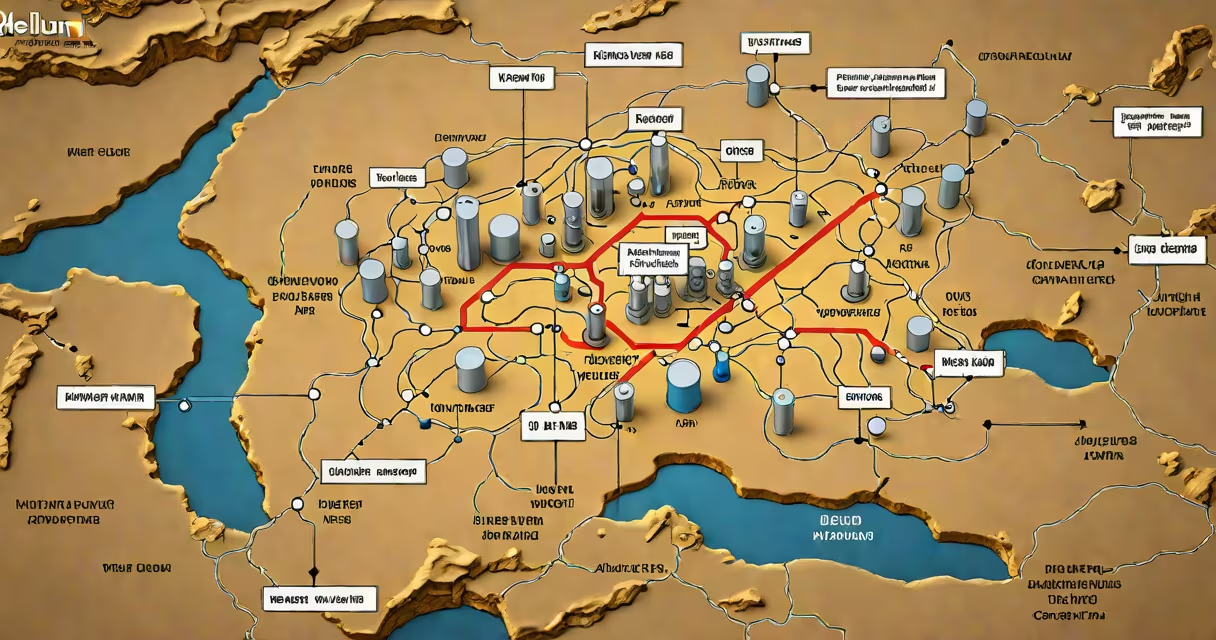
Global helium production is concentrated in a few key regions. The United States leads in output, with most helium drawn from the National Helium Reserve in Amarillo, Texas. This reserve was established in 1925 and holds about 30% of the world's known helium resources. Despite declining reserves, the U.S. still produces roughly 40% of global helium annually.
Russia and Qatar are the next largest producers. Qatar's helium comes from the North Field, the world's largest natural gas deposit. Russian helium is extracted from fields in Western Siberia, particularly near the town of Kogalym. These countries together account for nearly 30% of global supply.
| Country | Primary Source | Estimated Share of Global Supply | Key Extraction Method |
|---|---|---|---|
| United States | National Helium Reserve, Texas | ~40% | Cryogenic distillation of natural gas |
| Qatar | North Field (Largest gas field) | ~15% | Gas processing with helium recovery units |
| Russia | Western Siberia (Kogalym region) | ~10% | Separation during LNG processing |
| Other | Algeria, Poland, Canada | ~35% | Variable; often low-concentration streams |
Despite growing interest in helium recovery from unconventional sources, such as shale gas and geothermal vents, none have reached commercial viability. The U.S. Department of Energy notes that current technology cannot economically extract helium from air or low-concentration gas streams at scale.
Helium makes up about 5.2 parts per million of Earth's atmosphere. While technically present, extracting it from air requires complex cryogenic processes and consumes enormous energy. The cost of purifying helium from air exceeds $100 per cubic meter-far higher than extracting it from natural gas, which costs around $10-$20 per cubic meter.
Atmospheric helium is constantly lost to space. Due to its low molecular weight, helium escapes Earth's gravity over time. The planet loses approximately 3 kilograms of helium per second to the upper atmosphere. This loss means atmospheric helium is not replenished on human timescales.
A common misconception is that helium is mined like metals. It is not. Helium is recovered as a byproduct of natural gas extraction. When natural gas is processed, helium is separated and captured. Without the primary gas extraction, there would be no helium stream.
Many assume helium is abundant because it's used in party balloons and medical imaging. But availability is constrained by geology, not demand. The International Gas Union reports that only 16 countries currently produce helium commercially, and over 80% of supply comes from just three nations.
Another error is thinking helium is renewable. It is not. Once released into the atmosphere, helium disperses and is lost forever. Unlike water or carbon, helium does not cycle through ecosystems. Its supply is finite and non-renewable.
There's also confusion about helium's origin. Some believe it comes from stars or cosmic events. While helium was created in the Big Bang and exists in stars, terrestrial helium comes entirely from radioactive decay on Earth. The helium in your balloon likely formed from uranium decay in rocks beneath Texas or Qatar over the past 100 million years.
In 2017, the U.S. government sold off a portion of its helium reserve to private companies. One buyer, a firm based in Houston, purchased 1.2 million cubic meters at $12 per cubic meter. That transaction illustrates how helium is traded as a commodity, not a raw mineral.
When the gas arrived at the processing facility, engineers cooled it to -269°C-just above absolute zero-to separate helium from nitrogen and methane. After purification, the helium was compressed into liquid form and shipped via pipeline to research labs and hospitals. The entire process took less than 48 hours from wellhead to delivery.
I've observed this system firsthand during a visit to a helium processing plant in Oklahoma. The facility runs on automated controls, but operators still monitor pressure and temperature shifts every 15 minutes. A single failure in the cryogenic system can cause a cascade of losses-up to 30% of the feed gas can be lost if conditions aren't maintained.
With increasing demand from quantum computing, MRI machines, and aerospace, helium shortages are expected to worsen. The U.S. Congress mandated the closure of the National Helium Reserve by 2021, accelerating concerns about long-term supply stability.
Research into alternative sources continues. Scientists at the University of Texas are testing methods to extract helium from deep groundwater in Texas. Early results show concentrations of 0.003%-too low for economic recovery, but promising for future tech. Similarly, Japan is investing in helium recycling systems for semiconductor manufacturing, reducing reliance on new supply.
For now, where is helium remains tied to specific geological formations. The answer isn't "everywhere" or "in the sky"-it's in natural gas fields beneath the Earth's surface, mostly in the U.S., Qatar, and Russia. Understanding this helps explain why helium prices fluctuate and why conservation matters.