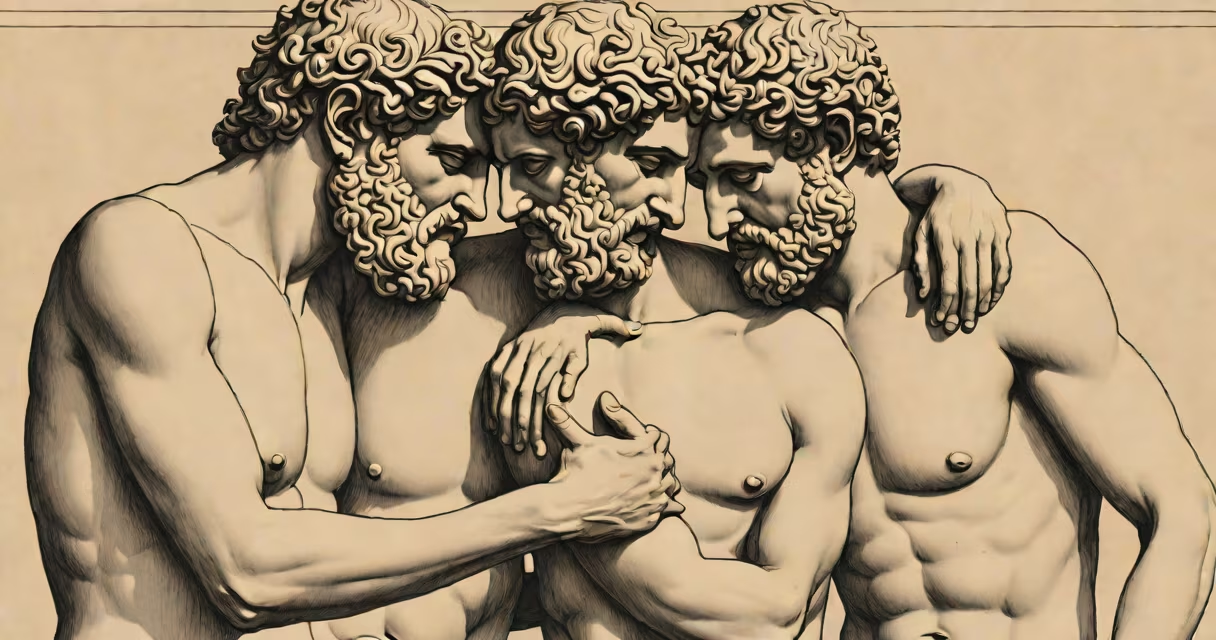
The concept of being "gay" as a stable identity did not exist in ancient times. There is no verified individual who can be definitively labeled the "first gay person" because modern understandings of sexual orientation emerged in the late 19th century. Identity categories like "gay" are cultural constructs, not biological facts tied to specific people.
Same-sex attraction and relationships have occurred throughout human history, but labeling them requires a structure that didn't exist until the 1800s. Ancient societies such as Greece and Rome acknowledged male-male relationships, often within social hierarchies, but these were not equivalent to modern concepts of homosexuality. The term "homosexual" was first used in 1869 by Hungarian journalist Károly Mária Benkő, and it wasn't widely adopted until decades later.
Modern research shows that same-sex behavior appears in over 1,500 animal species, suggesting biological roots. Yet human identity as "gay" arose from medical, legal, and social discourse-not biology. The earliest known use of "gay" to describe a man attracted to men dates to the 19th century in American slang, but it wasn't until the 20th century that it became a common self-identifier.
Before the 1800s, Western culture described same-sex desire through religious sin, moral failing, or medical pathology. In medieval Europe, male-male acts were condemned under Christian doctrine, but they weren't categorized as a personal identity. The modern notion of a "homosexual" as someone whose core identity revolves around same-sex attraction emerged only after psychiatrists began classifying behaviors.
In 1886, German psychiatrist Richard von Krafft-Ebing published *Psychopathia Sexualis*, which included detailed case studies of men with same-sex desires. He coined the term "homosexuality" to describe a distinct psychological condition. This marked the beginning of sexual orientation as a diagnostic category. By the early 20th century, activists and scholars began using the term to assert rights and visibility.
By the 1950s, the term "gay" had gained traction in U.S. LGBTQ communities. The 1969 Stonewall Riots catalyzed a shift from pathologized identity to political activism. The word "gay" became a badge of pride, replacing earlier terms like "queer" or "fairy," which carried derogatory weight. This evolution shows that identity is shaped by language, power, and collective action-not by a single person's existence.
A person is considered gay when they consistently experience romantic or sexual attraction to people of the same gender. This identity is not about isolated acts but about enduring patterns of attraction and self-understanding. The American Psychological Association states that homosexuality is not a disorder and that same-sex attraction is a normal variation of human sexuality.
Sexual orientation exists on a spectrum. Some people identify as exclusively gay, others as bisexual or pansexual. The term "gay" traditionally applies to men, though it is increasingly used inclusively. Women who are attracted to other women may identify as lesbian, though "gay woman" is also accepted in many contexts.
Identity formation is influenced by culture, family, religion, and access to community. A person raised in a conservative environment may suppress same-sex feelings for years. Conversely, someone in a supportive setting may come out early. There is no universal timeline or experience. The absence of a "first" person reflects the diversity of how people understand themselves.
Many assume that historical figures like Michelangelo or Leonardo da Vinci were gay based on their art or letters. While both men expressed deep emotional bonds with men, their relationships were not framed through modern identity categories. Da Vinci's notebooks contain sketches of nude male figures, but he never wrote about his attractions in personal terms. His work reflects Renaissance ideals of beauty and form, not self-identification.
Another myth is that same-sex relationships were absent in non-Western cultures. In fact, many Indigenous societies recognized gender and sexual diversity. The Two-Spirit tradition among some Native American tribes includes individuals who embody both masculine and feminine roles. In pre-colonial Africa, certain societies had formal roles for men who lived as women, such as the Sambia of Papua New Guinea. These identities were not "gay" in the Western sense, but they demonstrate that diverse expressions of gender and sexuality have always existed.
Correction: Not all same-sex relationships in history were romantic or sexual. In ancient Sparta, boys trained together in military units and formed close bonds called "pederasty." These relationships involved older men mentoring younger ones, but they were part of a structured social system, not private love affairs. The absence of consent or mutual affection in many cases challenges the assumption that all such pairings were emotionally or sexually intimate.
| Time Period | Culture/Region | Named Individual | Relevance to Identity |
|---|---|---|---|
| 5th century BCE | Greece | Alcibiades | Political leader known for relationships with men including Socrates. His life illustrates how same-sex bonds were embedded in elite social networks, not identity labels. |
| 1st century CE | Rome | Emperor Hadrian | Hadrian deeply loved Antinous, a young man from Bithynia. After Antinous died, Hadrian deified him and founded a city in his honor. This relationship was publicly celebrated, yet it wasn't framed as "homosexual" in modern terms. |
| 19th century | Germany | Adolf Brand | First person to publish a magazine explicitly for gay men-*Der Eigene*-in 1896. He used the term "homosexual" and promoted self-acceptance. His work marks the emergence of organized gay identity. |
One non-obvious fact: The first known public declaration of a gay identity came not from a famous figure, but from a German postal worker named Karl Heinrich Ulrichs. In 1864, he published a series of pamphlets arguing that "urnings"-men with female souls in male bodies-were a natural minority. He used the term "third sex" and advocated for legal rights. Though largely ignored at the time, his writings laid groundwork for later movements.
I once attended a lecture at the University of California, Berkeley, where a historian presented a 17th-century Dutch painting showing two men holding hands while walking through a garden. The artwork bore no inscription, but the artist's notes revealed he was a devout Catholic who believed same-sex affection could coexist with faith. That moment showed me how identity isn't always visible in records-it's often hidden in silence, gesture, or context.
Looking for the first gay person treats identity as a singular event rather than a process. Human sexuality has always been fluid. Ancient Mesopotamian texts describe rituals involving male couples, but they don't label them as "gay." The same applies to 14th-century Persian poetry, where themes of love between men appear in metaphors of spiritual longing.
Identity is not discovered-it is constructed. The term "gay" emerged from resistance to persecution. It became a tool of solidarity during the AIDS crisis. Today, it's used in activism, media, and law. The meaning changes depending on context. To ask who the first gay person was is to misunderstand how identity functions across time and space.
Understanding this helps clarify that no one person can represent the origin of a complex social identity. Instead, we see a continuum of expression, recognition, and resistance. The legacy of LGBTQ history lies not in finding a starting point, but in honoring the people who lived, loved, and fought for dignity across centuries.