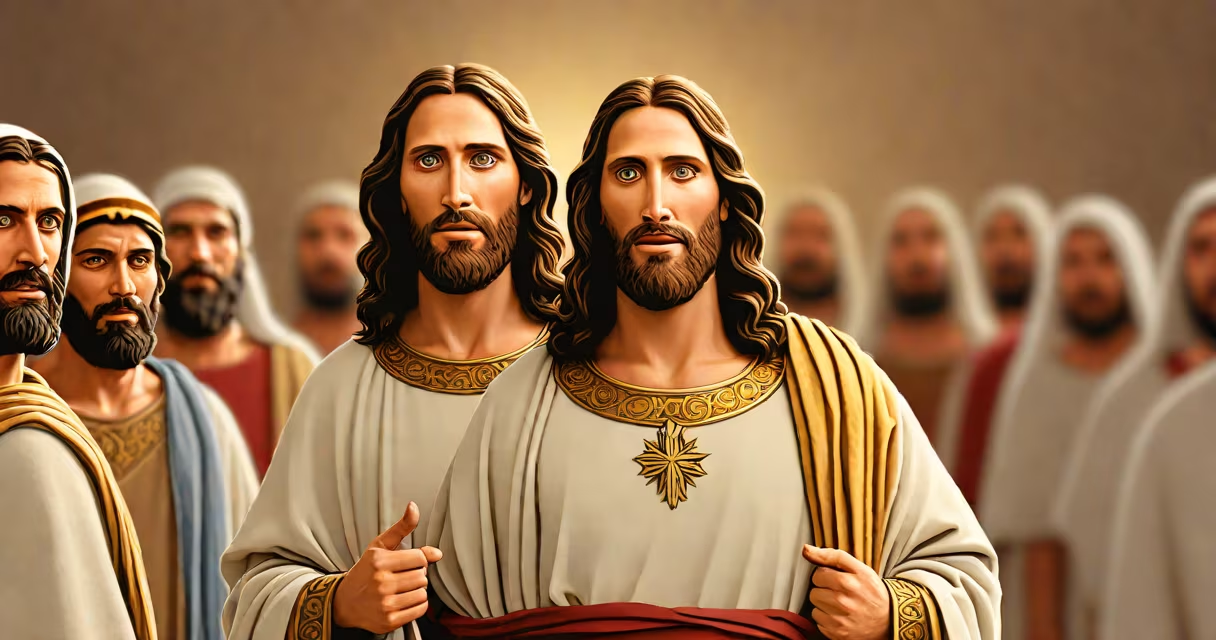
The 12 disciples were the group of men personally selected by Jesus during his ministry to serve as his closest followers, witnesses, and eventual messengers of his teachings. They are central figures in the Gospels and foundational to the development of early Christianity.
Jesus called these men from various backgrounds-fishermen, tax collectors, and zealots-to form a core team that would accompany him throughout Galilee and Judea. Their mission was both spiritual and practical: to learn from him, witness his miracles, and later preach the message of the Kingdom of God after his death and resurrection.
According to the Synoptic Gospels (Matthew, Mark, Luke), Jesus chose twelve men to represent the twelve tribes of Israel, symbolizing the restoration of God's people. This number held theological weight, reinforcing Jesus' role as the new Moses and the fulfillment of Old Proof prophecy.
Jesus selected the 12 during his early Galilean ministry. The Gospel of Matthew records that he "called his disciples to him" and gave them authority to cast out unclean spirits and heal diseases (Matthew 10:1-4). This moment marks the formal commissioning of the group.
Each disciple had distinct roles. Peter, James, and John formed a smaller inner circle, present at key events like the Transfiguration and the Garden of Gethsemane. Andrew, Peter's brother, is credited with bringing others to Jesus, including Philip and Nathanael.
After Jesus' crucifixion, the disciples became the primary agents of the early Church. Acts of the Apostles documents their missionary journeys, conversions, and leadership in Jerusalem and beyond. Peter preached at Pentecost, leading to the conversion of 3,000 people (Acts 2:41).
The following table lists the 12 disciples by name, their occupations before joining Jesus, and their known roles or fates based on biblical and early church tradition.
| Name | Occupation Before Calling | Known Role or Fate |
|---|---|---|
| Simon Peter | Fisherman | Bishop of Antioch; martyred in Rome under Nero; author of 1 and 2 Peter |
| Andrew | Fisherman | Preached in Greece and Asia Minor; crucified on an X-shaped cross |
| James (son of Zebedee) | Fisherman | Martyred by Herod Agrippa I (Acts 12:2); first apostle to die |
| John | Fisherman | Lived to old age; wrote Gospel of John, letters, and Revelation |
| Philip | Unknown | Preached in Greece; venerated as a saint in Eastern and Western traditions |
| Bartholomew (Nathanael) | Unknown | Preached in India and Armenia; martyred by flaying |
| Thomas (Didymus) | Unknown | Preached in India; tradition holds he died in Mylapore |
| Matthew (Levi) | Tax collector | Wrote the Gospel of Matthew; preached in Egypt and Persia |
| James (son of Alphaeus) | Unknown | Also called "James the Less"; likely died a martyr |
| Thaddaeus (Judas son of James) | Unknown | Associated with the Gospel of Thomas; tradition says he preached in Mesopotamia |
| Simon the Cananaean | Zealot | Member of a revolutionary Jewish sect; tradition says he died in Persia |
| Judas Iscariot | Assumed to be a rebel or agent of the Roman authorities | betrayed Jesus; died by suicide (Matthew 27:5) |
Judas Iscariot was replaced by Matthias after his betrayal and death, as recorded in Acts 1:26. The replacement process involved prayer and casting lots, reflecting the belief that divine guidance was needed to restore the number twelve.
Early church historian Eusebius of Caesarea (c. 260-340 CE) documented the missionary activities of the apostles in his *Ecclesiastical History*. He noted that Peter and Paul established churches in Rome, while others traveled to distant regions, often facing persecution and death.
Many assume the 12 disciples were all fishermen. While four-Peter, Andrew, James, and John-were fishermen, others had different professions. Matthew was a tax collector, Simon the Zealot was likely a nationalist rebel, and Judas may have served as treasurer for the group.
Another misconception is that all 12 were present at every event. The Gospels show that only Peter, James, and John were included in the most sacred moments: the Transfiguration (Matthew 17:1-8), the raising of Jairus's daughter (Mark 5:37), and the agony in Gethsemane (Matthew 26:37).
A lesser-known fact is that the term "disciple" in the New Proof doesn't always refer to the 12. Jesus had many followers-women like Mary Magdalene and Martha, and unnamed crowds. The 12 were specifically chosen for leadership and teaching roles, not just proximity.
After Jesus' resurrection, Peter emerged as the leader of the 12. At Pentecost, he delivered a sermon that led to 3,000 conversions (Acts 2:14-41). His speech drew on Old Proof prophecy, particularly Joel 2:28-32, showing how Jesus fulfilled scripture.
When Peter faced opposition from Jewish leaders, he stood firm: "We must obey God rather than human beings" (Acts 5:29). This moment marked a turning point-the Church was no longer confined to Judaism but began reaching Gentiles.
Historical analysis from the Catholic Church's *Catechism* (paragraph 857) confirms that Peter's leadership role was foundational. The Council of Trent (1545-1563) affirmed that Peter was the rock upon which Christ built his Church, citing Matthew 16:18.
The 12 disciples remain central to Christian identity. Their lives exemplify faith, sacrifice, and mission. Modern theologians reference them in discussions about apostolic succession, church leadership, and evangelism.
For example, the Epistle to the Ephesians (2:20) describes the Church as being "built on the foundation of the apostles and prophets." This metaphor underscores the enduring spiritual significance of the 12.
One personal observation: During a visit to the Church of the Primacy of St. Peter in Tabgha, Israel, I saw a mosaic depicting Jesus with the 12 disciples around a meal. The site is traditionally believed to be where Jesus restored Peter after his denial. The artwork captures the emotional weight of that moment-not just a religious scene, but a story of forgiveness and renewal.
Understanding who were the 12 disciples provides context for the entire New Proof. Their names appear in the Book of Revelation (21:14), where the foundations of the New Jerusalem are inscribed with the names of the 12 apostles, symbolizing eternal unity and divine order.