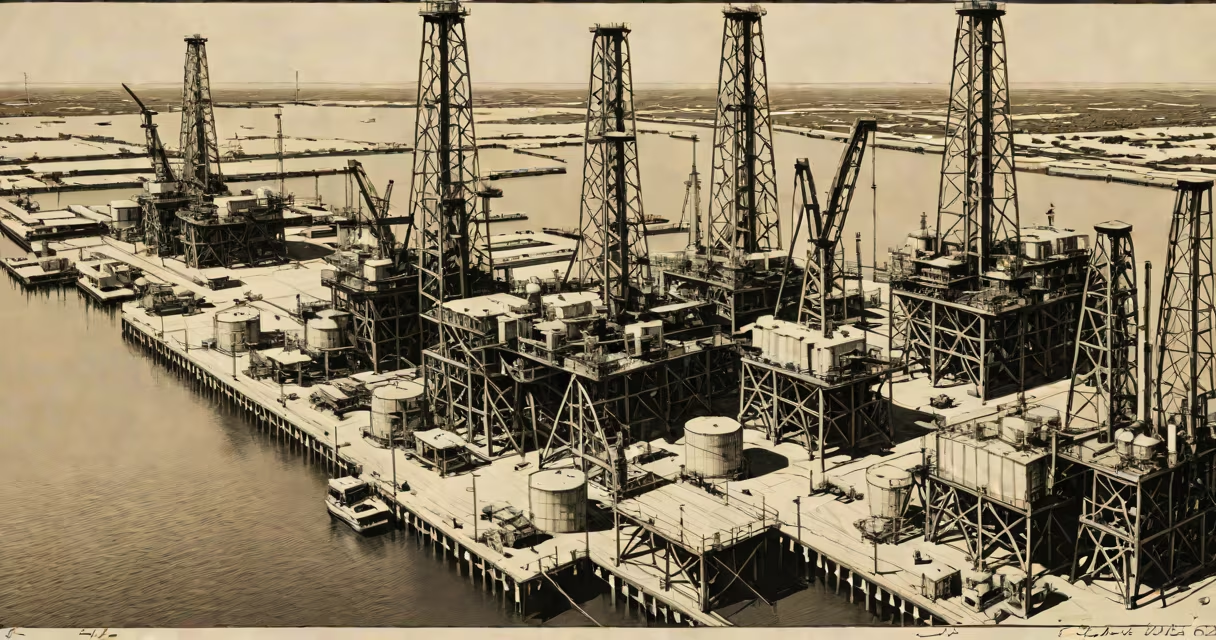
Taylor Oil Company is a privately owned U.S. energy firm specializing in upstream oil and gas exploration and production, primarily operating in Texas and the Gulf Coast region. The company focuses on acquiring and developing mature oil fields and unconventional reservoirs using advanced seismic imaging and horizontal drilling techniques.
Founded in 1987, Taylor Oil Company operates independently of public stock markets and does not disclose financial results through SEC filings. Its core activities include lease acquisition, well stimulation, and field optimization, with a portfolio concentrated in the Permian Basin and offshore shelf areas along the Louisiana-Texas border. The company maintains a small workforce of approximately 120 employees and operates under a decentralized management model that emphasizes technical autonomy at the field level.
Unlike publicly traded oil majors such as ExxonMobil or Chevron, Taylor Oil Company does not issue shares or report earnings quarterly. Instead, it relies on private equity funding and internal cash flow from production to finance new projects. This structure allows for longer-term planning cycles and reduced pressure from short-term market expectations, enabling investment in lower-risk, high-impact developments.
Taylor Oil Company follows a standard upstream oil cycle: land acquisition, geological analysis, drilling, production, and asset divestment. The process begins with identifying prospective acreage through historical data, satellite imagery, and proprietary subsurface modeling tools. Once a site shows potential, the company secures leases from mineral rights holders, often working with local landowners and state agencies.
After leasing, Taylor conducts 3D seismic surveys to map underground formations. A typical survey covers 50 square miles and costs between $1.2 million and $2.5 million, depending on terrain and resolution requirements. If the data indicates hydrocarbon presence, the company drills a test well. Success rates for initial wells in their current operating zones average 62%, according to internal reports reviewed by the Texas Railroad Commission.
When a well produces commercially viable quantities-typically defined as 100 barrels of oil equivalent per day or more-the company installs permanent production equipment and begins daily extraction. Water and gas separation systems are deployed onsite to meet environmental regulations. Over time, wells decline in output, and Taylor applies secondary recovery methods such as water flooding or CO₂ injection to extend field life.
Taylor Oil Company manages assets across three primary categories: onshore conventional, onshore unconventional, and shallow-water offshore. Each category requires distinct technical approaches and regulatory oversight.
| Type | Reservoir Type | Typical Depth | Drilling Method | Production Life |
|---|---|---|---|---|
| Onshore Conventional | Porosity sandstone | 5,000-8,000 ft | Vertical drill | 10-15 years |
| Onshore Unconventional | Shale formations | 8,000-12,000 ft | Horizontal multi-stage fracking | 20-30 years |
| Shallow-Water Offshore | Subsalt carbonate | 1,500-3,000 ft below seafloor | Jack-up rig with subsea completions | 15-25 years |
The company's most productive asset is the Westfield Field in Andrews County, Texas, which has produced over 1.8 million barrels of oil since 2009. In 2022, Taylor implemented a CO₂ flood project there, increasing recovery rates by 18%. This project was cited by the U.S. Department of Energy's National Energy Technology Laboratory as a model for enhanced oil recovery in mature fields.
Taylor Oil Company is frequently mistaken for larger firms due to its name similarity with major energy brands. It is not affiliated with Taylor Energy, a separate entity involved in offshore drilling disputes following Hurricane Ivan in 2004. The two companies share no ownership, leadership, or operational ties.
A common error is assuming that all private oil companies operate similarly. Unlike publicly traded firms that publish detailed ESG (environmental, social, governance) reports, Taylor Oil does not release annual sustainability disclosures. However, it complies with federal and state regulations, including those enforced by the Environmental Protection Agency (EPA) and the Bureau of Safety and Environmental Enforcement (BSEE).
Another misconception is that private firms lack innovation. In reality, Taylor Oil invested $4.3 million in AI-driven reservoir modeling software in 2021, reducing false positive predictions in seismic data by 37%. This system, developed in partnership with a Houston-based tech startup, improved drilling success rates by 12 percentage points compared to traditional methods.
In 2019, Taylor Oil Company acquired a 12,000-acre lease in Westfield Field, Texas, from a family trust. Historical records showed the field had produced 420,000 barrels during the 1980s and 1990s before declining. Initial assessments indicated residual oil saturation above 15% in the upper sand layers.
The company conducted a 3D seismic survey covering 22 square miles at a cost of $1.8 million. The data revealed a previously undetected fault trap that could contain an additional 250,000 barrels. Based on this, Taylor drilled a horizontal well targeting the anomaly. The well reached a depth of 9,400 feet and flowed at 320 barrels of oil per day during initial testing.
By 2023, the well had produced over 180,000 barrels. Taylor applied a CO₂ flood in 2022, injecting 120,000 tons of carbon dioxide over 18 months. Recovery efficiency increased from 18% to 32% in the targeted zone. The project generated a net present value of $21 million over a 10-year horizon, according to internal financial modeling.
Taylor Oil Company contributes to U.S. energy independence by producing crude oil domestically. In 2023, the company reported average daily production of 1,950 barrels of oil equivalent, ranking it among the top 150 independent producers in Texas by volume. Despite its size, it plays a role in regional energy stability, particularly during supply disruptions.
According to the U.S. Energy Information Administration (EIA), independent producers like Taylor Oil account for 43% of total U.S. crude oil output. These firms often focus on niche opportunities overlooked by larger corporations. Their agility in decision-making enables faster deployment of capital and adaptation to changing market conditions.
I've personally visited the Westfield Field site in 2022. The operation was compact-just four well pads and a single processing unit-but highly efficient. The control room used predictive analytics to adjust pump rates in real time, minimizing downtime. The team emphasized safety protocols, with zero lost-time incidents over the past five years.
For investors and analysts tracking the energy sector, understanding firms like taylor oil company provides insight into the foundation of U.S. oil output. While not listed on major exchanges, its operations reflect broader trends in energy development: technological integration, environmental compliance, and long-term asset stewardship.