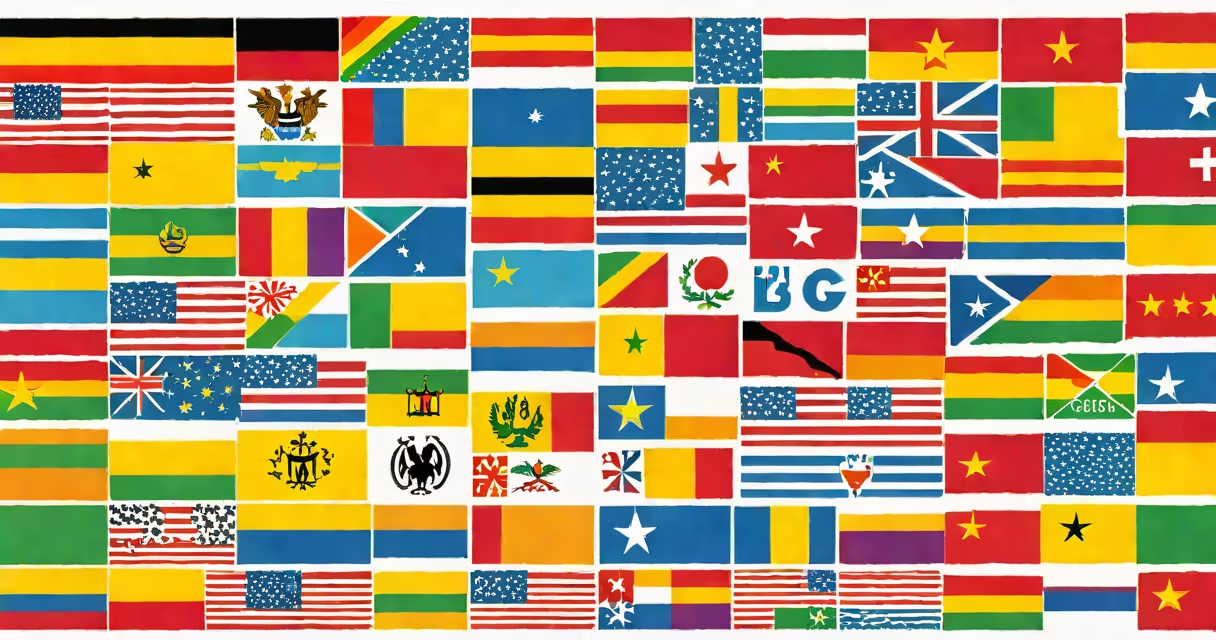
The term "all of the lgbtq flags and their meanings" refers to the set of symbolic banners representing diverse sexual orientations, gender identities, and communities within the LGBTQ+ spectrum. Each flag uses specific colors and designs to reflect shared experiences, values, and visibility. These flags serve both as public declarations of identity and tools for education and solidarity.
Each flag functions as a visual shorthand for a community's collective identity. Colors are chosen deliberately to represent core aspects of that group's lived experience-such as inclusion, resilience, or fluidity. The design often includes symmetry or layered bands to emphasize unity and balance. Flags are displayed during Pride events, on personal devices, and in public spaces to affirm belonging.
For example, the original rainbow flag-created in 1978 by Gilbert Baker-uses six colors: red, orange, yellow, green, blue, and violet. Red stands for life, orange for healing, yellow for sunlight, green for nature, blue for harmony, and violet for spirit. This arrangement was meant to reflect diversity and wholeness.
Flags are not static. They evolve as communities grow and new identities emerge. A flag may be revised or replaced when existing designs fail to capture nuances of identity, such as when the bisexual flag was updated in 2014 to improve visibility and reduce confusion with other symbols.
There are over 50 recognized LGBTQ+ flags globally, each serving distinct groups. Below is a breakdown of key flags, their origins, and symbolic meanings.
| Flag | Colors | Meaning | Year Introduced |
|---|---|---|---|
| Rainbow (Pride) | Red, orange, yellow, green, blue, violet | Life, healing, sunlight, nature, harmony, spirit | 1978 |
| Bisexual | Pink, purple, blue | Attraction to two or more genders | 1998 |
| Nonbinary | Yellow, white, purple, black | Gender beyond male/female; includes agender, bigender | 2010 |
| Transgender | Light blue, pink, white | Male, female, and non-binary identities; white for those who are intersex or have no gender | 1999 |
| Asexual | Black, gray, white, purple | Low or absent sexual attraction; gray for gray-asexuality | 2010 |
| Demisexual | Black, gray, white, purple | Sexual attraction only after forming a deep emotional bond | 2010 |
Some flags carry layered symbolism. The pansexual flag, introduced in 2010, features pink, yellow, and blue. Pink represents attraction to women, blue to men, and yellow to those outside the binary. The use of yellow instead of green reflects a focus on inclusivity beyond traditional gender categories.
Other flags address intersectionality. The Black LGBTQ+ flag, designed in 2016, combines red, black, and green-colors from the Pan-African flag-with a white star. Red symbolizes the blood shed by Black queer people in struggle, black represents strength and resilience, green stands for growth and renewal, and the star signifies unity and hope.
Many people assume the rainbow flag represents all LGBTQ+ identities. That's incorrect. While it remains the most visible symbol of LGBTQ+ pride, it was created specifically to represent gay men and lesbians. Its broad adoption has led to misperception about its scope.
Another frequent error is equating flag colors with arbitrary choices. For instance, the pink and blue in the transgender flag were selected to reflect traditional gender associations-but the placement of white in the center acknowledges that gender is not limited to these binaries. The white stripe also honors those who do not identify with either gender.
A lesser-known fact: the original rainbow flag had eight colors. Baker intended to include indigo for spirit and turquoise for art. Due to production limitations, those were removed. The current six-color version became standard after 1979, though some activists still advocate for the return of the full design.
LGBTQ+ flags appear at Pride parades, in classrooms, on social media, and in political campaigns. Their presence signals support and visibility. In schools, displaying the nonbinary flag alongside the rainbow flag helps students understand gender diversity beyond the binary.
During the 2022 U.S. Supreme Court decision in Dobbs v. Jackson Women's Health Organization, LGBTQ+ advocates used the bisexual flag to show how reproductive rights intersect with queer health access. The pink and blue stripes were paired with messages about bodily autonomy for all people, regardless of gender or orientation.
I once attended a Pride event in Portland where organizers hung 12 different flags across a city park. The demisexual flag-black, gray, white, and purple-was placed near a counseling tent. A participant told me, "I didn't realize I wasn't alone until I saw that flag." That moment underscored how important accurate representation is, especially for younger people going through identity.
Confusion often arises between the bisexual and pansexual flags. Both feature overlapping pink, purple, and blue bands. But the bisexual flag places pink and blue on the outer edges with purple in the middle-symbolizing attraction to two genders. The pansexual flag reverses this: pink and blue are adjacent, with purple separating them. This reflects a focus on attraction regardless of gender.
Similarly, the asexual flag and the demisexual flag share black, gray, white, and purple. The difference lies in the placement of gray. On the asexual flag, gray appears between black and white-representing the spectrum of asexuality. On the demisexual flag, gray is on the left side, with black below it. This arrangement emphasizes that demisexuality is a subset of asexuality, not a separate category.
Understanding all of the lgbtq flags and their meanings requires recognizing that each flag is rooted in lived experience, not aesthetics. The colors and layouts are informed by community input and historical context. Misusing or misrepresenting a flag can erase identity and cause harm.
When you see a flag, ask not just what it looks like-but who it represents, and why it matters.