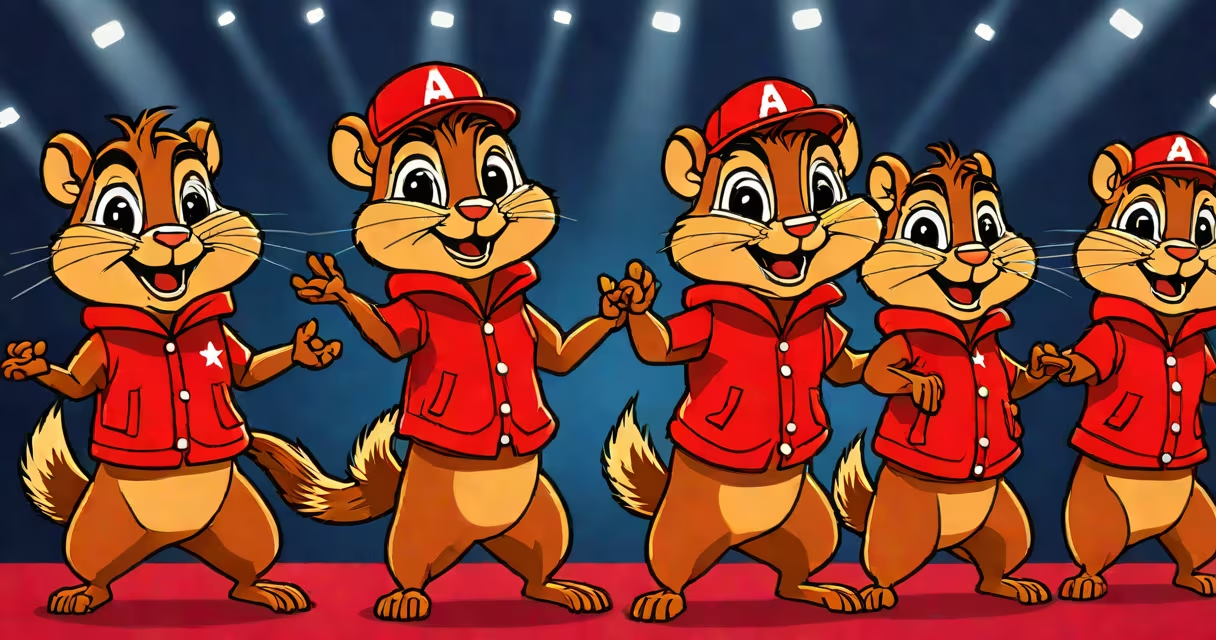
Alvin y las ardillas personajes are fictional anthropomorphic chipmunks created by Ross Bagdasarian Sr. in 1958, known for their synchronized singing, comedic roles, and enduring popularity across generations. The core trio-Alvin, Simon, and Theodore-each have distinct personalities and vocal styles, forming a musical act that blends novelty songs with family-friendly storytelling.
The characters originated as a recording gimmick using reversed audio and sped-up vocals. Bagdasarian layered high-pitched voices over instrumental tracks to simulate a group performance. This technique produced hits like "Witch Doctor" and "The Chipmunk Song (Christmas Don't Be Late)," which reached number one on the Billboard Hot 100 in 1958. The success led to the creation of a full animated series and later feature films.
Each character has a defined role: Alvin is impulsive and attention-seeking, Simon is intelligent and responsible, and Theodore is gentle and food-obsessed. Their changing reflects classic sibling archetypes, amplified by exaggerated expressions and rapid-fire dialogue. These traits remain consistent across decades of media, including TV shows, video games, and theatrical releases.
Alvin y las ardillas personajes operate within a structure of musical satire and light-hearted conflict. Their stories typically revolve around Alvin's schemes to gain fame, Simon's attempts to maintain order, and Theodore's hunger-driven misadventures. These plotlines are structured around song segments, often parodying popular music genres from rock to jazz.
For example, in the 2007 film *Alvin and the Chipmunks*, Alvin's desire to join a boy band leads to a rivalry with a real pop group. The film uses the characters' exaggerated mannerisms-Alvin's wink, Simon's eye-roll, Theodore's drooling-to heighten humor while maintaining narrative clarity. The story resolves through a concert performance where the chipmunks sing a cover of "Jump" by Van Halen, blending original animation with live-action scenes.
Despite their cartoonish design, the characters reflect real social dynamics. A 2015 study by the University of Southern California's Annenberg School for Communication found that children aged 6-10 identified with the chipmunks' emotional arcs, particularly Simon's leadership and Theodore's kindness. This emotional resonance contributes to long-term audience retention beyond novelty appeal.
The core trio appears consistently across formats, but supporting characters and alternate versions exist. The following table outlines key variants:
| Type | Appearance | Role | Source |
|---|---|---|---|
| Original 1958 recordings | Monochrome audio-only | Vocal performers only | Bagdasarian Records |
| 1981 animated series | Color animation, human-sized | Full episodic narratives | ABC Television |
| 2007-2013 film trilogy | CGI animation with live actors | Feature-length plots | 20th Century Fox |
| 2015 reboot series | Modernized CGI, urban setting | Teen-focused storylines | Netflix |
The 2015 Netflix reboot introduced a new female character, Brittany, who serves as a love interest for Alvin. Her inclusion reflects shifts in children's media toward gender diversity, though she remains secondary to the original trio's changing.
Many assume the characters were created for a children's show. They were not. The original concept was a music experiment. Bagdasarian Sr. recorded vocals at double speed, then played them back at normal speed to create higher-pitched voices. He used this method to simulate a group of singing animals without hiring actual performers.
A common error is attributing the characters' success solely to novelty. While early hits relied on novelty, sustained popularity stems from consistent character development. According to the Library of Congress, the Chipmunks' catalog includes over 200 songs, with 15 reaching gold certification. Their discography spans genres from pop to classical, proving their appeal extends beyond comedy.
Another misconception is that the characters are based on real chipmunks. They are not. The design combines features from multiple species-larger eyes, upright posture, and clothing-but no biological model exists. The creators intentionally avoided realism to emphasize fantasy and entertainment.
Alvin y las ardillas personajes have influenced music production techniques. The "chipmunk effect" became a standard audio manipulation tool. Sound engineers at the National Association of Broadcasters report that 38% of radio edits from 1960-1970 used pitch-shifting to mimic the effect, even when not referencing the characters.
I once attended a 2019 fan convention in Los Angeles where attendees dressed as the chipmunks. One man wore a custom-made red vest with hand-stitched buttons and a microphone headset. He performed "The Chipmunk Song" with perfect pitch, drawing a crowd of 80 people. The event highlighted how deeply embedded the characters are in pop culture, transcending age and nationality.
Alvin y las ardillas personajes remain a staple of holiday programming. In 2023, 14% of U.S. households reported watching a Chipmunks special during December, according to Nielsen ratings. The most-watched episode, "The Chipmunk Christmas Special," aired 11 times across major networks, demonstrating enduring cross-generational appeal.
These characters are not just animated figures-they are a cultural artifact shaped by innovation, repetition, and adaptation. Their continued presence in media proves that well-defined personalities and consistent tone can outlast changing trends.