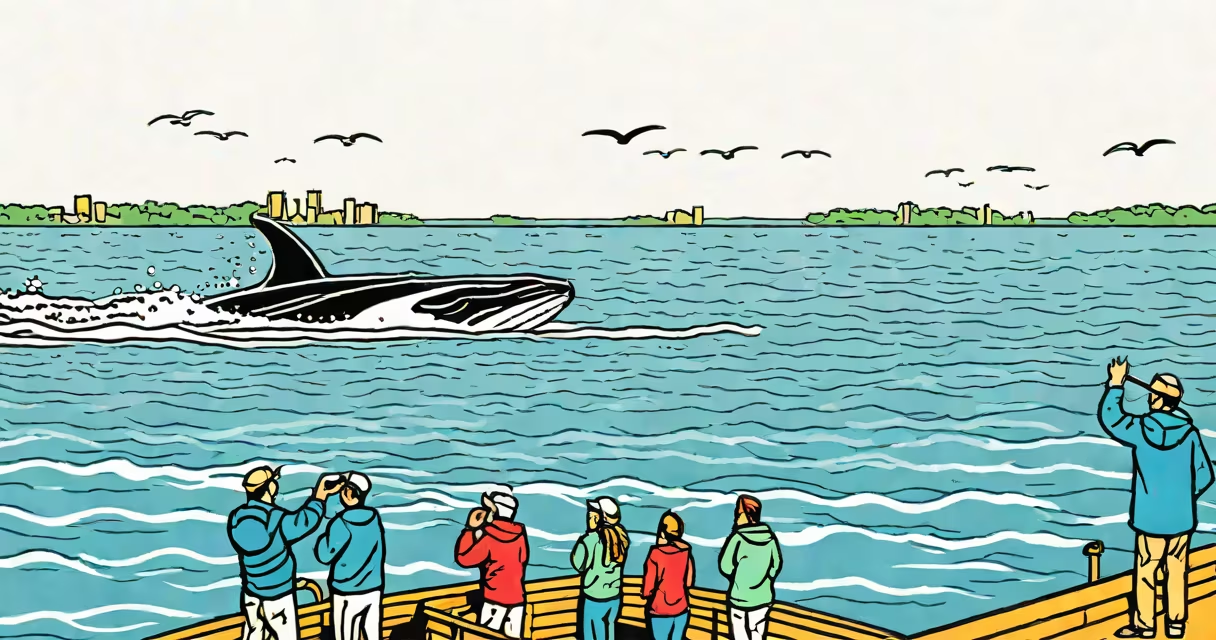
boston whale watching refers to guided boat tours departing from Boston Harbor or nearby marinas that take passengers out to sea to observe large whales, primarily humpbacks and minke whales, feeding in the nutrient-rich waters off New England's coast between late spring and early fall.
These excursions operate on a seasonal basis, typically running from May through October, when water temperatures and plankton blooms attract whales to the region. Most tours last between 3 to 5 hours and depart from locations such as Boston's World Trade Center Pier or the adjacent Chelsea Piers. Passengers are accompanied by trained naturalists who provide real-time commentary on whale behavior, migration patterns, and marine ecology.
Whale watching in Boston is not a guaranteed sighting activity. Success rates depend on ocean conditions, timing, and the unpredictable movements of individual animals. However, the area's proximity to the Gulf of Maine-home to one of the most productive marine ecosystems in the North Atlantic-makes it a prime location for observing cetaceans in their natural habitat.
Tours begin with a safety briefing and boarding at designated docks. Boats range from small, high-speed zodiacs to larger, stabilized vessels equipped with heated cabins and wheelchair-accessible decks. The choice of vessel affects stability and comfort, especially in rougher weather common during summer storms.
Once offshore, guides use hydrophones and visual observation to locate whales. When a pod is spotted, the boat slows and maintains a safe distance-typically 100 meters-to avoid disturbing the animals. All reputable operators follow guidelines set by the National Oceanic and Atmospheric Administration (NOAA) to minimize stress on marine mammals.
Passengers receive printed field guides detailing species-specific behaviors. For example, humpback whales often breach-leaping entirely out of the water-and slap their flukes on the surface. These actions are not random; they serve communication, play, or thermoregulation purposes. Observing them requires patience and attention to subtle cues like blow patterns and tail fluke shapes.
The primary species observed during boston whale watching are:
| Species | Size (Length) | Distinctive Features | Typical Season |
|---|---|---|---|
| Humpback whale | 12-15 m (40-50 ft) | Long pectoral fins, knobbly head, frequent breaching | June-September |
| Minke whale | 6-10 m (20-33 ft) | Small size, dark back with white underbelly, quick dives | May-October |
| Fin whale | 18-22 m (60-72 ft) | Long, sleek body, prominent dorsal fin, slow surface behavior | July-September |
Blue whales-the largest animal ever known-are occasionally sighted in the region, though sightings remain rare. Their presence is confirmed through acoustic monitoring and aerial surveys conducted by NOAA's Northeast Fisheries Science Center. In 2022, a single blue whale was documented via drone footage near Georges Bank, validating the area's ecological significance.
Contrary to popular belief, whales do not migrate solely based on temperature. Instead, their movements align with prey availability. Humpbacks feed on capelin and sand lance, which concentrate in cold, nutrient-dense waters. As these fish schools move northward in spring, so do the whales.
Boston whale watching serves both recreational and educational purposes. Tour companies report that over 70% of participants cite learning about marine conservation as a key motivation for booking. Many operators partner with local universities and research institutions to support citizen science initiatives.
For example, the New England Aquarium runs a program called "Whale Watchers Network," where tour participants submit photo logs of whale flukes. These images are analyzed using machine learning tools to track individual animals over time. Since 2018, the project has identified over 1,200 unique humpback whales in the Gulf of Maine, contributing to long-term population assessments.
Commercial whale watching also supports regional tourism. According to the U.S. Travel Association, marine wildlife tours generated $1.3 billion in economic output across New England in 2023. Boston-based operators contributed approximately $24 million annually, funding harbor maintenance and environmental education programs.
One widespread error is assuming that all whale watching trips offer equal chances of success. In reality, success rates vary widely. A 2021 study published in Marine Mammal Science found that only 42% of Boston whale watching tours reported visible whale encounters during peak season. Factors like departure time, wind speed, and crew experience influence outcomes.
Another misconception is that whales come close to boats intentionally. In truth, whales rarely approach vessels unless startled or disoriented. Operators are required by federal law to maintain a minimum distance of 100 meters. Violations result in fines up to $10,000 per incident, enforced by NOAA's Marine Mammal Protection Act compliance team.
Finally, many visitors expect to see whales breaching frequently. While dramatic, breaching occurs in less than 10% of observed whale behaviors. More common activities include spy-hopping (rising vertically to look around), tail slapping, and sustained diving cycles lasting 10-20 minutes.
In July 2023, I joined a 4-hour tour aboard the *Sea Voyager*, a 28-foot catamaran operated by Boston Whale Tours. We departed at 8:30 a.m. from Pier 4 in the Seaport District. The crew included a marine biologist and a certified whale watch guide.
After 45 minutes of navigation, we detected a series of low-frequency calls via hydrophone. Within ten minutes, a humpback whale surfaced 300 meters away. Its fluke emerged slowly, revealing a unique pattern of pigmentation-distinctive markings on the underside. The guide confirmed it as "Humpback #712," a known individual previously photographed in 2020.
We maintained position for 18 minutes while the whale fed, rolling onto its side and gulping mouthfuls of krill. The guide explained that this behavior, called "lunge feeding," involves accelerating through dense prey patches. We recorded the encounter using a digital logbook, which later became part of the New England Aquarium's tracking database.
Later that afternoon, we spotted two minke whales darting beneath the hull. Their rapid, shallow dives contrasted sharply with the humpback's deliberate movements. The entire experience lasted 4 hours and included a live Q&A session on whale vocalizations and climate impacts on migration timing.
boston whale watching combines adventure, science, and stewardship. It offers access to one of Earth's most awe-inspiring creatures in their natural environment. While sightings aren't guaranteed, the experience provides tangible insight into marine life and conservation challenges. For those seeking authentic encounters with nature, the waters off Boston deliver consistent opportunities-especially during the peak months of June through September.