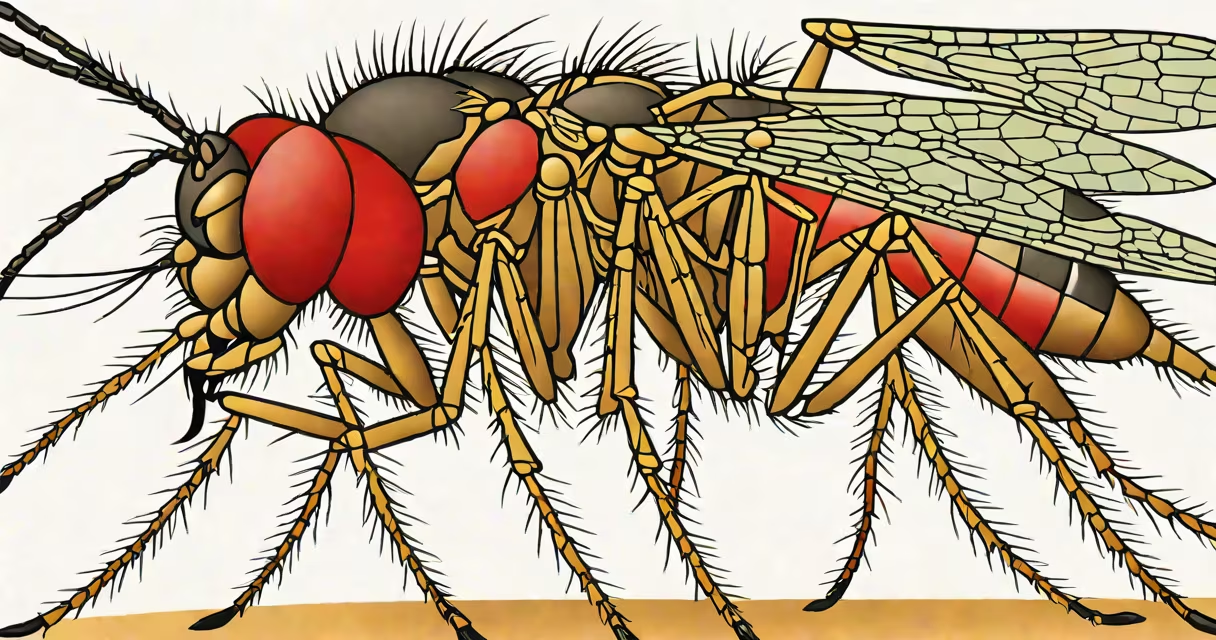
Female mosquitoes do not possess venom glands or deliver toxic substances through stings like bees or snakes. Instead, they inject saliva containing anticoagulants and immune modulators to help blood feeding. This saliva causes itching and swelling in humans but is not venom.
When a mosquito bites, it uses a specialized mouthpart called a proboscis to pierce the skin and locate a blood vessel. The proboscis contains multiple tubes: one for injecting saliva and another for sucking up blood. The saliva prevents clotting and reduces pain during feeding-key adaptations for successful blood meals.
True venom involves neurotoxins or cytotoxins that disrupt nerve function or destroy tissue. Venom is typically delivered via fangs, stingers, or specialized glands. Mosquitoes lack these structures. Their saliva functions as a biological tool for feeding, not attack.
Saliva from female mosquitoes contains over 60 different proteins. Key components include:
These compounds allow the mosquito to feed efficiently. Without them, blood would clot too quickly, making extraction difficult. The human body detects these foreign proteins as threats, triggering an allergic reaction-itching, redness, and swelling-within minutes to hours.
Not all biting insects use the same method. Comparing mosquito saliva to other insect delivery mechanisms reveals key differences:
| Insect | Delivery Method | Contains Venom? | Primary Function |
|---|---|---|---|
| Mosquito | Salivary injection via proboscis | No | Blood feeding facilitation |
| Wasp | Stinger with venom sac | Yes | Defense and prey immobilization |
| Spider | Fangs with venom glands | Yes | Prey capture and digestion |
| Scorpion | Sting with venom reservoir | Yes | Subduing prey and defense |
The absence of venom in mosquitoes is not a flaw-it's an evolutionary adaptation. Their survival depends on stealth and efficiency, not toxicity. They avoid detection long enough to complete a meal, then vanish.
Many assume mosquito bites cause pain or tissue damage because of the intense itch and localized swelling. These reactions stem from the immune system responding to foreign proteins, not from a toxic payload.
Some species, like the Asian tiger mosquito (*Aedes albopictus*), produce more potent salivary proteins. Studies show their saliva triggers stronger inflammatory responses in human skin cells. Yet even in these cases, the effect remains immunological-not toxic.
A common misconception is that mosquito bites can transmit diseases through venom. This is false. Pathogens like malaria (*Plasmodium*), dengue virus, and Zika are transmitted via infected saliva-but not because the saliva is venomous. The virus replicates in the mosquito's gut and migrates to the salivary glands. When the mosquito feeds, the virus enters the bloodstream along with the saliva.
In a 2018 study published in *Nature Microbiology*, researchers injected purified mosquito saliva into mice exposed to dengue virus. Mice receiving saliva showed higher viral loads and faster disease progression compared to controls. The study confirmed that mosquito saliva enhances infection rates-not through toxicity, but by suppressing early immune defenses.
This finding underscores a critical point: mosquito saliva is not venom, but it acts as a biological enhancer for pathogens. It doesn't harm the host directly-it creates conditions favorable for viral replication.
I once observed a lab experiment where researchers applied mosquito saliva to human skin biopsies under a microscope. After 15 minutes, immune cells began migrating toward the site-indicating an inflammatory response. No cell death occurred. The tissue remained intact. The reaction was purely immune-based, not necrotic or toxic.
This aligns with findings from the National Center for Biotechnology Information (NCBI), which confirms that mosquito saliva lacks cytotoxic or neurotoxic properties. Its effects are limited to altering blood flow and immune signaling.
Several myths persist about mosquito biology:
Even among experts, confusion arises from terminology. "Venom" often gets misapplied to any bioactive substance delivered during a bite. But in biological terms, venom requires specific traits: rapid action, targeted toxicity, and delivery via specialized apparatus. Mosquito saliva fails all three criteria.
Do mosquitoes have venom? No. Female mosquitoes do not produce or deliver venom. They inject saliva to aid blood feeding. This saliva contains anticoagulants, immunosuppressants, and vasodilators-tools for survival, not weapons. While the bite can trigger strong allergic reactions, the underlying mechanism is immune-driven, not toxic.