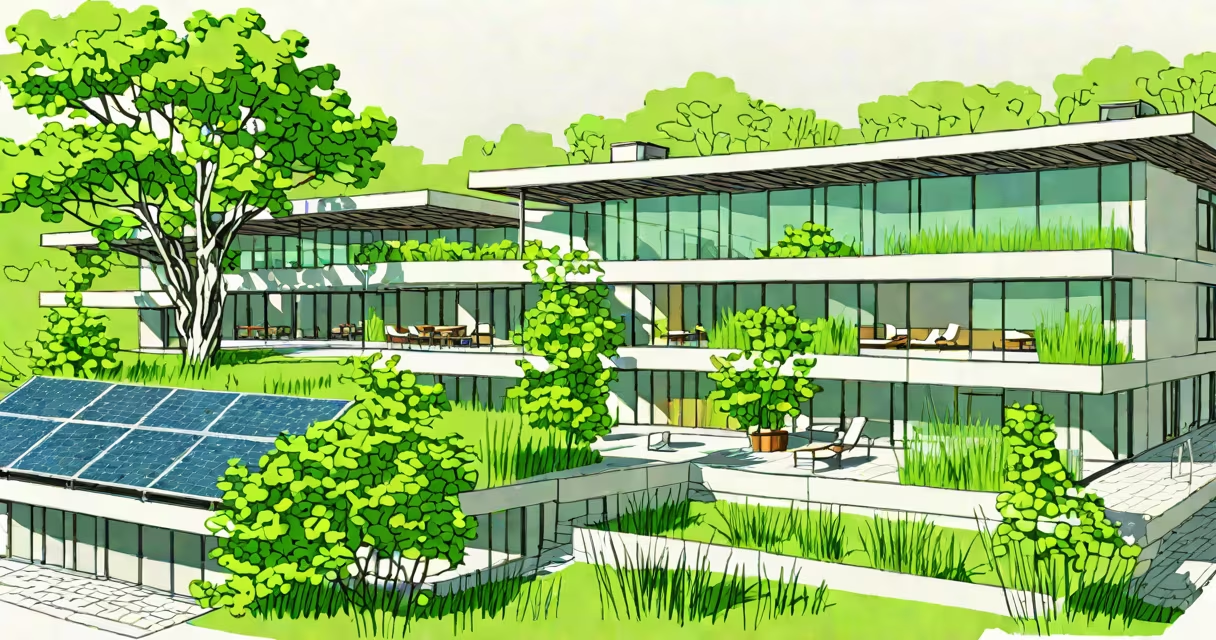
Examples of green design are real-world applications of sustainable principles in architecture, product development, and urban planning that minimize environmental harm through energy efficiency, renewable materials, and integration with nature. These projects prioritize long-term ecological health over short-term convenience.
Green design avoids resource depletion and pollution by rethinking material sourcing, energy use, and lifecycle impact. A building designed with green principles may use reclaimed wood, generate its own power via solar arrays, and manage stormwater through permeable surfaces and bioswales. Products like reusable water bottles made from recycled ocean plastic exemplify green design in consumer goods.
The core idea is not just reducing harm but actively restoring ecosystems. The Bullitt Center in Seattle-a six-story office building-produces more electricity than it consumes annually. It uses rainwater harvesting, composting toilets, and a 575-panel solar range. This net-positive energy performance makes it one of the most sustainable commercial buildings in North America.
Green design operates on three interlocking principles: energy conservation, material stewardship, and ecological integration. Energy conservation reduces dependence on fossil fuels. Material stewardship prioritizes recycled, rapidly renewable, or non-toxic inputs. Ecological integration ensures designs support biodiversity and human well-being.
For example, the Edge in Amsterdam-ranked the world's greenest office building by BREEAM-uses smart lighting that adjusts based on occupancy and daylight levels. Its HVAC system draws cooling from underground thermal storage. These systems cut energy use by 70% compared to standard offices.
Designers use life cycle assessments (LCAs) to quantify environmental impact across a product's lifespan. An LCA might reveal that a bamboo toothbrush, though biodegradable, has higher embedded energy due to transport emissions if sourced from Asia. This insight leads to local sourcing or alternative materials like recycled nylon.
Green design appears in multiple forms, each tailored to context and scale. The table below outlines common categories, their defining features, and real-world implementations.
| Type | Key Features | Example Project |
|---|---|---|
| Sustainable Architecture | Net-zero energy, passive heating/cooling, green roofs | Bullitt Center, Seattle |
| Circular Product Design | Modular components, recyclable materials, repairability | Patagonia's Worn Wear program |
| Biophilic Urbanism | Urban forests, green corridors, habitat connectivity | High Line Park, New York City |
| Eco-Friendly Manufacturing | Waterless dyeing, closed-loop systems, low-emission processes | Adidas x Parley shoes made from ocean plastic |
Each type addresses a different layer of environmental impact. Sustainable architecture focuses on buildings as systems. Circular product design targets consumer goods. Biophilic urbanism reshapes cities. Eco-manufacturing redefines industrial processes.
A lesser-known but critical distinction: green design is not synonymous with "eco" or "natural." A building with wooden beams and stone walls may still consume high energy due to poor insulation or inefficient HVAC. True green design requires measurable outcomes-not aesthetics.
Many assume green design is expensive or impractical. In reality, early investment often yields long-term savings. The U.S. Department of Energy reports that LEED-certified buildings use 25% less energy and have 13% lower maintenance costs than conventional structures.
Another myth is that green design only applies to large-scale projects. Small homes, furniture, and even packaging can embody green principles. For instance, a coffee cup made from molded fiber derived from agricultural waste-like banana leaves-reduces landfill burden and avoids virgin plastic.
Some confuse green design with greenwashing. A company claiming "eco-friendly" packaging without third-party certification or material transparency may mislead consumers. The FTC's Green Guides emphasize that such claims must be substantiated. A product labeled "biodegradable" must decompose within a specific timeframe in real-world conditions, not just in lab tests.
The Edge, a 40,000-square-meter office complex, serves as a benchmark for integrated green design. It achieved a 98.5 out of 100 score on the BREEAM sustainability assessment-the highest ever recorded at the time of certification.
Key systems include:
These systems collectively reduced energy consumption by 70% compared to typical office spaces. Employees report improved focus and satisfaction due to natural light access and personalized workspace settings.
During my visit in 2022, I observed the building's automated window shades adjusting in sync with sunlight patterns. The HVAC system responded instantly to occupancy changes. These details reflect how green design functions not as a set of isolated features, but as a responsive, adaptive system.
Urban areas face increasing pressure from climate change, population growth, and resource scarcity. Green design offers solutions that improve resilience and quality of life. Cities like Copenhagen and Singapore integrate green roofs, vertical gardens, and district energy networks to reduce heat island effects and carbon emissions.
Health impacts are measurable. Studies from the Harvard T.H. Chan School of Public Health show that occupants in green-certified buildings report 26% higher cognitive function scores and 30% fewer sick days. These benefits stem from better air quality, natural lighting, and acoustic comfort.
Regulatory momentum supports green design. The European Union's Green Deal mandates that all new buildings meet nearly zero-energy standards by 2027. California's Title 24 requires new residential constructions to include solar panels starting in 2025.
These policies reflect a shift from voluntary adoption to legal requirement. As climate risks grow, green design moves from niche innovation to essential infrastructure.
Understanding examples of green design reveals that sustainability is not a single action but a layered strategy combining engineering, ecology, and ethics. From the Bullitt Center's rainwater capture system to Adidas's ocean-plastic sneakers, these projects prove that environmental responsibility and functionality coexist.