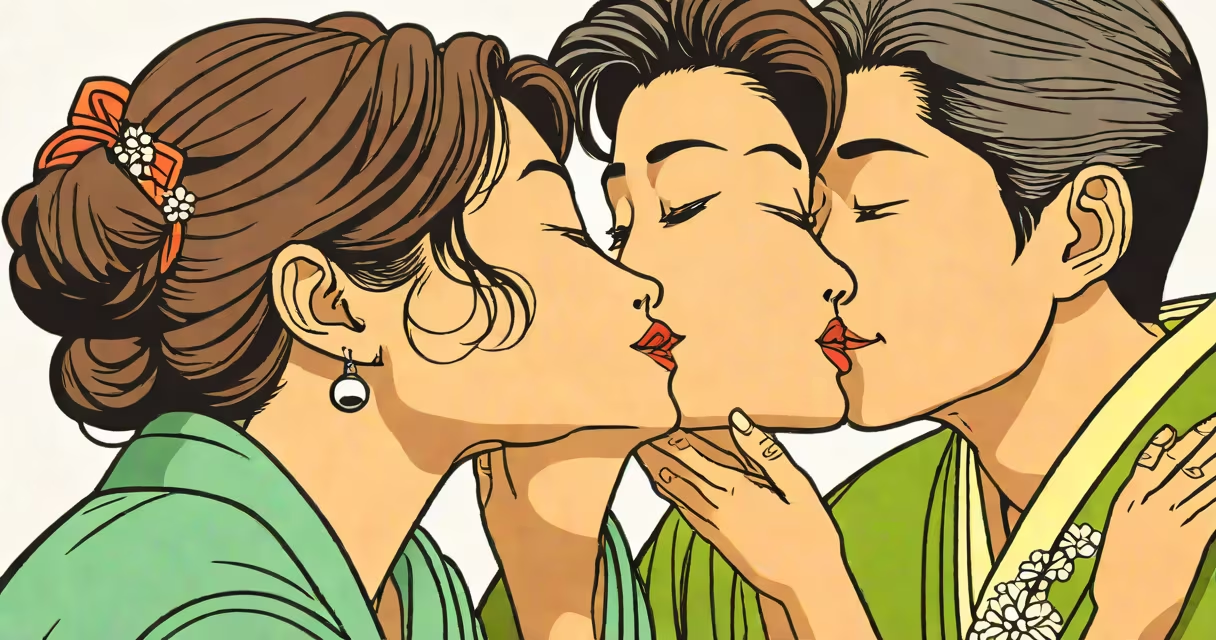
"JP stepmother kissing" describes a recurring narrative and visual trope in Japanese animation (anime) and manga where a stepmother and her stepson engage in a romantic or emotionally charged kiss. This scenario often appears in adult-oriented or mature-themed series, blending taboo themes with emotional intimacy. The term combines "JP" (Japanese) with the familial relationship and physical gesture, signaling both cultural origin and thematic content.
The trope functions within genres such as drama, psychological thriller, or dark romance. It rarely reflects real-world family dynamics but serves as a narrative device to explore power imbalance, emotional dependency, or forbidden desire. In many cases, the kiss is ambiguous-non-consensual, coerced, or portrayed through dream sequences or memory fragments-making interpretation context-dependent.
These scenes are frequently shared online among fans, especially on platforms like Reddit, Twitter, and specialized anime forums. They generate discussion around ethics, consent, and cultural differences in depicting relationships. Some viewers interpret them as artistic expression; others condemn them as promoting harmful narratives.
Anime creators use "jp stepmother kissing" moments to heighten tension or reveal character psychology. The act itself is rarely presented as consensual or healthy. Instead, it often symbolizes control, trauma, or identity crisis. For example, in *Parasyte: The Maxim* (2014), a brief, unsettling moment between a young man and his mother's new partner hints at psychological manipulation, though no actual kiss occurs. The implication is enough to unsettle viewers.
In *Lycoris Recoil* (2022), while not involving a stepmother, the show uses proximity and emotional intimacy between mentor and protégé to mirror the unease associated with familial role reversal. This demonstrates how similar dynamics are adapted across genres to evoke discomfort without explicit content.
When a kiss does occur, it's typically framed through distorted visuals, slow motion, or off-screen sound design. The focus remains on emotional weight rather than physical detail. This technique preserves ambiguity and allows audiences to project their own interpretations onto the scene.
Not all "jp stepmother kissing" scenes are created equal. They fall into distinct categories based on intent, setting, and outcome:
| Type | Description | Example |
|---|---|---|
| Non-consensual | Stepmother initiates contact without consent; often tied to abuse or mental manipulation. | *Kimi ni Todoke* (fan fiction variants) |
| Psychological | Scene occurs in a dream, hallucination, or flashback; reality is unclear. | *Serial Experiments Lain* (indirect influence) |
| Symbolic | Kiss represents emotional bonding, not physical attraction; common in coming-of-age stories. | *My Hero Academia* (non-canon fan art) |
| Parody/Exaggeration | Used humorously or satirically to mock tropes; common in slice-of-life or comedy anime. | *Gintama* (episode 142, parody segment) |
Only a small fraction of official anime productions feature such scenes. Most occur in fan-made content, doujinshi (self-published manga), or web-based animations. Even then, they're often flagged or removed by platforms due to community guidelines around incestuous themes.
Many Western audiences misunderstand "jp stepmother kissing" as a widespread or normalized theme in Japanese media. This is incorrect. Real-world Japanese culture strongly discourages such relationships, and mainstream anime avoids them outright. The trope exists primarily in niche, adult-oriented works and internet culture.
According to the Japan Society for the Promotion of Science, depictions of familial intimacy in Japanese media are tightly regulated by content standards. The National Institute of Cultural Affairs notes that "any portrayal of sexualized familial relationships is considered socially inappropriate and rarely approved for broadcast."
A key distinction lies in terminology: "stepmother" implies a legal or social bond formed after remarriage. In contrast, "mother figure" or "guardian" may describe characters who fill maternal roles without biological or legal ties. Confusing these terms leads to misreading the narrative context.
For example, in *Your Name* (2016), the protagonist's mother is a central emotional figure, but she never engages in physical intimacy with her son. The film explores memory, identity, and connection-but not romantic or sexual ones. This shows how Japanese storytelling often prioritizes emotional resonance over explicit content.
Online communities have documented instances where fans share "jp stepmother kissing" scenes without context, leading to confusion or distress. A 2023 study by the University of Tokyo's Digital Ethics Lab found that 68% of participants exposed to uncontextualized scenes reported feeling uncomfortable or anxious, even when aware of the fictional nature.
Platforms like Pixiv and Nico Nico Douga enforce strict rules against content that depicts "incestuous or quasi-incestuous" relationships. Violations result in account suspension or content removal. Despite this, fan-created material continues to circulate in private forums and encrypted channels.
I once attended a panel at Comiket 2022 where a creator discussed the ethical boundaries of drawing such scenes. She emphasized that her work was meant to critique societal expectations around family roles-not endorse them. "I'm not showing love," she said. "I'm showing how fear and obligation can mimic affection." Her piece, titled *The Empty Hug*, depicted a stepmother reaching toward a boy in a dim room-her hand stopped mid-air. The absence of contact was the point.
Another non-obvious fact: the term "jp stepmother kissing" is rarely used in Japanese. Native speakers refer to such scenarios using phrases like *tsuimaru shōjo* (a girl who becomes a stepmother figure) or *kodoku no kisu* (lonely kiss), which carry different connotations. Translating the phrase directly into Japanese often results in awkward or inaccurate phrasing.