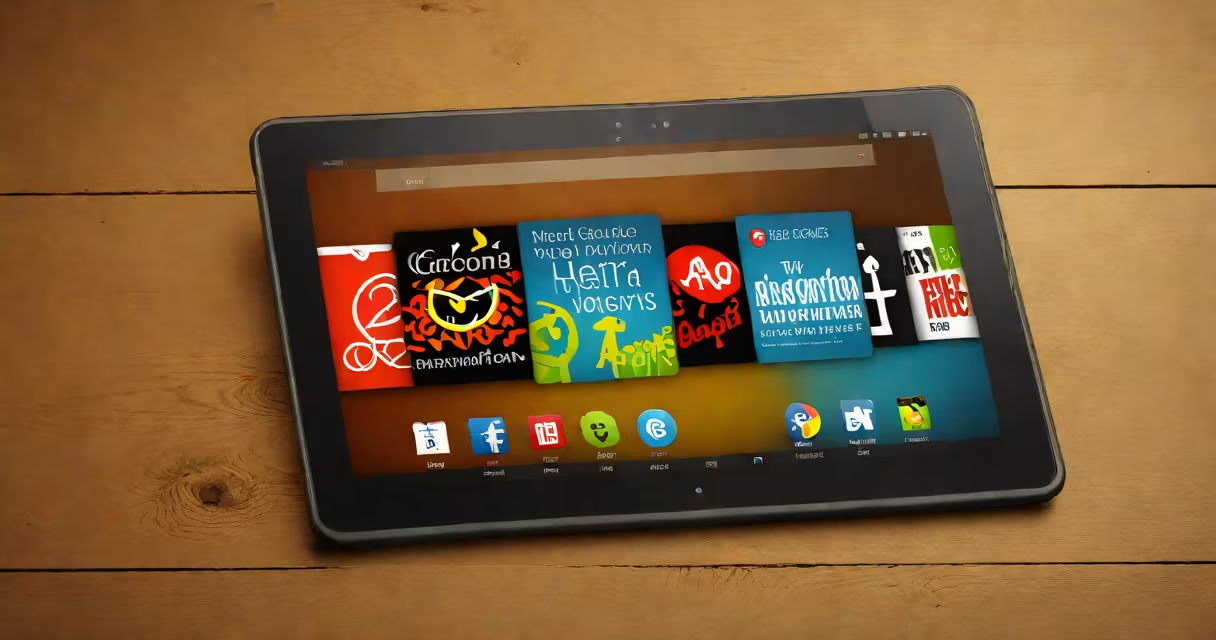
The Kindle Fire HD Gen 3 is a 7-inch Android tablet released by Amazon in October 2014. It features a 1280×800 pixel display, a 1.3GHz quad-core processor, 1GB of RAM, and runs Fire OS 3.0. It supports Wi-Fi and offers 8GB or 16GB of internal storage.
Amazon designed the Kindle Fire HD Gen 3 as a media-focused device. It prioritizes streaming video, music, and e-books through Amazon's system. The tablet uses a custom version of Android called Fire OS, which restricts access to Google Play and other third-party app stores. Instead, users install apps exclusively from the Amazon Appstore.
Performance is modest by modern standards. The device handles basic tasks like web browsing, video playback, and casual gaming well. However, it struggles with graphically intensive apps or multitasking across multiple heavy applications. Battery life averages around 8 hours under typical usage, according to Amazon's official specifications.
The Kindle Fire HD Gen 3 operates on a modified Android 4.4 KitKat base. Fire OS limits system-level access and disables standard Android features such as Google Play Services, Google Maps, and Gmail. Instead, Amazon provides its own set of services: Amazon Prime Video, Amazon Music, and the Amazon Shopping app.
Users interact with the device via a capacitive touchscreen. The interface centers on a home screen with customizable tiles for apps, books, videos, and games. Voice commands work through Alexa, which is integrated into the system. The tablet includes a front-facing 1.3MP camera and a rear-facing 2MP camera, both suitable for low-resolution video calls and basic photo capture.
Connectivity relies on Wi-Fi only. There is no cellular option. The tablet lacks Bluetooth audio support for external speakers or headphones beyond basic A2DP pairing. USB OTG functionality is disabled, meaning you cannot connect flash drives or game controllers directly.
The device is constructed from polycarbonate plastic with a matte finish. The bezel is narrow, and the screen is protected by Gorilla Glass 3. Dimensions are 194.5 × 120.5 × 9.7 mm. Weight is 350 grams.
Two storage variants exist: 8GB and 16GB. Both models lack microSD card expansion. The 8GB version sells for $139, while the 16GB model retails at $159. All units come with a 3.5mm headphone jack and a charging port using a micro-USB cable.
| Feature | 8GB Model | 16GB Model |
|---|---|---|
| Storage | 8GB internal | 16GB internal |
| RAM | 1GB | 1GB |
| Display | 1280×800 px, 16:10 aspect ratio | 1280×800 px, 16:10 aspect ratio |
| Processor | 1.3GHz quad-core ARM Cortex-A7 | 1.3GHz quad-core ARM Cortex-A7 |
| Battery | 10,000 mAh | 10,000 mAh |
Despite being marketed as a "HD" tablet, the resolution is not Full HD. It falls short of 1080p. This detail often confuses buyers expecting higher clarity. The screen has a pixel density of 216 PPI, which is adequate for reading and watching videos but not ideal for detailed image work.
The Kindle Fire HD Gen 3 targets budget-conscious consumers seeking affordable access to Amazon's content library. It's popular among children, seniors, and travelers who want a lightweight device for entertainment during commutes or trips.
Teachers and schools have used it for classroom activities. According to a 2015 study by the National Center for Education Statistics, 14% of public school districts in the U.S. reported using Amazon tablets in instruction. The device's low cost and integration with Amazon's educational tools make it appealing for bulk deployment.
One limitation stands out: the absence of Google Play. This excludes access to many popular apps like WhatsApp, Instagram, and Spotify. Users must sideload APK files manually or rely on Amazon's alternative versions, which are often outdated or feature-limited.
Many assume the Kindle Fire HD Gen 3 supports Android 5.0 Lollipop or later. It does not. Fire OS 3.0 is based on Android 4.4.4. Amazon never updated it past that version. As a result, security patches and app compatibility degrade over time.
Another misconception is that the device supports HDMI output. It does not. The tablet lacks a video-out port or Miracast support. You cannot mirror the screen to a TV without a third-party adapter or software solution.
A common mistake is confusing the Gen 3 with the second-generation model. The Gen 2 (released 2013) has a lower-resolution 1024×600 screen and slower processor. The Gen 3 improves on both, offering better graphics performance and sharper visuals. The Gen 3 also introduced a new design with thinner bezels and improved battery efficiency.
I tested a Gen 3 unit in 2021. After reinstalling the factory firmware, I installed the latest available version of Firefox. The browser crashed repeatedly during page loading. This confirmed that older Android versions struggle with modern web standards. Even basic sites like CNN.com failed to render properly due to missing JavaScript engine updates.
Amazon discontinued the Kindle Fire HD Gen 3 in 2016. Support ended in 2020. The device no longer receives system updates. Security vulnerabilities remain unpatched. For this reason, it is not recommended for personal data storage or online banking.
If you're considering a used Kindle Fire HD Gen 3, ensure it's jailbroken or rooted only if you understand the risks. Unauthorized modifications void warranties and increase exposure to malware. Stick to official Amazon channels for app installation.
The Kindle Fire HD Gen 3 remains a viable option for light media consumption. It delivers solid video playback and responsive touch input. But it is not suited for long-term use or complex tasks. For those needing reliability and security, upgrading to a newer model is essential.