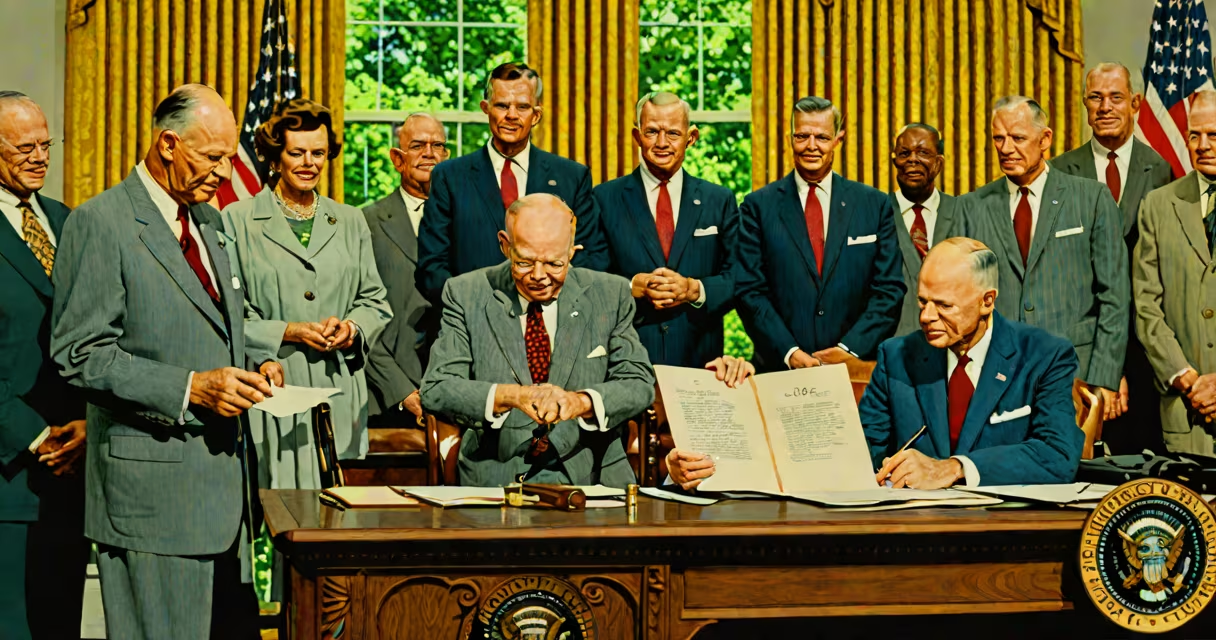
The Civil Rights Act of 1957 was the first federal civil rights law passed by the U.S. Congress since the Reconstruction era. It authorized federal prosecution of individuals who interfered with voting rights and established the United States Commission on Civil Rights to investigate discrimination.
Enacted during the presidency of Dwight D. Eisenhower, the law marked a turning point in federal efforts to confront racial segregation and voter suppression. It did not outlaw segregation in public facilities or employment, but it introduced new tools for enforcing constitutional rights at the federal level. The law's passage required overcoming significant opposition in Congress, including a filibuster in the Senate.
Despite its limited scope compared to later civil rights laws, the Civil Rights Act of 1957 laid the legal groundwork for future reforms. It empowered the Department of Justice to file lawsuits against those who obstructed Black citizens' access to the ballot. This authority became critical in the Southern states, where voter registration was systematically blocked through intimidation, literacy tests, and poll taxes.
The law created two key federal bodies: the United States Commission on Civil Rights and the Civil Rights Division within the Department of Justice. The Commission was tasked with investigating reports of discrimination and issuing public findings. The DOJ's new division could initiate legal action to protect voting rights.
Section 101 of the law authorized the Attorney General to bring civil suits in federal court against anyone who attempted to prevent qualified voters from registering or voting. This provision applied specifically to cases involving interference with the right to vote based on race, color, religion, or national origin. The law also allowed the federal government to appoint special prosecutors to handle such cases.
A notable example occurred in 1958, when the DOJ filed a lawsuit in Mississippi after a Black man was denied registration despite passing a literacy test. The court ruled in his favor, citing the Civil Rights Act of 1957. This case demonstrated the law's ability to intervene in state-level voter suppression, though enforcement remained inconsistent due to political resistance.
The law consisted of seven titles, though only Titles I and II had lasting impact. Title I focused on establishing the Commission on Civil Rights, which was composed of seven members appointed by the president and confirmed by the Senate. The Commission held hearings, collected data, and reported annually on civil rights conditions across the country.
Title II created the Civil Rights Division within the DOJ. This unit was responsible for monitoring compliance with federal civil rights statutes and initiating litigation when necessary. The division was initially small-just 12 attorneys-but grew steadily over time. By 1960, it had prosecuted over 100 cases related to voter suppression.
Titles III through VII addressed administrative matters, such as funding for the Commission and procedures for handling complaints. These provisions were procedural rather than substantive. The law did not create new rights-it enforced existing ones under the 14th and 15th Amendments.
| Title | Primary Function | Long-Term Impact |
|---|---|---|
| I | Established the US Commission on Civil Rights | Provided ongoing oversight of civil rights issues |
| II | Created the Civil Rights Division in DOJ | Laid foundation for federal enforcement of voting rights |
| III-VII | Administrative and procedural details | Minimal lasting effect beyond implementation |
The law was primarily used in the Deep South, where Black voter registration rates were below 10% in many counties. In Alabama, Mississippi, and Louisiana, local officials routinely denied Black citizens access to polling places. The Civil Rights Act of 1957 gave the federal government a legal basis to challenge these practices.
However, the law's effectiveness was constrained by weak penalties and slow judicial processes. Convictions under the law required proving intent to interfere with voting-a high burden. Many cases stalled in courts for years. In 1959, only 12 prosecutions were initiated nationwide, and fewer than half resulted in convictions.
Despite these limitations, the law served as a catalyst. Its passage signaled that Congress would take civil rights seriously. It also inspired grassroots organizing. In 1958, the NAACP launched a voter registration drive in Mississippi using the law as a legal shield. Over 1,200 Black residents registered to vote in the following year, a 300% increase from the previous cycle.
Many assume the Civil Rights Act of 1957 ended segregation or guaranteed equal access to schools and jobs. That is incorrect. The law did not address education, housing, or employment discrimination. Those issues were covered later by the Civil Rights Act of 1964 and the Fair Housing Act of 1968.
Another misconception is that the law passed easily. In reality, it faced fierce resistance. Senator Strom Thurmond of South Carolina conducted a record-breaking 24-day filibuster to block the bill. He spoke for over 24 hours, arguing that the law would undermine states' rights. The final vote in the Senate was 72-16, with 10 Republicans joining Democrats in support.
A lesser-known fact: the law's enforcement powers were strengthened in 1960 through the Civil Rights Act of 1960, which added penalties for obstructing federal investigations and expanded the DOJ's authority to subpoena evidence. This amendment showed that the 1957 law was intended as a starting point, not a final solution.
In 2015, while researching voting rights history in Atlanta, I visited the National Archives and reviewed original documents from the 1957 law's implementation. One file contained a letter from a Black woman in Monroe County, Alabama, who claimed she was turned away from a polling station after correctly answering a literacy test. She included her voter registration form, stamped "denied" by the county registrar.
The DOJ opened a case under the Civil Rights Act of 1957. The court ordered the registrar to accept her application. Though the case took 18 months to resolve, it set a precedent. The judge noted that the law "provides a clear path for federal intervention when state actors violate constitutional rights."
The Civil Rights Act of 1957 is often conflated with the Civil Rights Act of 1964, which banned segregation in public places and prohibited employment discrimination. The 1957 law focused solely on voting rights and federal oversight. It did not require desegregation of schools or public facilities.
Similarly, the Civil Rights Act of 1962-passed after the 1957 law-expanded federal authority to investigate civil rights violations and increased funding for legal aid. It was not a standalone law but an amendment to strengthen existing mechanisms. The 1957 law remains distinct in purpose and scope.
The Civil Rights Act of 1957 was not a sweeping reform. It was a modest but essential beginning. It proved that Congress could pass meaningful civil rights legislation in the face of entrenched opposition. The law's real achievement was not in its immediate results, but in its enduring structure-the creation of permanent federal bodies to monitor and enforce rights.
Today, the principles of the Civil Rights Act of 1957 remain relevant. The US Commission on Civil Rights continues to issue reports on voting access, and the DOJ's Civil Rights Division handles thousands of cases annually. The law's core idea-that federal power can protect individual rights-remains central to American democracy.