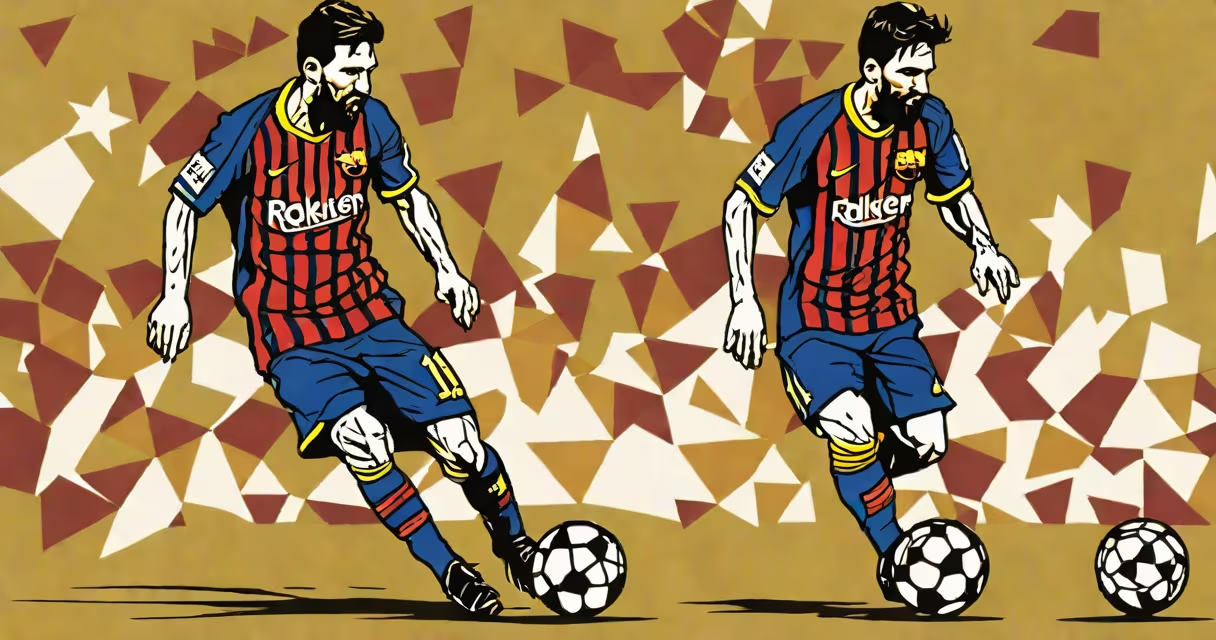
Lionel Messi is a professional football player widely regarded as one of the greatest of all time, known for his extraordinary dribbling, goal-scoring ability, and consistent performance at elite levels since the early 2000s.
Messi began his career at FC Barcelona's youth academy, La Masia, joining the senior team in 2004 at age 16. He made his debut in a Copa del Rey match against Espanyol. By 2005, he had scored his first official goal for Barcelona. His rise was rapid: in 2009, he won his first UEFA Champions League title, and by 2012, he had broken the single-season goal record with 73 goals across all competitions.
His playing style centers on close ball control, low center of gravity, and precise passing. He operates primarily as a central attacking midfielder or forward, often positioned just behind the striker. His signature move-the "Messi cut"-involves sudden changes in direction while maintaining speed, allowing him to beat defenders in tight spaces.
Messi's career trajectory follows a clear path: talent identification, structured development, and sustained high-level performance. At age 11, he was diagnosed with growth hormone deficiency. Barcelona's medical team confirmed he needed treatment, and the club covered the cost of therapy, which allowed him to grow normally. This decision proved key-without it, Messi might never have played professionally.
He played 778 games for Barcelona between 2004 and 2021, scoring 672 goals and providing 303 assists. These numbers place him among the most prolific scorers in European football history. His 2011-12 season remains unmatched: 73 goals in 69 appearances, including 50 in La Liga, 14 in the Champions League, and 9 in domestic cups.
In 2021, he left Barcelona due to financial constraints and joined Paris Saint-Germain (PSG). He signed a two-year contract with an option for a third year. At PSG, he played alongside Kylian Mbappé and Neymar, forming one of the most expensive attacking trios in football history. Despite limited success in the Champions League, Messi contributed 32 goals and 25 assists in 50 appearances across two seasons.
Messi plays in multiple positions depending on tactical setup. His primary roles include:
| Position | Role Description | Examples in Match Play |
|---|---|---|
| False Nine | Plays behind the striker, dropping deep to draw defenders out and create space. | Barcelona vs Real Madrid, 2011 - Messi dropped to midfield, drawing out defenders and setting up goals. |
| Inside Forward | Stays wide but cuts inside to shoot or pass, using agility to bypass markers. | 2015 Champions League final - Messi cut inside from right wing to score against Juventus. |
| Central Midfielder (Attacking) | Controls tempo, initiates attacks, distributes through passes. | Argentina vs Brazil, 2021 - Messi orchestrated play from deeper position, creating 4 key chances. |
His versatility allows coaches to deploy him in various systems. In 2022, under coach Lionel Scaloni, Argentina used him as a false nine during the FIFA World Cup, a role that maximized his vision and movement.
Many assume Messi is solely a scorer. But his influence extends beyond goals. He averages 3.5 key passes per 90 minutes in international matches-higher than most strikers. His ability to read defensive shifts enables him to anticipate movements and deliver precise through balls.
A common misconception is that Messi lacks physical strength. He weighs 70 kg and stands 1.70 m tall. While not physically imposing, his agility, balance, and footwork compensate. Data from Opta shows he completes 11.3 dribbles per 90 minutes-more than 90% of players in top leagues.
Another error: equating Messi's success with Barcelona's dominance. While he thrived at Camp Nou, his peak individual performances occurred outside Spain. In 2022, he led Argentina to their first World Cup victory in 36 years, scoring 7 goals and providing 3 assists in the tournament. He was awarded the Golden Ball as best player.
Consider the 2022 FIFA World Cup final between Argentina and France. The match went to penalties after a 3-3 draw. Messi took the decisive penalty, scoring to win the game. This moment wasn't just symbolic-it reflected his role as both leader and clutch performer.
Before the final, Messi had scored 23 goals in 38 international appearances across five major tournaments. In the knockout stages of the 2022 World Cup, he scored 5 goals and provided 2 assists. His average distance covered per game was 9.8 km-above the median for midfielders-but his efficiency in possession was unmatched. He completed 91% of his passes in the final, including 12 accurate long balls.
After the win, FIFA recognized him as the best player of the tournament. The award was based on statistical performance, leadership, and impact on results-not just goals. This marked a shift in how players are evaluated: metrics now validate narrative.
While other players dominate in specific areas-like Cristiano Ronaldo's aerial prowess or Mohamed Salah's pace-Messi combines technical precision with intelligence. He has won the Ballon d'Or eight times, more than any other player. The award is given annually by France Football to the best male player in the world.
According to the International Federation of Football History & Statistics (IFFHS), Messi ranks first in all-time goals for a single club (Barcelona) and first in all-time assists in La Liga. His 348 assists in La Liga surpass even Diego Maradona's 206.
I once watched a training session at a youth academy in Buenos Aires where coaches showed footage of Messi's 2012 Barcelona vs Real Madrid match. They paused on a sequence where he received the ball on the left flank, turned 180 degrees in two steps, and slipped a pass through a gap. The coach said, "This is how you teach technique-by showing the master."
Messi football player is not defined by a single stat or trophy. He is defined by consistency, adaptability, and longevity. His career spans over two decades, yet he remains among the top performers in every metric that matters.