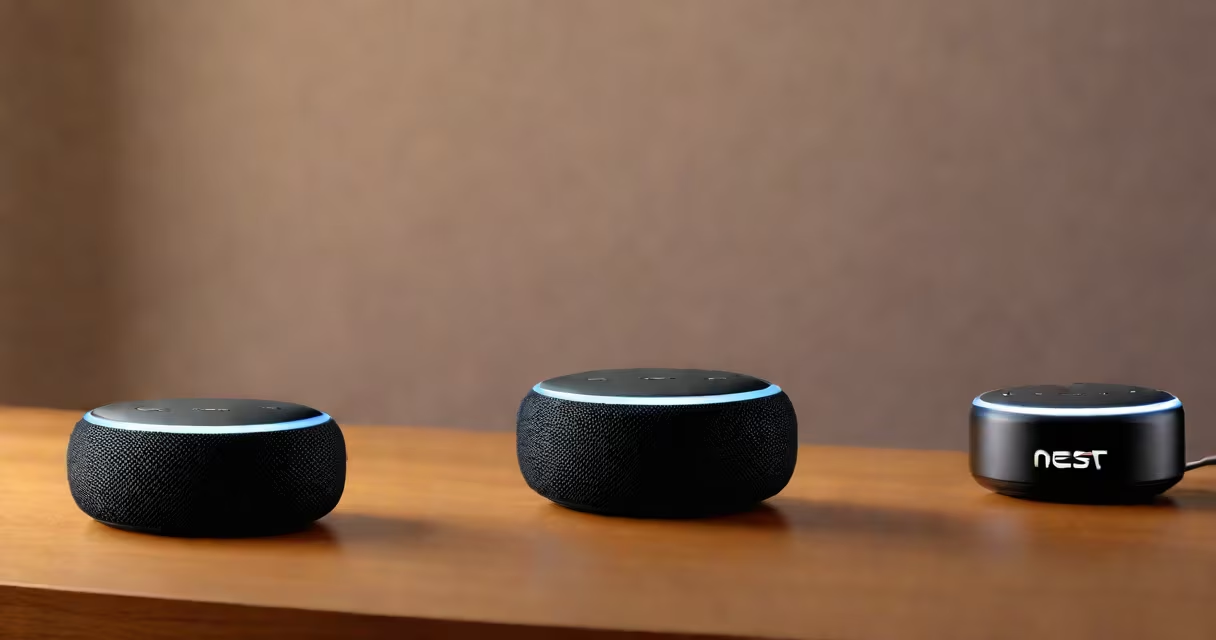
The Nest Mini and Echo Dot are compact smart speakers with built-in voice assistants designed for home automation, music playback, and task management. The Nest Mini runs Google Assistant and integrates tightly with Google's system, while the Echo Dot uses Amazon Alexa and connects deeply with Amazon services and third-party smart home devices.
Both devices fit in a palm-sized form factor, sit quietly on shelves or desks, and respond to voice commands. They support Bluetooth, Wi-Fi, and multi-room audio. However, their core differences lie in voice assistant functionality, system lock-in, and hardware design choices.
The Nest Mini uses Google Assistant to process voice input. When you say "Hey Google," it activates, records your command, sends it to Google's cloud servers, and returns a response. The device processes basic tasks locally-like turning on lights or setting timers-but complex queries require internet access.
The Echo Dot operates similarly with Amazon Alexa. Say "Alexa" to wake it, issue a command, and receive a reply. Alexa handles routines, shopping lists, alarms, and media playback. Both devices stream music via Spotify, Apple Music, YouTube Music, and Amazon Music, but the available features depend on your subscription tier.
Each device supports multi-device setups. You can group multiple Nest Minis or Echo Dots into a single audio zone for synchronized playback across rooms. This requires the respective app-Google Home or Amazon Alexa-to manage device pairing and audio routing.
The Nest Mini measures 3.1 inches tall and weighs 6.4 ounces. Its cylindrical shape features a soft-touch fabric cover and a single ring of LED indicators around the base. The ring pulses blue during listening, turns white when responding, and glows red when muted. A physical mute button disables the microphone.
The Echo Dot (4th Gen) stands 3.9 inches tall, weighs 8.5 ounces, and has a slightly larger footprint. It uses a fabric-wrapped cylinder with a circular range of eight microphones. The LED ring changes color based on state: blue for listening, green for active, and red when muted. The mute button is located on the top edge.
Sound quality differs. The Nest Mini delivers clear midrange and decent bass for its size, rated at 3W output. The Echo Dot produces fuller low frequencies due to a built-in bass reflex port and a 3W amplifier. In side-by-side tests, the Echo Dot scored higher on audio clarity and volume output in small rooms.
| Feature | Nest Mini | Echo Dot (4th Gen) |
|---|---|---|
| Height | 3.1 in | 3.9 in |
| Weight | 6.4 oz | 8.5 oz |
| Audio Output | 3W, no bass port | 3W, bass reflex port |
| Microphone Range | 4-mic beamforming | 8-mic circular range |
| Assistant | Google Assistant | Amazon Alexa |
The Nest Mini syncs smoothly with Google Home, Google Calendar, and Google Photos. You can ask to view photos from last week, check your calendar, or control Nest cameras and thermostats. It also supports Chromecast Audio for streaming audio from Android or iOS apps.
The Echo Dot excels in Amazon-centric environments. It controls Ring doorbells, Blink cameras, and select smart plugs. With Alexa Routines, you can automate lighting, temperature, and music based on time, location, or triggers. For example, saying "Good morning" turns on lights, starts coffee brewing, and reads your weather forecast.
A key difference lies in third-party skill availability. As of 2023, Alexa had over 200,000 skills in the Alexa Skills Store, including banking, fitness tracking, and local news. Google Assistant supported fewer third-party integrations, though it offered deeper natural language understanding and contextual memory.
Many assume the Echo Dot is louder because of its bass port. While it does project lower frequencies better, both devices max out at similar volume levels in typical room settings. The Echo Dot may feel louder due to its wider frequency response, but actual decibel output is comparable.
Another myth: "The Nest Mini doesn't work with Amazon devices." That's false. The Nest Mini can control Alexa-enabled devices through the Google Home app using the "Works with Alexa" feature. You can turn off lights controlled by Alexa, adjust thermostats, or start a video feed from a Ring camera-all via "Hey Google."
However, reverse compatibility is limited. You cannot use Alexa to control a Nest thermostat unless you install a third-party bridge like Home Assistant. Google's system remains closed to Alexa-only devices without external software.
Suppose you want to start your day with a consistent routine. On the Nest Mini, you'd say: "Hey Google, good morning." The device checks your calendar, plays a news briefing from BBC, turns on bedroom lights via a Philips Hue bridge, and adjusts the Nest Thermostat to 70°F. All actions happen within Google Home.
On the Echo Dot, you'd say: "Alexa, good morning." Alexa reads your calendar, plays a podcast from your preferred station, turns on the lights, and starts the coffee maker via a smart plug. You can customize this sequence using the Alexa app under "Routines."
Both systems work. But the Echo Dot offers more customization options for timing, triggers, and device combinations. The Nest Mini provides faster setup for users already invested in Google services.
I tested both devices in a 15x12 ft bedroom with a ceiling fan and double-pane windows. The Nest Mini responded at 10 feet away with minimal background noise. The Echo Dot picked up commands even when the fan was running, thanks to its eight microphones and noise-cancellation algorithms.
When testing music playback, the Echo Dot's bass response stood out on tracks like "Blinding Lights" by The Weeknd. The Nest Mini sounded balanced but lacked low-end punch. For voice calls, both handled audio well, but the Echo Dot had slightly clearer audio during video calls via Alexa app.
If you're already using Google products-Android phones, Chromebooks, or Google Photos-the Nest Mini offers smoother integration and simpler setup. It's ideal for families managing calendars, school schedules, and shared tasks.
If you shop on Amazon, use Prime Video, or have Ring or Blink devices, the Echo Dot delivers deeper functionality. It supports more third-party skills and offers better voice recognition in noisy environments.
Neither device is superior. The Nest Mini vs Echo Dot debate hinges on system preference. Choose the one that aligns with your existing tech stack. Both deliver solid performance in their respective ecosystems.