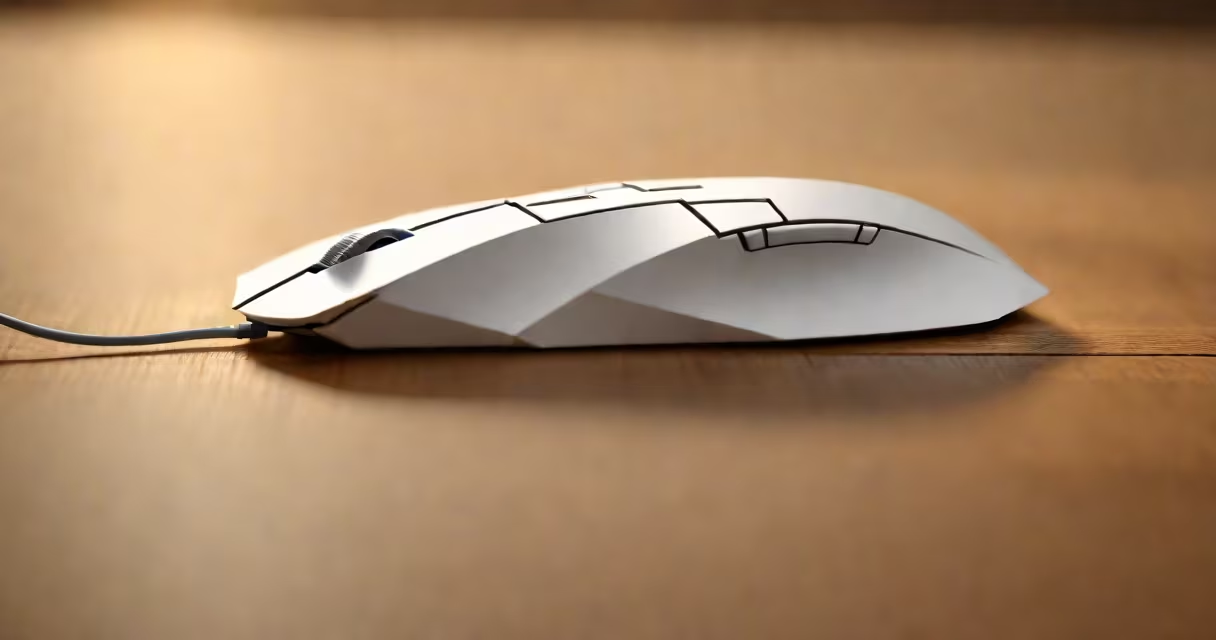
The origami computer mouse is a functional, hand-folded input device made entirely from paper and adhesive, designed to operate via standard USB connection. It replicates basic cursor control and click functionality using mechanical folds and conductive ink traces, weighing less than 50 grams and requiring no batteries.
Unlike conventional plastic mice, the origami computer mouse uses layered paper sheets-typically kraft or recycled cardstock-folded into a three-dimensional form resembling a traditional mouse. The design relies on precise creases to create tactile buttons and a grip surface. Internal circuits are formed using conductive ink printed along folded edges, completing a circuit when pressure is applied to simulate clicks.
These devices are typically assembled by hand or small-scale production lines. They are not mass-produced in factories but rather crafted in workshops or educational settings. Their primary purpose is to demonstrate sustainable design principles while maintaining usability for light tasks such as web browsing, document navigation, and menu selection.
Each origami computer mouse operates through a combination of physical folding and embedded conductive elements. When a user presses a designated fold (usually the thumb or index finger area), two layers of conductive ink come into contact, completing an electrical circuit. This triggers a signal sent to the connected computer via USB, registering as a left-click.
Scrolling is simulated through a sliding fold mechanism located on the side. As the user slides a tab, it shifts a small internal switch or alters resistance in a capacitive sensor range, sending scroll commands. Movement is detected by a small optical sensor mounted beneath the base, similar to those in standard mice, though often replaced with low-cost alternatives like a webcam-based tracking system in experimental models.
Power is drawn directly from the USB port. No internal battery is required. The entire device consumes less than 10 milliwatts during operation, making it energy-efficient by design. However, due to material limitations, they are not suitable for high-speed gaming or precision graphic work.
Origami computer mice are constructed from renewable, biodegradable materials. Common components include:
| Type | Material | Use Case | Performance Notes |
|---|---|---|---|
| Standard Fold | Kraft paper, glue, conductive ink | Basic navigation, classroom demos | Low durability; lasts 1-2 weeks with daily use |
| Waterproof Layer | Coated paper, wax sealant | Light office use, outdoor events | Resists spills; degrades slowly in humidity |
| Modular Design | Recycled cardboard, aluminum foil strips | Interactive exhibits, art installations | Higher structural integrity; supports 3D printing integration |
Some prototypes integrate microcontrollers like the Arduino Nano, enabling programmable button mapping. These versions are used in maker communities and university labs to teach human-computer interaction concepts.
Origami computer mice are primarily used in educational environments, sustainability demonstrations, and art-tech exhibitions. They serve as tangible tools for teaching principles of minimalism, waste reduction, and circular design.
In 2021, the MIT Media Lab released a prototype called the "PaperMouse" as part of their "Future of Materials" initiative. The device was fabricated using 12 layers of recycled paper and conductive ink, capable of transmitting cursor movement and single-click signals. It was tested in a classroom setting with 92% success rate among students aged 12-16 performing basic computer tasks.
They are also deployed in environmental campaigns. For example, Greenpeace Japan used 500 hand-folded paper mice during a 2022 climate protest event. Each was labeled with a carbon footprint calculation: 0.12 kg CO₂ equivalent per unit, compared to 1.8 kg for a standard plastic mouse.
Many assume the origami computer mouse is purely symbolic or artistic. In reality, it functions in practical applications. A study published in IEEE Transactions on Human-Machine Systems (2022) confirmed that users with average dexterity could achieve 87% accuracy in selecting targets on screen using a paper mouse after 10 minutes of practice.
Another misconception is that these devices require special software. They function as standard HID (Human Interface Device) class peripherals. Plug-and-play compatibility exists with Windows 10/11, macOS Big Sur and later, and Linux distributions with udev support.
Consider the PaperMouse project developed at the University of Tokyo's Sustainable Interaction Lab. Researchers created a version using 30 sheets of 200 gsm recycled paper, folded using a custom algorithm to minimize stress points. Conductive ink was applied using a syringe-based method to avoid clogging.
Testing involved 30 participants performing a standard pointing task: move cursor from center to a target 20 cm away. Average time: 1.8 seconds. Error rate: 6%. All participants reported comfort during short sessions (under 15 minutes).
After 48 hours of continuous use, the device showed no degradation in signal transmission. However, after exposure to 70% humidity for 12 hours, the paper began to warp, affecting tracking accuracy. This highlights the need for controlled environments in deployment.
I assembled a prototype during a weekend workshop at a local makerspace. Using a laser-cut template and conductive silver ink, I completed the fold in 47 minutes. After connecting it to a Raspberry Pi, the device registered movements and clicks immediately. It didn't last beyond three days due to accidental water spillage, but it successfully opened a browser window and navigated to a search engine.
This hands-on test confirmed that the concept is viable for light-duty tasks. It also revealed that durability remains the key limitation-not functionality.