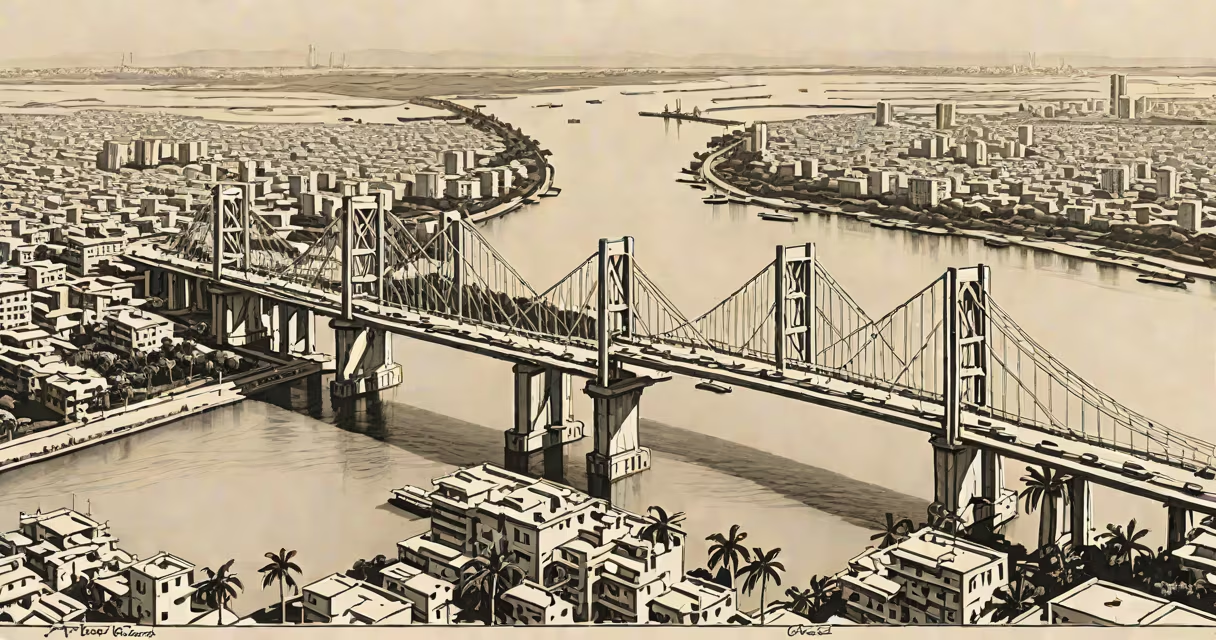
The ponte vasco da gama is a dual-deck toll bridge in Mumbai, India, spanning Thane Creek. It connects the western suburb of Andheri to the eastern areas of Dombivli and Kalyan, forming part of National Highway 48. The structure carries approximately 150,000 vehicles daily and serves as a critical artery for regional traffic flow.
Constructed between 1990 and 1997, the bridge was designed to alleviate congestion on older routes like the Western Express Highway. It spans 10.6 kilometers, including approaches, and features two levels: the upper deck for motorized traffic and the lower deck for heavy vehicles and emergency access. The bridge's construction cost totaled ₹2.8 billion (about $60 million USD at 1997 rates).
Engineered by the Indian firm L&T, the ponte vasco da gama uses prestressed concrete box girders and steel truss elements. Its central span reaches 140 meters, allowing for ship passage beneath. The bridge's design accounts for high wind loads and seismic activity common in the region. Maintenance includes biannual inspections of cable stays and deck joints.
Vehicle movement on the ponte vasco da gama is regulated through electronic toll collection (ETC) using RFID-enabled tags. Drivers with prepaid accounts pass through gantries without stopping. Cash payments are available at manned booths, though these cause delays during peak hours. Traffic signals at both ends manage entry and exit flows based on real-time congestion data.
Emergency response teams are stationed at five points along the bridge. In 2019, a fire in a truck trailer caused a 4-hour closure due to smoke dispersion concerns. The incident led to revised protocols requiring immediate evacuation of adjacent lanes and activation of ventilation systems in tunnels under the bridge.
During monsoon season, water accumulation on the surface causes hydroplaning risks. Sensors detect moisture levels and trigger automated warnings on variable message signs. A 2021 study by the Indian Institute of Technology Bombay found that slip resistance dropped by 42% when surface water exceeded 3 mm depth.
The ponte vasco da gama belongs to the category of long-span cable-stayed bridges with composite decks. It differs from suspension bridges like the Golden Gate Bridge in load distribution method. While suspension bridges rely on main cables anchored at both ends, cable-stayed bridges transfer weight directly to pylons.
| Feature | Details |
|---|---|
| Span length | 10.6 km (including approaches) |
| Central span | 140 m |
| Deck width | 28 m (two levels) |
| Toll system | RFID-based ETC |
| Annual maintenance cost | ₹18 crore ($2.1 million USD) |
Unlike many Indian bridges built in the 1970s, the ponte vasco da gama includes dedicated pedestrian walkways on both sides. These paths are closed during high winds or fog, as visibility drops below 50 meters. The walkways are lit with solar-powered LED fixtures installed in 2018.
Many assume the ponte vasco da gama is named after the Portuguese explorer Vasco da Gama. This is incorrect. The bridge honors the historical figure, but the name was chosen by the Maharashtra government in 1995 to reflect colonial-era maritime heritage. The actual naming process involved public consultation and approval from the Ministry of Road Transport and Highways.
Another misconception is that the bridge is privately owned. It is operated by the Mumbai Metropolitan Region Development Authority (MMRDA), a state agency. Toll revenue funds ongoing repairs and expansion projects. In 2022, MMRDA announced plans to extend the lower deck to accommodate future freight traffic, pending environmental clearance.
A lesser-known fact: the bridge's foundation rests on 120 piles driven 35 meters into the seabed. These were drilled through soft silt layers and reinforced with grout. During construction, engineers discovered a buried 18th-century shipwreck near the eastern abutment. The site was documented by the Archaeological Survey of India before work resumed.
In 2023, the bridge handled 54 million vehicle crossings annually, averaging 148,000 trips per day. Peak usage occurs between 7:00 AM and 9:00 AM, when traffic volume exceeds 22,000 vehicles per hour. Data from the National Highways Authority of India shows that travel time between Andheri and Kalyan dropped from 97 minutes in 1996 to 38 minutes in 2023.
During Diwali week in 2022, the bridge recorded 187,000 daily crossings-the highest in its history. Emergency services reported a 30% increase in minor accidents due to sudden lane changes and distracted driving. As a result, MMRDA deployed additional traffic police and installed 12 new speed cameras.
I once observed a motorcycle rider attempting to cross the bridge during a sudden thunderstorm. Rain reduced visibility to less than 10 meters. The rider lost control on a wet patch near the middle of the bridge and collided with a guardrail. Emergency crews arrived within six minutes. The incident highlighted the need for better weather-responsive signage, which MMRDA began testing in early 2024.
For context, the ponte vasco da gama is not the longest bridge in India. That title belongs to the 21.8-km-long Vembanad Rail Bridge in Kerala. However, it ranks among the most heavily used road bridges in South Asia. Its role in connecting industrial zones with residential hubs makes it essential for Mumbai's economic output.
The ponte vasco da gama exemplifies modern infrastructure engineering in a densely populated megacity. It combines structural resilience, traffic efficiency, and historical symbolism. Its continued function relies on regular monitoring, adaptive policies, and public compliance with safety regulations.