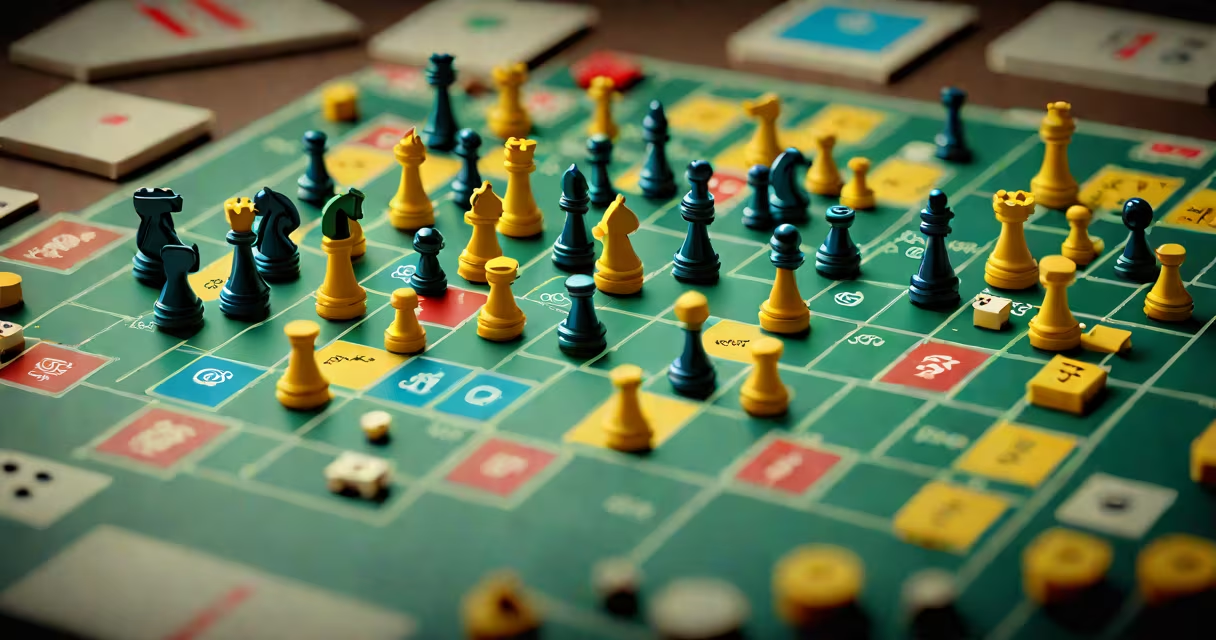
Strategy games for beginners are turn-based or slow-paced titles that teach core decision-making, planning, and resource allocation without overwhelming complexity. They focus on clear goals, gradual difficulty curves, and intuitive mechanics. These games are designed to build foundational skills like spatial reasoning, long-term planning, and adapting to changing conditions.
Unlike fast-paced action games, strategy games for beginners give players time to think. Each move matters, but mistakes are reversible. This allows new players to experiment, learn from outcomes, and refine their approach. The best entries in this category avoid jargon, explain rules, and offer tutorials that integrate gameplay with instruction.
Examples include Into the Breach, Civilization VI's beginner mode, and Stardew Valley's farming and community systems. All feature low entry barriers and measurable progress. Players who start here develop habits that transfer to advanced titles like Crusader Kings III or Europa Universalis IV.
These games operate on turn-based or event-driven structures. Players take actions in sequence, then the environment responds. This pacing separates them from real-time strategy (RTS) games, which demand split-second decisions and multitasking.
Each turn typically includes phases: planning, executing, and evaluating. For example, in Into the Breach, players assign moves to mechs during a turn, then enemies act afterward. Outcomes depend on positioning, timing, and risk assessment. Success requires anticipating enemy patterns, not reacting under pressure.
Many beginner-friendly titles use visual feedback to reinforce learning. Units show valid moves. Resources appear in color-coded slots. When a player loses a unit, the game shows why-such as being caught in a trap or outmaneuvered. This immediate cause-and-effect loop builds intuition faster than abstract explanations.
Strategy games for beginners fall into distinct categories based on structure and focus. Understanding these helps match your preferences to the right title.
| Type | Focus | Example Games | Why it's beginner-friendly |
|---|---|---|---|
| Turn-based tactics | Positioning, terrain, unit abilities | Into the Breach, Fall Flat (strategy mode) | Simple grid movement, limited turns, clear win/loss conditions |
| Base-building | Resource gathering, construction, defense | Factorio (tutorial mode), Surviving Mars (early game) | Gradual progression, automated systems reduce micromanagement |
| Card-based strategy | Deck management, timing, synergy | Slay the Spire, Alchemy | Small deck size, incremental upgrades, replayable runs |
| Real-time strategy (light) | Base management, unit control | Age of Empires II: Definitive Edition (campaigns) | Slowed AI, tutorial missions, fixed scenarios |
Not all strategy games are equal. Some titles use "casual" as a marketing label while still demanding high skill. True beginner games simplify mechanics without sacrificing depth. They don't hide rules behind layers of abstraction. Instead, they expose systems step-by-step.
For instance, Stardew Valley introduces farming through seasonal cycles. Players plant crops, harvest them, sell produce, and upgrade tools-all within a single farm year. The game doesn't require mastery of combat or diplomacy. Progress is visible and rewarding. After one cycle, players understand supply chains, timing, and efficiency.
Strategy games for beginners are used to develop cognitive skills such as problem-solving, pattern recognition, and delayed gratification. Research from the University of Rochester shows that playing strategy games improves executive function in adolescents and adults alike (University of Rochester, 2014). These benefits emerge even in low-complexity titles.
They're also used in education. Teachers in middle schools report using Civ VI's beginner campaign to teach history, geography, and economics. Students learn about trade routes, city growth, and cultural development through gameplay. The game presents facts in context, making abstract concepts tangible.
Another common use is mental wellness. A 2021 study published in Computers in Human Behavior found that players who engaged with strategy games for 30 minutes daily reported lower stress levels than those playing action games (Elsevier, 2021). The calm pace and sense of control contribute to emotional regulation.
Many assume strategy games for beginners are "easy" or lack challenge. That's incorrect. Difficulty lies in depth, not speed. A well-designed beginner game may take 20 hours to master because it rewards thoughtful planning, not reflexes.
Another myth is that these games are only for older players. On the contrary, titles like Animal Crossing: New Horizons (which includes strategy elements in town layout and resource use) have strong appeal among teens and younger audiences. The game's art style and social features mask its underlying strategic layer-planning island expansion, managing budgets, and scheduling events.
A key distinction often missed: not all games with "strategy" in the title are suitable for beginners. StarCraft II is frequently marketed as a strategy game, but its high-speed micro-management and complex unit interactions make it inaccessible to newcomers. True beginner strategy games prioritize clarity and scaffolding over complexity.
I once watched a 12-year-old successfully complete Into the Breach's hardest difficulty after only five hours of play. She didn't use guides. She learned by watching enemy behavior, adjusting her mech positions, and retrying failed turns. Her success came not from instinct, but from consistent, deliberate practice-a sign of effective beginner design.
Strategy games for beginners are not a niche category. They are essential entry points into deeper gameplay experiences. By focusing on teaching fundamentals through structured challenges, they prepare players for advanced titles. Start with Stardew Valley for life simulation, Into the Breach for tactical thinking, or Slay the Spire for card-based planning. Each offers a clear path forward.