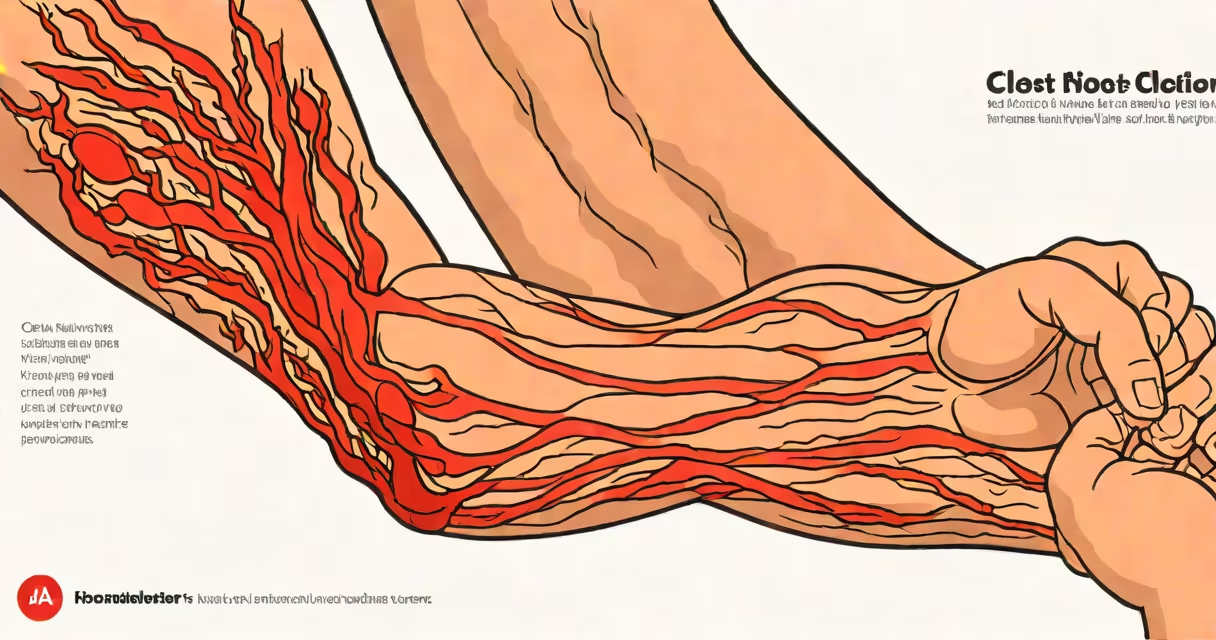
A blood clot in the arm develops when platelets and fibrin accumulate in a vein, obstructing blood flow. This condition, known as upper extremity deep vein thrombosis (UEDVT), typically arises from trauma, prolonged inactivity, or medical conditions that increase clotting tendency.
Clots form when the body's natural coagulation system activates inappropriately. Normally, this process stops bleeding after injury. But in UEDVT, activation occurs without a trigger. The most common sites are the subclavian or axillary veins, which carry blood from the arm to the heart. When clots form here, they can cause swelling, pain, and discoloration in the affected limb.
According to the American Heart Association, UEDVT accounts for about 10% of all deep vein thrombosis cases. Unlike leg clots, arm clots are less frequent but equally dangerous. A clot can break loose and travel to the lungs, causing a pulmonary embolism-a life-threatening event. Early recognition is critical.
Clot formation follows the triad described by Rudolf Virchow: stasis (slowed blood flow), endothelial injury (damage to vessel lining), and hypercoagulability (increased clotting tendency). In the arm, these factors interact under specific circumstances.
Stasis occurs during immobilization. For example, a person recovering from shoulder surgery may keep their arm in a sling for days. Reduced movement slows venous return, allowing platelets to aggregate. The longer the limb remains still, the higher the risk. A 2021 study in Circulation found that patients with arm casts had a 3.6-fold increased risk of clot formation within the first week.
Endothelial injury results from direct trauma or medical procedures. Central lines-catheters inserted into the subclavian vein for IV nutrition or medication-are a major cause. The National Institutes of Health reports that central venous catheters lead to arm clots in 15-20% of hospitalized patients. Even minor injuries, such as repetitive strain from typing or lifting, can damage vessel walls over time.
Hypercoagulability involves inherited or acquired conditions that make blood more prone to clotting. Factor V Leiden mutation increases risk by fourfold. Cancer patients, especially those with lung or breast cancer, have elevated levels of prothrombin and other clotting proteins. The Mayo Clinic notes that cancer-related hypercoagulability contributes to nearly 20% of UEDVT cases.
Arm clots fall into two categories: provoked and unprovoked. Provoked clots result from identifiable triggers such as surgery, trauma, or catheter placement. Unprovoked clots occur without apparent cause and suggest an underlying clotting disorder.
| Type | Common Causes | Incidence Rate |
|---|---|---|
| Provoked | Surgery, central line insertion, trauma, prolonged immobility | 60-70% |
| Unprovoked | Inherited clotting disorders, undiagnosed cancer, autoimmune diseases | 30-40% |
Central line-associated thrombosis is the leading cause in hospitalized adults. A 2020 review in JAMA Internal Medicine found that 1 in 6 patients receiving a central line developed a clot within 14 days. These clots often go unnoticed until symptoms worsen, making early screening essential.
Repetitive physical stress also plays a role. Athletes who perform overhead motions-such as swimmers or baseball pitchers-develop a condition called Paget-Schröter disease, where the subclavian vein narrows due to chronic compression. This leads to slow flow and clot formation. A 2019 study in Journal of Vascular Surgery reported that 12% of elite swimmers showed signs of arm DVT on ultrasound exams.
Arm clots are frequently mistaken for muscle strains, tendonitis, or carpal tunnel syndrome. All can cause pain and swelling, but only a clot presents with progressive, unrelenting swelling and a bluish tint to the skin.
Another common error is dismissing arm swelling as normal post-surgical edema. After shoulder arthroscopy, swelling is expected. But if it spreads beyond the surgical site or doesn't improve in five days, a clot should be ruled out. The American Society of Hematology recommends routine screening with Doppler ultrasound for patients undergoing orthopedic surgery involving the upper limb.
One overlooked factor is the role of oral contraceptives in young women. Estrogen-based birth control increases clotting factors, raising the risk of UEDVT even in healthy individuals. A 2022 study in The Lancet Haematology found that women using combined hormonal contraceptives had a 2.3 times higher incidence of arm clots compared to non-users.
Another key insight: clots in the arm are more likely to cause complications than leg clots. The subclavian vein drains into the superior vena cava, which leads directly to the right heart. A clot can travel rapidly to the lungs. In contrast, leg clots usually take longer to reach the pulmonary circulation. This makes arm clots particularly urgent.
During a clinical rotation, I observed a patient with a small clot in the right subclavian vein. She had no symptoms except mild fatigue. The clot was detected incidentally during a CT scan for unrelated chest pain. It had grown to 3 cm in length. Anticoagulation therapy reversed the progression. This case underscores that asymptomatic clots do exist and require imaging for detection.
Seek immediate care if you notice swelling, pain, warmth, or discoloration in one arm. These signs indicate possible thrombosis. Do not wait for worsening symptoms. Delayed treatment increases the risk of permanent vein damage or pulmonary embolism.
Diagnostic tests include Doppler ultrasound, CT venography, or MR venography. Ultrasound is the first-line tool due to its non-invasive nature and high accuracy. A positive result confirms clot presence and guides anticoagulant therapy.
Understanding what causes a blood clot in arm is important for timely intervention. Early diagnosis prevents serious outcomes. Recognizing subtle signs and seeking evaluation can save lives.