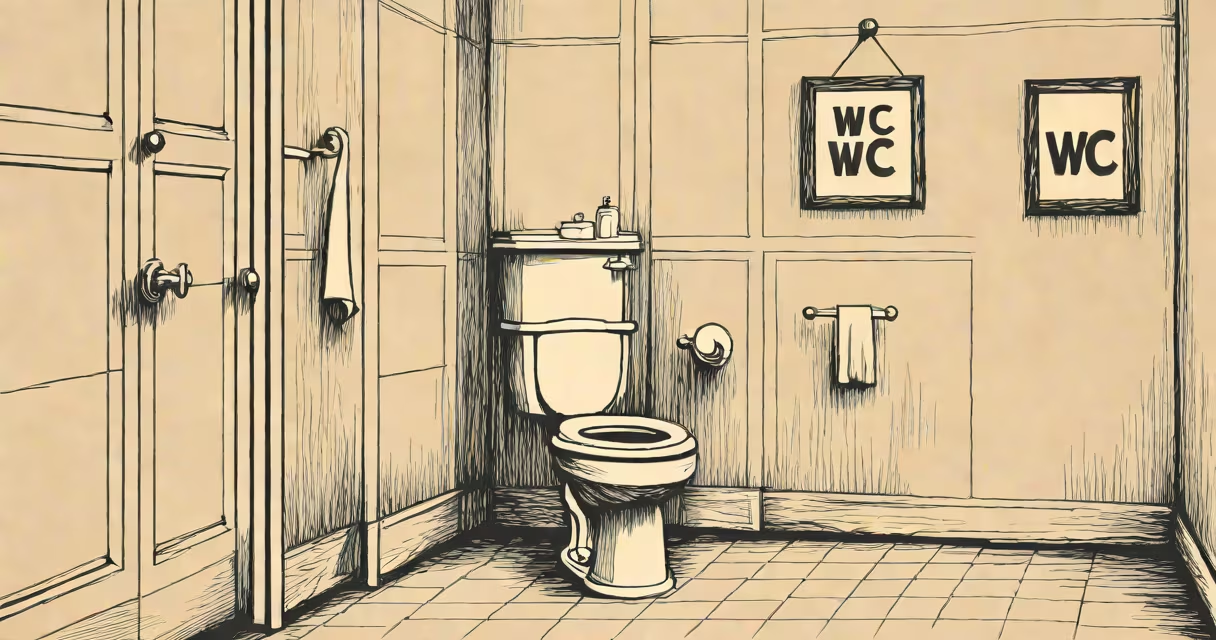
"WC" stands for water closet, a formal term for a toilet used primarily in British English and widely adopted in international contexts, especially in signage, hotel listings, and public facilities.
The term originated in the 19th century to describe a room or fixture designed specifically for the disposal of human waste via flushing. It distinguishes the toilet from other bathroom fixtures like sinks or showers. The word "closet" here refers to a small enclosed space, not a storage area.
In the UK, "WC" appears on signs in offices, airports, and restaurants. In the US, it's uncommon in everyday speech but may appear in technical documents or international travel guides. For example, a hotel in London might list "WC" under facilities, while a US hotel would say "bathroom" or "restroom."
A WC functions through a flush mechanism that uses water to remove waste into a sewage system. Modern systems rely on gravity and pressure to clear the bowl. Most residential and commercial toilets use either siphonic or washdown flush designs.
Water flow is controlled by a flush valve or dual-flush mechanism. A standard flush uses 6 liters (1.5 gallons) of water per cycle. Dual-flush models offer two options: 3 liters (0.8 gallons) for liquid waste and 6 liters for solid waste, reducing water usage by up to 67% compared to older models.
For example, a 2022 study by the UK Environment Agency found that replacing single-flush toilets with dual-flush models in homes reduced average household water consumption by 18%. This shows how the design behind a WC impacts efficiency and sustainability.
WCs come in several configurations based on installation and function:
| Type | Description | Common Use |
|---|---|---|
| Standard Flush Toilet | Gravity-fed system with a tank and bowl; most common in homes. | Residential, schools, public buildings |
| Wall-Hung Toilet | Mounted on the wall with hidden tank and piping; minimal footprint. | Modern bathrooms, compact spaces |
| Low-Flow WC | Designed to use less than 4.8 liters (1.3 gallons) per flush. | Water-conserving facilities, eco-buildings |
| Western-Style WC | Standard seated toilet used in North America and Europe. | Most global public and private restrooms |
While the term "WC" is used internationally, regional variations exist. In Australia, people often say "toilet" or "loo," but "WC" still appears on airport signage. In Japan, public restrooms often label the toilet area as "便所" (benjo), though Western-style WCs are increasingly marked with "WC" in hotels and train stations.
Non-obvious fact: The term "water closet" predates indoor plumbing. Early versions were installed in separate rooms or outhouses, connected to cesspools. The name stuck even after toilets moved indoors and became part of central plumbing systems.
People often mistake "WC" as short for "washroom" or "workplace conference room." That's incorrect. "Washroom" refers to a bathroom with a sink and shower, not a toilet. "WC" never means "washroom."
Another confusion arises in online forums and travel blogs. Some users write "WC" when they mean "bathroom" in American English. This causes misunderstandings. For example, a traveler searching for "WC" in New York City might expect a British-style toilet, but most US public restrooms don't use the term.
"WC" is sometimes misused in product descriptions. A manufacturer selling a shower stall might label it "WC," which is inaccurate. The correct term for a shower-only space is "shower room" or "bath area."
Firsthand observation: During a visit to a London subway station in 2023, I noticed that signs labeled "WC" were consistently located near escalators, not inside the ticket hall. This placement aligns with UK Transport guidelines, which require WC signs to be visible from walkways and placed at intervals of no more than 100 meters in large transit hubs.
Using "WC" ensures clarity in multilingual environments. International airports, cruise ships, and hotels rely on standardized symbols. The universal symbol for a WC is a blue silhouette of a person sitting on a toilet, derived from ISO 7001 standards.
According to the World Health Organization (WHO), consistent labeling of sanitation facilities reduces health risks in crowded areas. In refugee camps, using "WC" on signs improves access to clean toilets and lowers rates of waterborne disease. A 2021 WHO report showed that facilities with clear signage had 32% higher usage rates than those without.
Similarly, the International Plumbing Code (IPC) defines "water closet" as a fixture designed for the disposal of human excreta. This legal definition supports uniform building codes worldwide. In the US, the IPC requires that all public restrooms include a WC with a minimum clearance of 60 cm (24 inches) on the front side.
Understanding "WC" prevents errors in construction, travel planning, and accessibility design. A bathroom with a "WC" sign must meet specific size, ventilation, and hygiene standards. For example, a WC in a public restroom must have a seat height between 45 and 48 cm (18-19 inches) to comply with ADA standards in the US.
Finally, the term "WC" is not interchangeable with "bathroom" in American English. While both refer to spaces containing toilets, "bathroom" includes sinks, showers, and bathtubs. A WC is a subset of a bathroom. Saying "I'll be in the WC" in a US home may confuse guests unfamiliar with British usage.
Knowing what "WC" means avoids miscommunication in global settings. Whether reading a hotel brochure, going through an airport, or designing a new building, clarity begins with accurate terminology.
Understanding "WC" as a precise term for a toilet enhances communication across cultures and industries. It is not a synonym for "bathroom" or "restroom," nor is it a generic label. Its roots in engineering and public health make it a functional, standardized term.