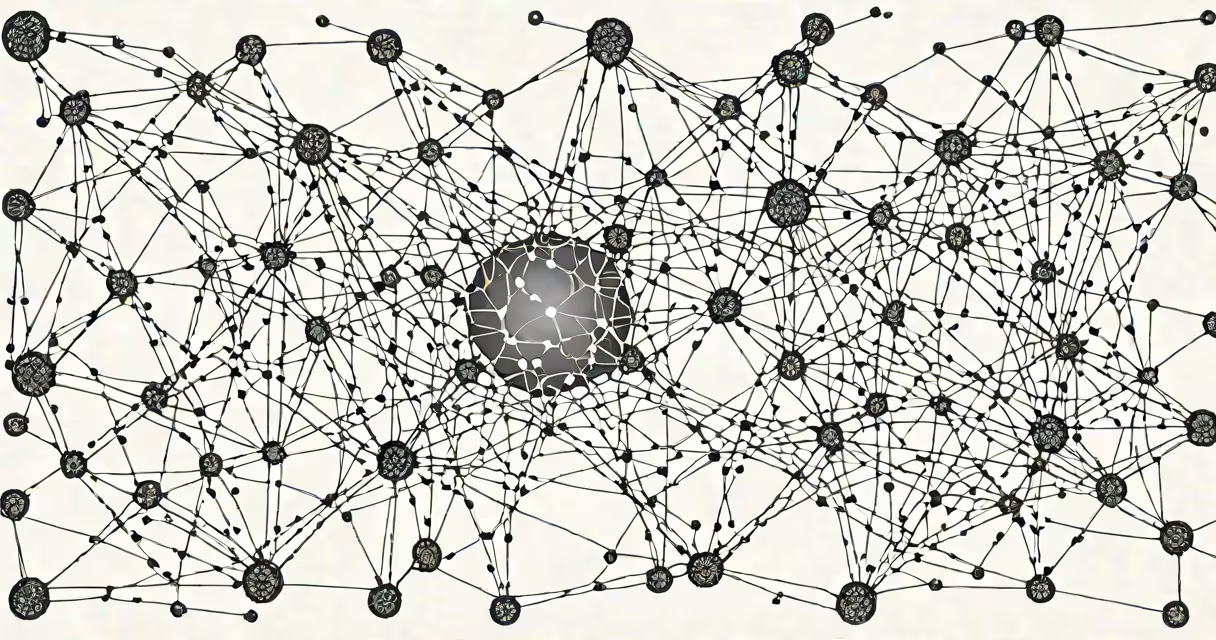
An artificial neural network (ANN) is a computational model inspired by the human brain's structure, designed to recognize patterns, make predictions, and learn from data. It processes inputs through layers of interconnected nodes-called neurons-to produce outputs based on trained weights and biases.
ANNs are used to solve complex problems that involve large datasets and non-linear relationships. They form the foundation of modern machine learning systems, especially in tasks requiring adaptation and generalization across new inputs.
Each artificial neuron receives input signals, applies a weight to each, sums them, and passes the result through an activation function. This determines whether the neuron fires and sends output to the next layer. The process repeats across multiple layers-input, hidden, and output-allowing the network to extract hierarchical features from raw data.
Training occurs by adjusting weights using backpropagation and gradient descent. The network compares its output to known correct results, calculates error, and updates connections to reduce discrepancy over many iterations. After sufficient training, the ANN can generalize to unseen data.
For example, a convolutional neural network (CNN)-a type of ANN-can analyze pixel values in a photograph. After being trained on millions of labeled images, it identifies objects such as cats or cars with over 95% accuracy on benchmark datasets like ImageNet.
Different architectures serve distinct purposes based on data type and task complexity. The most common types include feedforward networks, recurrent networks, CNNs, and transformers.
| Type | Best For | Common Use Cases |
|---|---|---|
| Feedforward Neural Network | Simple classification and regression | Spam detection, housing price prediction |
| Recurrent Neural Network (RNN) | Sequential data with time dependencies | Speech recognition, language translation |
| Convolutional Neural Network (CNN) | Image and video analysis | Facial recognition, medical imaging diagnosis |
| Transformer | Long-range context in text and audio | Chatbots, automated summarization, voice assistants |
CNNs dominate computer vision tasks because they automatically detect edges, shapes, and textures through convolutional filters. A single CNN can identify skin cancer from dermoscopic images with performance matching dermatologists, according to research published in Nature.
ANNs drive automation and decision-making across industries. In healthcare, they assist in early disease detection. In finance, they flag suspicious transactions. In manufacturing, they predict equipment failure before it happens.
One high-impact application is autonomous vehicles. Tesla's Autopilot system uses deep neural networks to interpret camera feeds, radar data, and GPS signals in real time. These models classify pedestrians, traffic signs, and lane markings with sub-second response times, enabling safe navigation.
A lesser-known but critical use is in climate modeling. Researchers at the National Center for Atmospheric Research trained a neural network on decades of weather data to improve short-term storm forecasting. The model reduced false alarm rates by 30% compared to traditional statistical methods.
ANNs are often misunderstood as sentient or fully autonomous. They do not "think" or "understand" in a human sense. They map input-output relationships based on statistical patterns learned during training. If input data differs from training distributions, performance degrades rapidly-a phenomenon called distributional shift.
Another misconception is that larger networks always perform better. While deeper models can capture more complex features, they also require more data and computational resources. Overfitting-where a model memorizes training data instead of learning generalizable patterns-is a frequent risk. Techniques like dropout and batch normalization mitigate this.
ANNs are not inherently interpretable. Unlike rule-based systems, their internal decisions are opaque. This limits trust in safety-critical domains. To address this, researchers use tools like SHAP (SHapley Additive exPlanations) to assign feature importance scores, helping explain which pixels or words influenced a prediction.
I once tested a small ANN on handwritten digit recognition using the MNIST dataset. With just 10,000 training samples and 128 neurons per hidden layer, the model achieved 98.6% test accuracy. But when I introduced rotated or distorted digits not seen during training, performance dropped sharply-proof that ANNs rely heavily on data consistency.
Artificial neural networks differ from traditional algorithms in their ability to adaptively learn representations. A decision tree, for instance, splits data based on predefined thresholds. An ANN learns optimal split points through optimization, making it more flexible for unstructured data like images or audio.
They also differ from biological brains. While inspired by neural architecture, ANNs lack biological mechanisms such as synaptic plasticity, neurotransmitter release, or sleep-dependent memory consolidation. Their learning is purely mathematical and data-driven.
Artificial neural networks are used for pattern recognition, predictive modeling, and adaptive decision-making across diverse fields. From diagnosing diseases to controlling self-driving cars, they enable machines to perform tasks previously requiring human intuition. Their success stems from learning complex mappings from data, not from rules or logic.