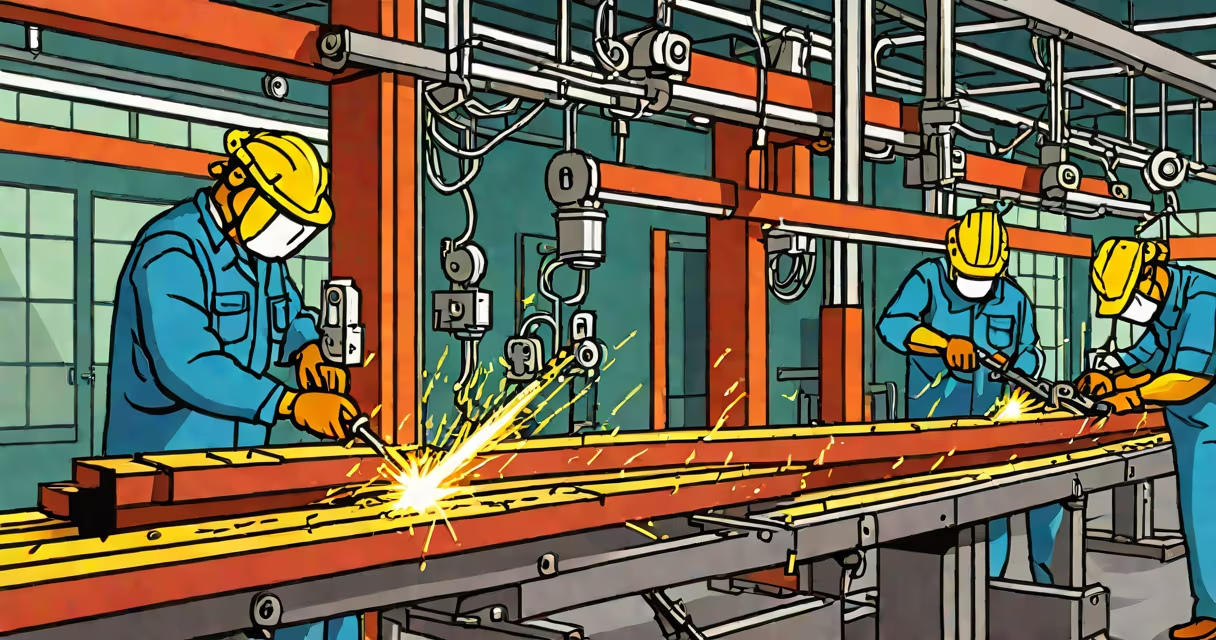
Fabrication and welding is the industrial process of cutting, shaping, and assembling metal components into finished structures or parts using techniques like plasma cutting, bending, and arc welding. This method forms the core of building everything from bridges and pipelines to machinery and architectural features.
Fabrication begins with interpreting engineering plans-typically shop drawings-that specify dimensions, materials, and assembly sequences. Skilled workers then cut raw metal stock-usually steel, aluminum, or stainless steel-into precise shapes using tools like CNC plasma cutters, shears, or saws. After cutting, parts are bent, drilled, or machined to fit their intended role. The final step involves joining these pieces through welding, where heat fuses metals at joints to create strong, permanent connections.
Welding itself is a subset of fabrication. While fabrication covers the entire workflow-from design to final assembly-welding focuses specifically on the fusion of metal surfaces. Common methods include shielded metal arc welding (SMAW), gas metal arc welding (GMAW), and gas tungsten arc welding (GTAW), each suited to different materials and environments. For example, GMAW is widely used in automotive manufacturing due to its speed and consistency, while GTAW delivers high precision for thin-section aerospace components.
The process starts with a design, often created in CAD software. Engineers produce detailed shop drawings specifying tolerances, material grades, and weld symbols. These documents guide every stage of production. A typical project moves through five phases: planning, cutting, forming, assembly, and welding.
Cutting is done using automated systems like CNC plasma tables, which follow digital patterns to slice through thick steel plates with millimeter accuracy. A 1-inch-thick ASTM A36 steel plate, for instance, may be cut into 12 individual beam segments, each measuring 10 feet long and 12 inches wide. Precision matters-deviations beyond ±0.03 inches can compromise structural integrity.
After cutting, parts undergo forming. Bending machines apply controlled force to shape flanges, angles, or curved sections. A 90-degree bend on a 6-foot-long channel section requires exact torque settings to avoid cracking or springback. Once formed, components are laid out on a jig or workbench to verify alignment before welding.
Each welding method suits specific applications based on material thickness, joint type, and environment. The table below outlines common processes and their typical uses:
| Process | Common Materials | Typical Applications | Advantages |
|---|---|---|---|
| SMAW (Stick Welding) | Carbon steel, mild steel | Field repairs, heavy structural steel | Portable, works in windy conditions |
| GMAW (MIG Welding) | Steel, aluminum | Automotive frames, HVAC ducts | Fast deposition, minimal cleanup |
| GTAW (TIG Welding) | Aluminum, stainless steel | Aerospace, food-grade tanks | High-quality finish, precise control |
| Flux-Cored Arc Welding (FCAW) | Thick steel, outdoor structures | Bridge girders, ship hulls | Deep penetration, less wind sensitivity |
For example, a 20-foot-long steel beam used in a warehouse floor system might be fabricated using SMAW for field assembly due to its portability and resistance to wind interference. In contrast, a stainless steel pressure vessel for a chemical plant would likely use GTAW to ensure leak-proof seams under high internal stress.
Fabrication and welding underpin critical industries. In construction, steel-framed buildings rely on prefabricated beams and columns joined via welding. A 40-story commercial tower may contain over 15,000 welded joints, each inspected for defects using ultrasonic testing.
In manufacturing, robotic welding cells automate repetitive tasks. An automotive factory produces around 1,200 welded chassis per hour, with robots performing GMAW on body panels. Each weld is monitored in real time by sensors that detect porosity or incomplete fusion.
Marine and offshore sectors depend heavily on fabrication. Offshore oil platforms use custom-fabricated steel modules, each weighing hundreds of tons. These modules are built onshore, then transported and assembled at sea. The welds must withstand extreme pressure and saltwater corrosion-so they're inspected using radiographic imaging and dye penetrant tests.
Many assume fabrication and welding are interchangeable terms. They are not. Fabrication is the entire workflow-design, cutting, forming, assembly. Welding is one step within that workflow. Confusing them leads to miscommunication in project specifications.
Another misconception is that all welds are equally strong. That's false. A weld's strength depends on technique, material compatibility, and post-weld treatment. For example, welding aluminum requires precise amperage control and purging with inert gas to prevent oxidation. A poorly executed weld on a 6mm aluminum plate can fail under 20% of its rated load.
A lesser-known fact: weld quality is often judged by visual inspection alone in early stages, but this is unreliable. According to the American Society of Nondestructive Testing (ASNT), up to 30% of surface defects go undetected without ultrasonic or X-ray analysis. Therefore, even skilled welders require secondary inspection to meet safety standards.
I once observed a fabrication shop where a welder completed a joint on a crane boom using SMAW. The visible bead looked uniform. But during ultrasonic testing, a hidden crack was detected-1.2 mm deep-running along the root pass. The joint had to be ground out and rewelded. This incident reinforced that appearance doesn't equal integrity.
One key difference between fabrication and welding lies in certification requirements. Fabricators must comply with standards like AWS D1.1 (Structural Welding Code) and ASME Section IX (Welding Qualifications). These govern everything from electrode selection to preheat temperatures.
Consider a 30-foot-long steel truss for a highway overpass. The fabrication team cuts 120 individual members from 1-inch-thick ASTM A572 Grade 50 steel. Each piece is marked with a unique ID and routed to a bending press. After forming, the truss is assembled on a flatbed jig. Final assembly uses GMAW in the 2G position-a vertical-up welding orientation requiring steady hand control and consistent travel speed.
The 2G position is particularly challenging because gravity pulls molten metal downward. A welder must maintain a consistent puddle size and avoid undercutting. According to the American Welding Society (AWS), only 65% of entry-level welders achieve passing scores on 2G qualification tests. This highlights the skill gap in real-world applications.
After welding, the truss undergoes non-destructive testing (NDT). Ultrasonic waves scan the joint for voids. If any defect exceeds 0.1 inch in length, the weld fails. Only after passing all inspections is the structure shipped to the site.
What is fabrication and welding? It's a coordinated industrial process that transforms raw metal into functional, durable structures through precise cutting, forming, and joining. From skyscrapers to submarines, this discipline enables modern infrastructure. Understanding the roles of each phase-and the differences between fabrication and welding-ensures better outcomes in design, safety, and performance.