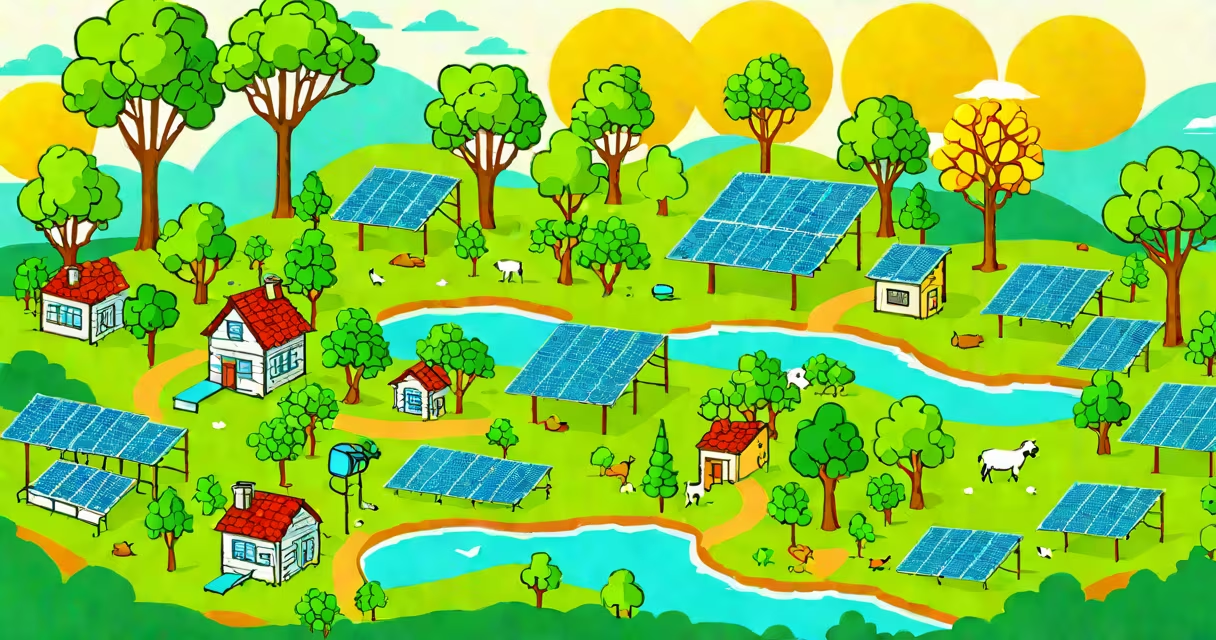
Sustainability of resources refers to managing natural assets-like water, forests, minerals, and energy-so they remain available and functional for current and future generations without degrading ecosystems.
This concept centers on maintaining ecological balance while meeting human demands. It's not about stopping resource use, but using them in ways that don't exceed renewal rates or cause irreversible harm. The goal is long-term viability, not short-term gain.
For example, harvesting timber at a rate below regrowth ensures forests continue to provide habitat, carbon sequestration, and raw materials. Overharvesting leads to deforestation, soil erosion, and loss of biodiversity-disrupting both environment and economy.
Sustainability of resources operates on three core principles: environmental protection, economic feasibility, and social equity. These form the foundation of sustainable development, as defined by the United Nations' Brundtland Report (1987).
Environmental protection means limiting extraction to levels that allow natural systems to recover. For instance, fishing quotas based on fish population models prevent overfishing. The Food and Agriculture Organization (FAO) reports that 36% of global fish stocks were overexploited in 2020-highlighting the gap between current practices and sustainable management.
Economic feasibility helps resource use supports livelihoods without exhausting supply. A community relying on groundwater for agriculture must monitor usage to avoid aquifer depletion. In California's Central Valley, over-pumping led to land subsidence exceeding 30 cm in some areas between 1925 and 1977-demonstrating long-term consequences of unsustainable use.
Social equity ensures fair access and benefit distribution. Indigenous communities often manage forests sustainably through traditional knowledge. Research from the World Resources Institute shows that lands managed by Indigenous peoples have lower deforestation rates than protected areas managed by governments.
Resources fall into two categories: renewable and non-renewable. Sustainability applies differently to each.
| Type | Examples | Sustainability Approach |
|---|---|---|
| Rare earth metals | Neodymium, cobalt | Recycling and substitution in electronics reduce mining pressure. |
| Freshwater | Rivers, aquifers | Water pricing, drip irrigation, and watershed protection maintain supply. |
| Forest biomass | Timber, paper pulp | Controlled logging cycles and reforestation preserve forest health. |
| Oil and gas | Crude petroleum, natural gas | Transition to renewables reduces dependency; carbon capture may offset emissions. |
Renewable resources such as solar and wind energy are inherently sustainable when deployed at scale. Solar farms in Nevada generate enough electricity annually to power over 100,000 homes without emitting greenhouse gases-proving that energy can be both abundant and low-impact.
Non-renewable resources require careful stewardship. The U.S. Energy Information Administration notes that domestic oil production peaked in 1970 and has since declined despite technological advances. This illustrates that even with innovation, finite supplies eventually diminish unless replaced.
Many assume sustainability means halting industrial activity. That's incorrect. Sustainable resource use allows development-but within ecological boundaries. The key difference lies in timing: sustainability avoids trade-offs that burden future generations.
Another misconception is equating sustainability with "green" branding. A product labeled "eco-friendly" may still rely on unsustainable sourcing. For example, palm oil used in cosmetics is often linked to rainforest destruction in Indonesia and Malaysia-even when marketed as "natural." The Roundtable on Sustainable Palm Oil (RSPO) certifies only 20% of global palm oil as sustainable, showing that labeling alone doesn't ensure responsible use.
A lesser-known but critical point: sustainability isn't static. It requires continuous monitoring and adaptation. Climate change alters rainfall patterns, affecting crop yields and water availability. In sub-Saharan Africa, changing precipitation trends have reduced maize yields by up to 20% since 2000-forcing farmers to adjust planting schedules and crop choices to maintain food security.
In 2018, the city of Copenhagen launched a district heating system powered entirely by waste-to-energy plants and geothermal sources. The system supplies heat to over 98% of homes in the city center, reducing reliance on fossil fuels. This model demonstrates how urban infrastructure can integrate multiple sustainable resource strategies-waste reuse, renewable energy, and centralized efficiency.
I visited a small-scale dairy farm in Vermont that uses rotational grazing and composting to manage manure. Their cows rotate pastures every 14 days, allowing grass to regenerate. Manure is collected and composted, then returned to fields as fertilizer. Soil tests show a 40% increase in organic matter over five years. This closed-loop system maintains productivity while improving land health-proof that sustainability is achievable at the local level.
These cases reflect a broader trend: successful sustainability integrates science, policy, and community action. The European Union's Common Fisheries Policy, revised in 2013, introduced science-based catch limits and seasonal closures. Since implementation, cod populations in the North Sea have stabilized, reversing decades of decline.
Without sustainability of resources, economies face collapse. The 2010 collapse of the Atlantic bluefin tuna fishery in the Mediterranean resulted in a 90% drop in catch volume within a decade due to unregulated overfishing. Recovery efforts now take 15 years or more per generation-highlighting the long-term cost of neglect.
Resource sustainability underpins climate resilience, food security, and economic stability. According to the Intergovernmental Panel on Climate Change (IPCC), sustainable land use can sequester up to 11 gigatons of CO₂ annually-equivalent to removing 2.5 billion cars from roads.
When resources are managed sustainably, benefits compound. Cleaner air, stable water supplies, and preserved habitats improve public health and reduce disaster risk. Communities that invest in sustainable forestry see fewer wildfires and faster recovery after storms.
Understanding sustainability of resources isn't theoretical-it's operational. It shapes how we build cities, grow food, extract energy, and live together on a shared planet.