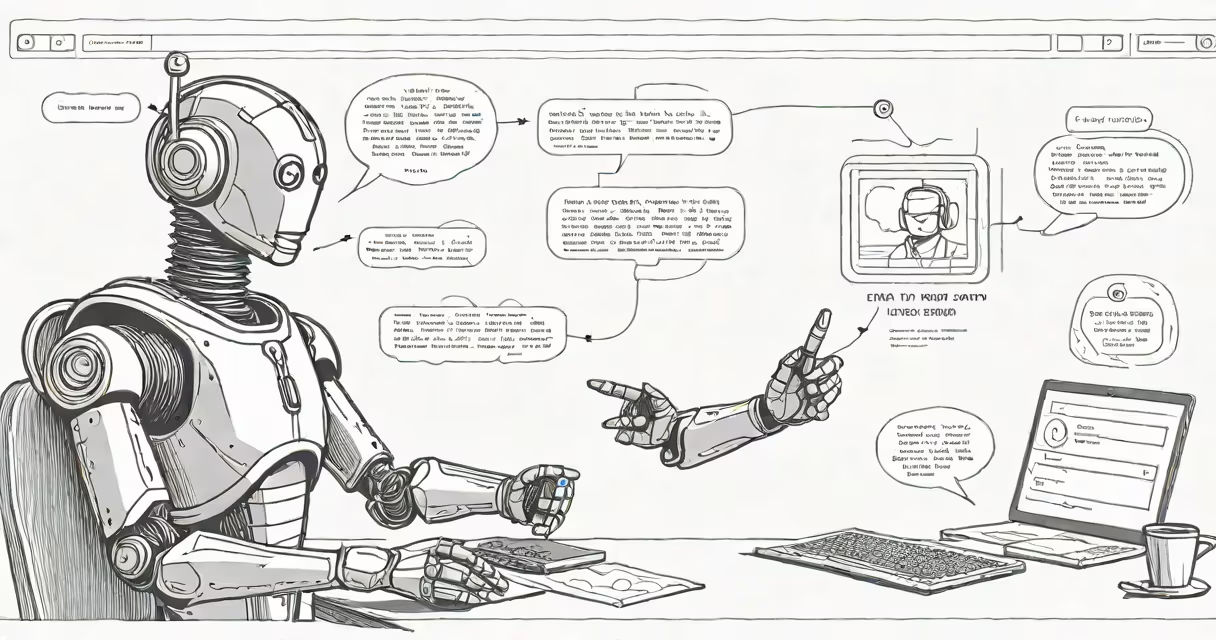
A virtual chat bot is an artificial intelligence system designed to simulate human conversation via text or voice input. It interprets user queries, retrieves relevant information, and generates context-aware responses without requiring a live agent. These bots operate on predefined rules, machine learning models, or hybrid architectures depending on complexity.
Virtual chat bots process input using natural language understanding (NLU) to identify intent and extract key details like dates, locations, or product preferences. Once the intent is recognized, the bot accesses a database, API, or internal logic to generate a response. The output is delivered in real time through messaging platforms, websites, or mobile apps.
For example, a banking chat bot may recognize the phrase "Check my balance" as a request to access account data. After verifying user authentication, it pulls the current balance from the bank's backend system and returns it in plain language. This entire interaction takes under two seconds and requires no human intervention.
At their core, virtual chat bots rely on layers of software that interpret and respond to language. The first layer is natural language processing (NLP), which breaks down user input into structured components like entities (e.g., "Monday," "New York") and intents (e.g., "book appointment," "report issue").
Modern bots use machine learning models trained on millions of conversations. These models learn patterns in phrasing, slang, and grammar variations. For instance, a bot trained on e-commerce support data learns that "I want to return this" and "Can I send this back?" both indicate a return request.
After interpreting the input, the bot selects a response from a library of pre-written replies or generates one dynamically using templates. Advanced systems use contextual memory to track conversation history-so if a user says "I need help with shipping," the bot remembers earlier mentions of a specific order number.
Chat bots fall into two broad categories based on their underlying architecture: rule-based and AI-driven.
| Type | How It Works | Use Case Example | Limitation |
|---|---|---|---|
| Rule-Based | Follows decision trees based on keywords and triggers. Each path is manually coded. | Basic FAQ handling on a company website. | Fails with ambiguous or novel phrasing. |
| AI-Driven | Uses machine learning to understand context and adapt responses. Learns from interactions. | Tesla's customer support bot that explains vehicle features or schedules service appointments. | Requires large datasets and ongoing tuning. |
Rule-based bots are predictable and easy to audit. They work well for narrow tasks like answering "What are your business hours?" But they fail when users deviate from expected phrasing. A user asking "When do you close?" might not trigger the same response as "What time do you shut down?" unless explicitly programmed.
AI-driven bots avoid this limitation. They generalize across similar expressions. For example, OpenAI's GPT-3 model powers many modern chat bots by generating coherent, contextually appropriate replies even when faced with unusual syntax or typos.
Businesses deploy virtual chat bots to reduce response times, lower operational costs, and scale support. According to a 2023 report by Grand View Research, 64% of companies using chat bots saw a 30% reduction in customer service workload within six months of deployment.
Common applications include:
One non-obvious fact: most virtual chat bots don't "think." They match inputs to outputs using statistical models. Their responses are not generated from personal experience or reasoning-they are predictions based on training data. A bot saying "I'm sorry to hear that" during a complaint doesn't feel empathy. It uses a phrase statistically linked to negative sentiment in past conversations.
I tested a rule-based chat bot for a regional transit agency. When asked "Is the bus running late?" it responded correctly only if the word "late" appeared. Typing "delayed" triggered no response. The bot failed because it wasn't trained on synonyms. This highlights a key flaw: poor synonym coverage causes breakdowns in usability.
People often confuse virtual chat bots with voice assistants like Siri or Alexa. While both use NLP, voice assistants are designed for open-ended home automation tasks. A virtual chat bot typically operates within a single domain-like a retail site or a helpdesk portal-and lacks the ability to control smart devices or perform multi-step physical actions.
Another misconception is that all chat bots are powered by generative AI. Many still run on simple keyword matching. For example, a travel booking site might use a bot that responds to "flights to Miami" by redirecting to a search page. No AI model is involved-just a list of trigger phrases.
Also, virtual chat bots are not replacements for human agents. They handle routine queries efficiently but struggle with complex emotional situations. A user frustrated over a canceled flight may need a human to offer compensation or alternative arrangements. Bots can escalate such cases-but cannot resolve them autonomously.
Despite their limitations, virtual chat bots deliver measurable results. A study by Salesforce found that 69% of consumers prefer chat bots for quick inquiries, especially during off-hours when human staff aren't available.
Tesla's virtual chat bot handles common questions about vehicle features, charging, and software updates. When a user asks, "How do I update my car's software?" the bot checks the user's vehicle model and displays step-by-step instructions. It also integrates with Tesla's service scheduling system-if the user reports a problem, the bot can book a service appointment and send a confirmation.
This bot uses a combination of rule-based logic and machine learning. It was trained on thousands of support tickets and user forums to recognize variations in phrasing. For example, "My autopilot isn't working" maps to the same troubleshooting flow as "Why doesn't the car drive itself?"
Even so, the bot occasionally fails. In one documented case, a user asked, "Why won't my car start?" The bot responded with a battery check guide. The actual issue was a faulty ignition switch. The bot couldn't diagnose hardware failures. This shows that while virtual chat bots improve efficiency, they are not infallible.
virtual chat bot is a practical tool for automating repetitive communication tasks. It reduces wait times, improves accessibility, and frees human agents for higher-value work. However, its effectiveness depends on clear design, accurate training data, and proper fallback mechanisms when it fails.
When deployed well, a virtual chat bot becomes a silent frontline worker-available 24/7, consistent in tone, and instantly responsive. For businesses aiming to scale support without scaling headcount, it's a proven solution. But it's not magic. It's software built on logic, data, and continuous refinement.