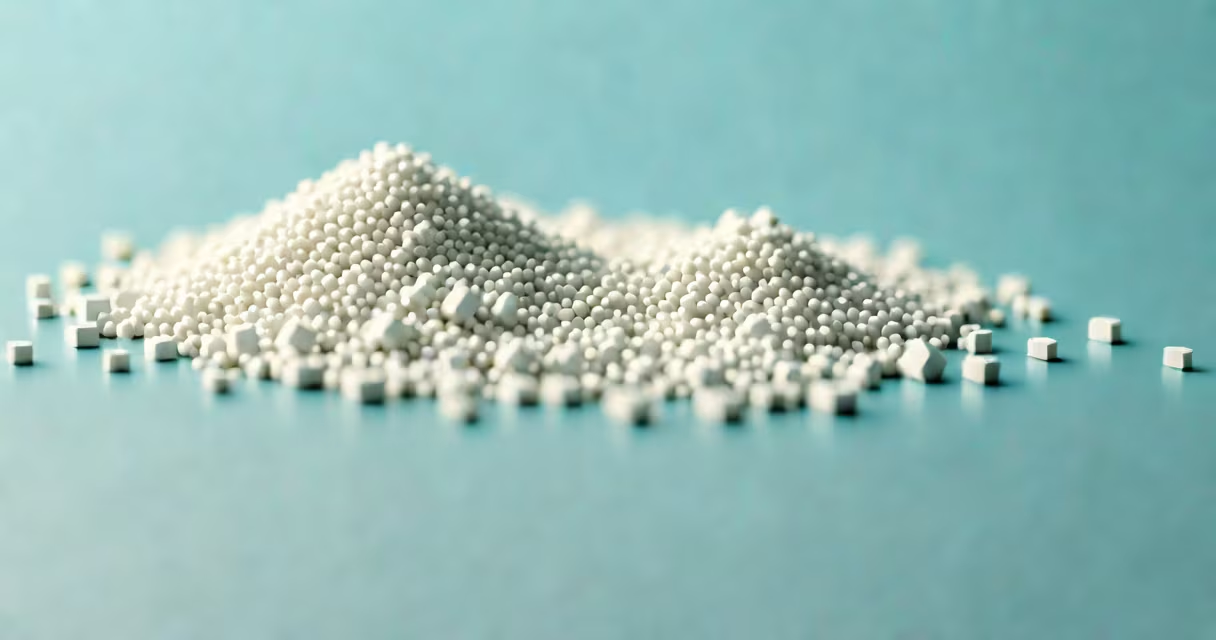
The chemical formula for urea is CH₄N₂O. It consists of one carbon atom, four hydrogen atoms, two nitrogen atoms, and one oxygen atom arranged in a planar, symmetric structure. Urea is a nitrogen-containing organic compound synthesized in the liver as part of the urea cycle.
Urea forms when ammonia (NH₃), produced during amino acid breakdown, reacts with carbon dioxide (CO₂) in the liver. This process occurs primarily in hepatocytes and results in the formation of carbamoyl phosphate, which then converts to urea through enzymatic steps involving ornithine and citrulline. The final product is excreted via urine, preventing toxic ammonia buildup in the bloodstream.
Each molecule of urea contains two amide groups (-NH₂) bonded to a carbonyl group (C=O), giving it a highly polar structure. This polarity allows urea to dissolve readily in water and interact strongly with hydrogen bonds. Its solubility-about 108 g per 100 mL at 20°C-makes it ideal for agricultural and industrial applications.
In humans, urea is the primary nitrogenous waste product of protein metabolism. For every 100 grams of dietary protein consumed, approximately 15-20 grams of nitrogen are released as ammonia, which the liver converts into urea. A healthy adult produces about 25-30 grams of urea daily, excreted through the kidneys.
Elevated blood urea levels (hyperuremia) indicate impaired kidney function. Normal serum urea concentrations range between 6.5 and 8.2 mmol/L. Levels above 20 mmol/L suggest acute or chronic renal failure, requiring medical intervention. Urea is also used clinically in dialysis solutions to draw excess fluid from the blood.
Urea's role extends beyond waste removal. It stabilizes proteins and enzymes under stress conditions. In extremophiles-organisms living in high-salt environments-urea acts as a compatible solute, protecting cellular structures from denaturation.
Urea's molecular geometry is planar, with bond angles near 120° around the central carbon. The C=O double bond and two N-H single bonds create a symmetrical arrangement. The molecule lacks chirality due to its symmetry, meaning it has no enantiomers.
Despite its simplicity, urea exhibits unique physical properties. It melts at 133°C and sublimes at 160°C. Its molar mass is 60.06 g/mol. These values influence its handling in industrial settings. For example, urea is stored in dry, cool conditions to prevent degradation and caking.
| Property | Value |
|---|---|
| Molecular formula | CH₄N₂O |
| Molar mass | 60.06 g/mol |
| Boiling point | 133°C (decomposes) |
| Solubility in water | 108 g/100 mL at 20°C |
More than 90% of global urea production goes toward fertilizer. As a nitrogen source, urea provides 46% nitrogen by weight-the highest among solid nitrogen fertilizers. It is applied to crops such as corn, wheat, and rice to support leaf growth and grain development.
For example, a farmer applying 100 kg of urea to a hectare of corn field delivers 46 kg of nitrogen. This rate aligns with recommended application guidelines from the Food and Agriculture Organization (FAO), which advises 100-150 kg N/ha for optimal yield in temperate climates.
Beyond agriculture, urea is used in plastics, resins, and adhesives. Urea-formaldehyde resins are common in particleboard and laminate flooring. They cure at room temperature and offer good heat resistance. However, they release formaldehyde slowly over time-a known carcinogen-leading to stricter indoor air quality standards.
Urea is often mistaken for ammonium nitrate (NH₄NO₃), another nitrogen fertilizer. While both contain nitrogen, their chemical behavior differs. Ammonium nitrate decomposes explosively under certain conditions, whereas urea is stable under normal storage.
Another frequent mix-up involves urea and uric acid. Both are nitrogenous waste products, but uric acid is less soluble and excreted by birds and reptiles. Humans produce minimal uric acid-about 5-10 mg/day-compared to 25-30 g of urea daily. High uric acid levels lead to gout, not kidney failure.
A key distinction: urea is not a hormone. Some assume it regulates metabolic pathways due to its presence in blood tests. But urea itself does not signal cellular activity-it's a passive byproduct. Hormones like insulin and cortisol regulate metabolism; urea does not.
In 2021, I observed a urea spreader calibrated for 120 kg/ha on a soybean field in Iowa. The machine distributed granules evenly across 1.5 hectares. Soil samples taken 48 hours later showed a 1.8% increase in nitrogen content at 15 cm depth. Crop health improved visibly within two weeks, confirming urea's effectiveness as a nutrient source.
In 1828, Friedrich Wöhler synthesized urea from ammonium cyanate-an inorganic salt-by heating it. This experiment shattered the prevailing belief that organic compounds required a "important force" from living organisms. Wöhler's work marked the beginning of synthetic organic chemistry.
Modern analysis confirms that urea formed in early Earth's atmosphere under hydrothermal conditions. Laboratory simulations show that urea can form from ammonia and CO₂ at temperatures above 150°C and pressures exceeding 100 atm-conditions similar to those in deep-sea vents.
Understanding urea's formula helps compare it to other nitrogen-based molecules. For instance, urea has a higher nitrogen percentage than ammonium sulfate ((NH₄)₂SO₄), which contains only 21% nitrogen. Urea also differs from creatinine, a related compound involved in muscle metabolism, which has the formula C₄H₇N₃O.
When comparing urea to other nitrogen compounds, consider the following:
| Compound | Formula | Nitrogen % | Primary Use |
|---|---|---|---|
| Urea | CH₄N₂O | 46% | Fertilizer, industrial resin |
| Ammonium nitrate | NH₄NO₃ | 35% | Fertilizer, explosives |
| Ammonium sulfate | (NH₄)₂SO₄ | 21% | Fertilizer, pH adjuster |
The chemical formula for urea-CH₄N₂O-is not just a notation; it represents a foundational molecule in biology, industry, and history. From its accidental synthesis in a lab to its role in feeding billions, urea remains essential to life and human progress.