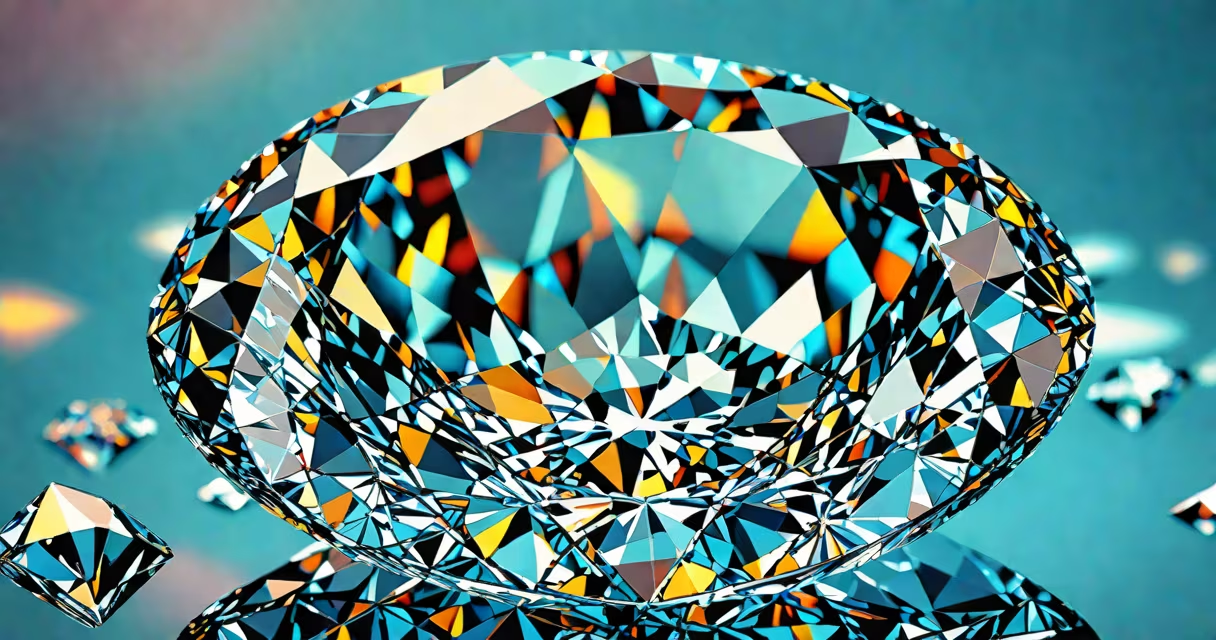
A VVS diamond denotes a high clarity grade in gemstone evaluation, meaning it contains extremely minor internal flaws (inclusions) or surface blemishes that are nearly impossible to see under 10x magnification. These imperfections are so small they do not affect light performance or visual appearance to the naked eye.
The term VVS stands for Very, Very Slight, a classification within the Gemological Institute of America's (GIA) diamond clarity scale. This grade sits just below Internally Flawless (IF) and above VS (Very Slightly Included). Only about 1% of diamonds achieve VVS clarity, making them rare and valuable.
When evaluating a VVS diamond, professionals examine the stone under 10x magnification using a jeweler's loupe or microscope. Inclusions may appear as tiny crystals, feathers, or pinpoints-so small they don't disrupt the diamond's brilliance or fire. The human eye cannot detect these features in normal lighting conditions.
Diamond clarity is assessed based on the size, number, position, and visibility of internal and external characteristics. A VVS diamond has inclusions so small and few that they are difficult even for trained graders to spot under standard inspection tools.
GIA divides VVS into two subcategories: VVS1 and VVS2. VVS1 diamonds have inclusions that are even rarer and typically located in less visible areas-often near the girdle or pavilion. VVS2 diamonds may have slightly more noticeable inclusions, but still invisible to the unaided eye.
For example, a VVS1 diamond might contain a single pinpoint inclusion near the lower girdle, while a VVS2 could have two tiny crystals clustered toward the bottom of the stone. Both grades meet the GIA's strict criteria for minimal impact on optical performance.
Not all VVS diamonds are equal. The distinction between VVS1 and VVS2 matters in both grading accuracy and market value.
| Grade | Inclusion Visibility (10x) | Typical Location | Market Value Relative to Other Grades |
|---|---|---|---|
| VVS1 | Extremely rare; often only visible with careful examination | Lower girdle, pavilion facets | Higher premium due to scarcity |
| VVS2 | Slightly more common; may require optimal lighting and angle | Upper girdle, near culet | Still high value, but less than VVS1 |
Both grades fall within the top 1% of diamonds by clarity. However, VVS1 stones command higher prices because their inclusions are less likely to be detected during inspection.
Real-world example: A 1.5-carat, D-color, round brilliant-cut diamond graded VVS1 sold for $12,400 at a 2022 auction. Its counterpart with the same carat weight, color, and cut-but graded VVS2-sold for $11,600. The $800 difference reflects the premium placed on superior clarity.
Clarity affects how light travels through a diamond. Inclusions scatter or absorb light, reducing sparkle and fire. While VVS diamonds have negligible impact on brilliance, their rarity increases desirability among collectors and high-end buyers.
According to the GIA, diamonds with VVS clarity exhibit no visible flaws under 10x magnification. This standard ensures consistency across global grading reports. The GIA's system is widely accepted as the most accurate benchmark in the industry.
Many consumers assume that higher clarity always means better appearance. But in practice, a VS1 diamond appears identical to a VVS diamond to the naked eye. The difference lies in technical precision, not visual perception.
Non-obvious fact: A VVS diamond can still have inclusions that affect durability. For example, a feather inclusion near the girdle may weaken the stone under stress. A VVS grade doesn't guarantee structural integrity-it only confirms invisibility under magnification.
People often confuse VVS clarity with diamond quality. Clarity is just one factor in the 4Cs: cut, color, carat weight, and clarity. A poorly cut VVS diamond will look dull, regardless of its clarity grade.
Another misunderstanding is that VVS diamonds are "perfect." They aren't. Even VVS1 diamonds contain microscopic imperfections. The label means the flaws are too small to see without magnification-not that the diamond is flawless.
I once examined a VVS2 emerald-cut diamond under a bench microscope during a jewelry appraisal. The inclusion-a tiny crystal-was visible only at a specific angle and with focused light. To the customer, it looked like a perfect stone. That's the power of VVS grading: it separates technical excellence from visual perfection.
Understanding where VVS fits in the hierarchy helps clarify its significance.
| Clarity Grade | Visibility Under 10x | Naked Eye Visibility | Approximate Rarity |
|---|---|---|---|
| Internally Flawless (IF) | No inclusions | None | ~0.1% |
| VVS1 | Extremely rare inclusions | None | ~0.5% |
| VVS2 | Rare inclusions; harder to find | None | ~0.5% |
| VS1 | Small inclusions; hard to see | None | ~3% |
| VS2 | Small inclusions; may be seen with effort | None | ~3% |
Only IF and VVS diamonds are considered high-grade clarity. The jump from VS to VVS represents a significant increase in rarity and cost-often 20-30% more per carat.
For perspective, a 1-carat, GIA-certified VVS1 diamond averages $15,000-$18,000 depending on color and cut. A VS1 of similar quality costs $10,000-$13,000. The price gap reflects the demand for near-perfect clarity.
When you hear "what does VVS diamond mean," remember: it describes a stone with strong clarity, where imperfections are undetectable without magnification. This grade is reserved for the rarest diamonds and commands a premium in the market.
While VVS diamonds offer no visual advantage over VS-grade stones, their rarity and technical precision make them highly sought after. They represent the upper tier of diamond quality, especially when paired with excellent cut and color.
Understanding the difference between clarity grades prevents overspending on features invisible to the eye. For those seeking maximum quality, a VVS diamond delivers unmatched precision. For others, a VS diamond offers the same beauty at a fraction of the cost.