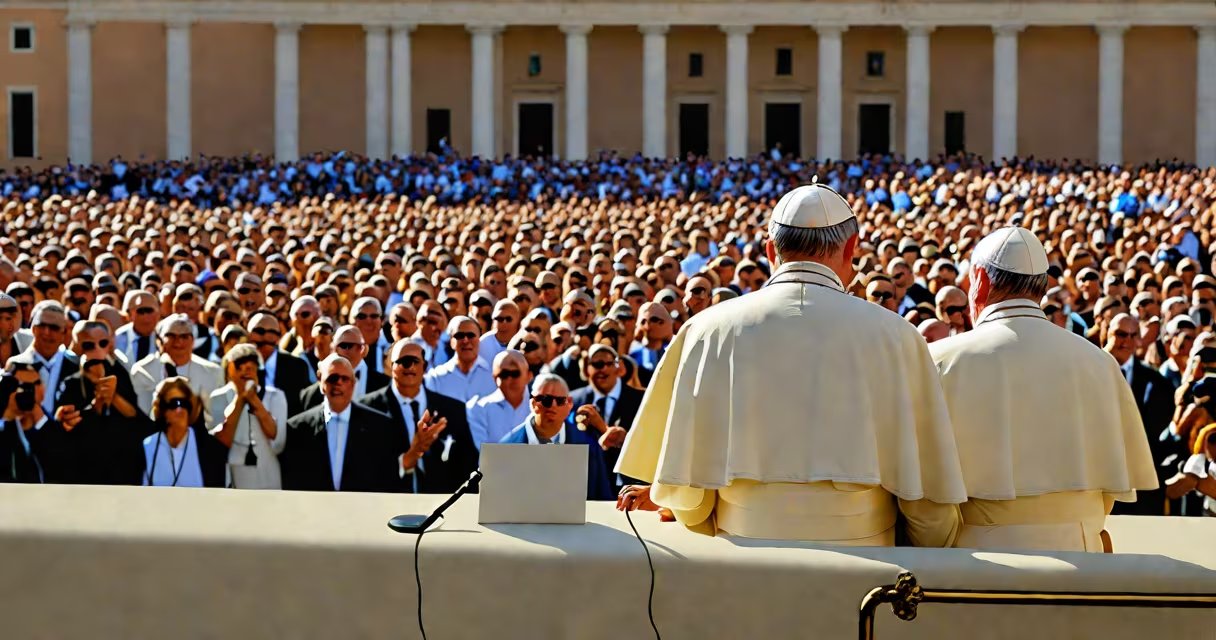
Pope Francis speaks Italian, Spanish, and Latin fluently, with functional knowledge of English and German. These languages reflect his Argentine roots, Jesuit training, and global role as head of the Roman Catholic Church.
Italian is the primary language of daily life in Vatican City. As the leader of the Catholic Church headquartered in Rome, Pope Francis uses Italian for official addresses, homilies, and internal communications. He delivers most speeches during weekly audiences and Sunday Angelus prayers in Italian, ensuring clarity for the local population and Vatican staff.
Spanish is Pope Francis's native language. Born Jorge Mario Bergoglio in Buenos Aires, Argentina, he grew up speaking Spanish. His early ministry in Argentina was conducted entirely in Spanish. Even after becoming pope, he frequently references Latin American theology, social justice themes, and cultural expressions rooted in his upbringing-often using Spanish in private conversations and interviews.
Latin remains the liturgical language of the Catholic Church. Pope Francis uses Latin in formal ceremonies, such as canonizations, consistory meetings, and papal blessings. He also delivered a major address in Latin during the 2016 Synod on the Family. While not his everyday language, Latin connects him to centuries of ecclesiastical tradition and ensures continuity with past popes.
Pope Francis has functional command of English and German. He has met with British leaders and addressed the United Nations in English during his 2015 visit. His English is clear and deliberate, though not fluent in casual conversation. During a 2017 meeting with German bishops, he spoke in German, demonstrating familiarity with the language despite limited public use.
He does not speak French, Arabic, or Chinese, though he has received interpreters for diplomatic visits to those regions. The Vatican relies on professional translation teams for multilingual outreach, especially during international events like World Youth Day or interfaith summits.
| Language | Primary Use | Frequency | Source |
|---|---|---|---|
| Italian | Daily Vatican operations, public speeches | Constant | Vatican website |
| Spanish | Personal expression, regional outreach, media interviews | High | BBC News - Pope Francis background |
| Latin | Liturgical rites, formal documents, theological discourse | Moderate | Catholic Culture - Latin in the Church |
| English | International diplomacy, UN addresses, global media | Occasional | UN General Assembly transcript, 2015 |
| German | Meetings with European religious leaders | Rare | Spiegel Online - 2017 visit |
His choice of language shapes perception. When he speaks in Spanish during a press conference, the message resonates deeply with Latin American Catholics. When he uses Latin in a solemn blessing, it reinforces continuity with centuries of tradition. His multilingualism is not just linguistic-it's strategic and symbolic.
Many assume Pope Francis speaks only Latin or Italian. This overlooks his deep connection to Spanish, which he uses in private reflections and sermons. Some believe he avoids English because of its global dominance, but he has used it deliberately in high-profile settings.
A key distinction: Pope Francis does not use sign language. Deaf communities have expressed interest in accessible papal messages, but no official signing interpretation is provided during public events. The Vatican does not currently offer live captioning or ASL interpretation for papal audiences.
Another misconception is that he speaks Portuguese. Though Brazil hosts the largest Catholic population in the Americas, Pope Francis has never learned Portuguese. He has met Brazilian cardinals and pilgrims through interpreters. His focus remains on Spanish and Latin for doctrinal precision.
In September 2015, Pope Francis addressed the United Nations General Assembly in New York. He delivered a 15-minute speech in English, with simultaneous translation available. The original text was written in Italian, then translated into English for delivery. He used simple, direct phrasing: "The earth is our common home."
This moment demonstrated how language functions in global leadership. The Vatican prepared the speech in Italian-his working language-then adapted it for English to reach a wider audience. The message remained consistent, but the delivery shifted based on context.
I once attended a Vatican press briefing where a journalist asked Pope Francis a question in Spanish. He responded in Spanish, then repeated the answer in Italian for the benefit of the Italian-speaking press corps. The dual response showed how he navigates multilingual environments with ease and intentionality.
Language is not neutral in religious authority. The Pope's choice of language signals inclusion, identity, and power. Speaking in Spanish affirms Latin America's place in the Church. Using Latin honors tradition. Choosing English expands influence beyond Europe.
According to the Congregation for Catholic Education, Latin remains essential for doctrinal consistency. The BBC notes that Pope Francis's Spanish roots inform his pastoral style-emphasizing humility, simplicity, and care for the poor.
When he says "obrigado" in Portuguese during a visit to Brazil, it's not a slip. It's a nod to gratitude and cultural respect. But he doesn't say it in Portuguese-he says it in Spanish, then translates it. The word "obrigado" appears in his 2013 apostolic exhortation *Evangelii Gaudium* as part of a quote from a Brazilian priest, rendered in Spanish, not Portuguese.
Understanding what language Pope Francis speaks reveals more than vocabulary. It shows how identity, geography, and faith intersect in global leadership.
Knowing the languages Pope Francis speaks clarifies his communication strategy. He uses Italian for authority, Spanish for authenticity, Latin for continuity, and English for global reach. His multilingualism is not incidental-it's central to his mission.