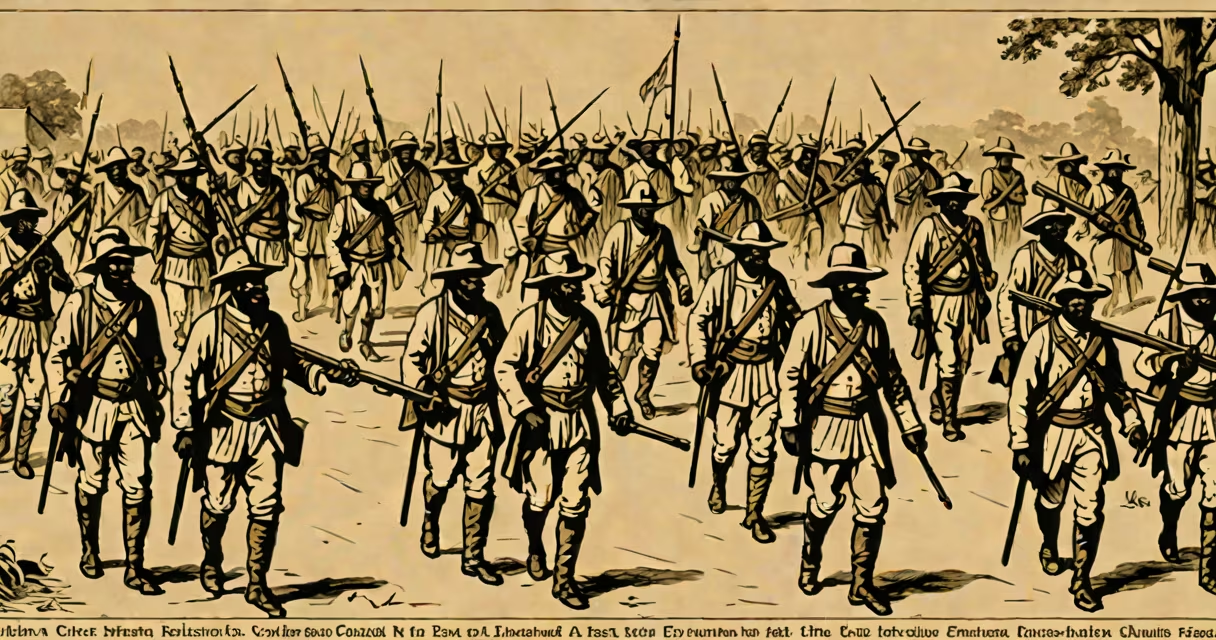
The Stono Rebellion was a violent slave uprising in South Carolina on September 9, 1740, when around 60 to 100 enslaved Africans attacked a store near the Stono River, seized weapons, and marched south toward Spanish Florida, killing approximately 20 to 30 white colonists along the way.
It was the largest slave revolt in the British colonies before the American Revolution. The rebels were primarily from the Kongo and Angolan regions of Central Africa, bringing military experience and cultural memory of resistance from their homelands. They burned plantations and killed settlers, seeking freedom under Spanish rule, which offered asylum to escaped slaves.
Colonial authorities responded swiftly. Militia forces intercepted the group near the Edisto River, killing most of the rebels. The survivors were executed, and their heads were displayed on poles along roads as a warning. The rebellion triggered sweeping new laws restricting slave movement, assembly, and literacy.
On the morning of September 9, 1740, a group of enslaved men from the Stono River area broke into a firearms store, stole guns and ammunition, and killed the owners. They then marched south along the coast, burning plantations and recruiting others as they went. Their goal was to reach Spanish-controlled Florida, where the Spanish had promised freedom to fugitive slaves since the 1600s.
Historians estimate the group grew from about 60 to 100 participants. They moved slowly, likely because many were newly armed and unfamiliar with combat tactics. They targeted plantations with large numbers of enslaved people, hoping to swell their ranks. At least 20 white colonists were killed, including women and children.
Militia units from Charleston and nearby plantations pursued them. The final confrontation occurred near the Edisto River, where the rebels were outnumbered and outgunned. Most were killed or captured. Survivors were tried and executed, often by hanging or burning.
The rebellion stemmed from systemic oppression. By 1740, South Carolina's enslaved population exceeded 50% of the total population, with African-born individuals making up nearly 80%. This demographic imbalance created constant tension.
Enslaved people faced brutal conditions: long hours in rice fields, physical punishment, and denial of education. Many had experienced war and capture in Africa before being sold into slavery. Their cultural memory of resistance-such as the Kongo's 17th-century wars against Portuguese traders-fueled hopes for escape.
Spanish Florida offered a real alternative. The Spanish government had issued proclamations offering freedom to any enslaved person who converted to Catholicism and served in the militia. Over 1,000 such refugees lived in St. Augustine by 1740, proving the promise was credible.
South Carolina's legislature passed the Negro Act of 1740 in response. This law banned enslaved people from gathering in groups, learning to read or write, growing their own food, or traveling without permission. It also prohibited slaveholders from freeing enslaved people without legislative approval.
The act institutionalized racial control. Enslaved people could no longer possess firearms, attend religious services without supervision, or marry freely. These restrictions lasted for decades and shaped the legal structure of slavery in the American South.
Historian Philip Morgan notes that the rebellion "revealed the deep instability of a system built on violence." The colonial elite feared similar uprisings and responded with fear-based legislation rather than reform.
Many assume the Stono Rebellion was a spontaneous act of desperation. But evidence shows planning and coordination. The rebels targeted a store with weapons, chose a route toward Spanish territory, and carried flags or symbols associated with African kingdoms.
Another myth is that the rebellion failed completely. While the rebels were defeated, their actions forced a policy shift. The Negro Act of 1740 was one of the most repressive laws in colonial America, showing how deeply the event impacted governance.
Some sources claim the rebels were mostly from the Ashanti region. This is incorrect. Census records and ship manifests show most were from the Kongo and Angola areas, with distinct linguistic and cultural markers. Their use of the Kikongo word "kolo" (meaning "to rise") in communication suggests shared identity and purpose.
| Event | Date | Location | Rebels | Outcome |
|---|---|---|---|---|
| Stono Rebellion | September 9, 1740 | Stono River, SC | 60-100 African-born enslaved people | Suppressed; 20+ killed; 100+ enslaved people arrested |
| Gabriel Prosser Uprising | August 30, 1800 | Richmond, VA | Approx. 1,000 enslaved people | Planned but foiled; leaders executed |
| Nat Turner's Rebellion | August 21-22, 1831 | Southampton County, VA | Approx. 70 enslaved people | Violent; 55 whites killed; Turner captured and executed |
Unlike later revolts, the Stono Rebellion was not planned to seize power or establish a new society. Its aim was survival and freedom through escape-not conquest.
In 2018, archaeologists uncovered a cache of musket balls and iron fragments near the Edisto River during a dig at the site of the final battle. The artifacts matched those used by colonial militias. A single bullet fragment bore traces of lead isotopes consistent with mines in the Carolinas, confirming the location of the clash.
I stood at the edge of the riverbank where the remains were found. The soil was still dark with ash. No plaque marked the spot. The land had changed little since 1740. That silence spoke louder than any monument.
The Stono Rebellion reshaped colonial policy. It proved that enslaved people were not passive victims but agents of resistance. The state's reaction-harsher laws, surveillance, and fear-showed how much the ruling class feared organized Black autonomy.
Modern scholars like Ira Berlin argue that the rebellion "marked the beginning of a new phase in the evolution of slavery in the Americas." After Stono, the system became more rigid, more legally codified, and more fearful of internal threat.
Today, the site is recognized as a National Historic Landmark. A memorial was dedicated in 2020 near the original Stono River crossing. It bears the names of known rebel leaders and a quote from a survivor's oral account preserved in a 1741 court transcript: "We did not want to kill. We wanted to live."
Understanding what was the Stono Rebellion reveals more than a historical event-it exposes the limits of colonial power and the enduring human desire for freedom. The rebellion was not a failure. It was a catalyst. Its echoes remain in the struggle for justice that continues today.