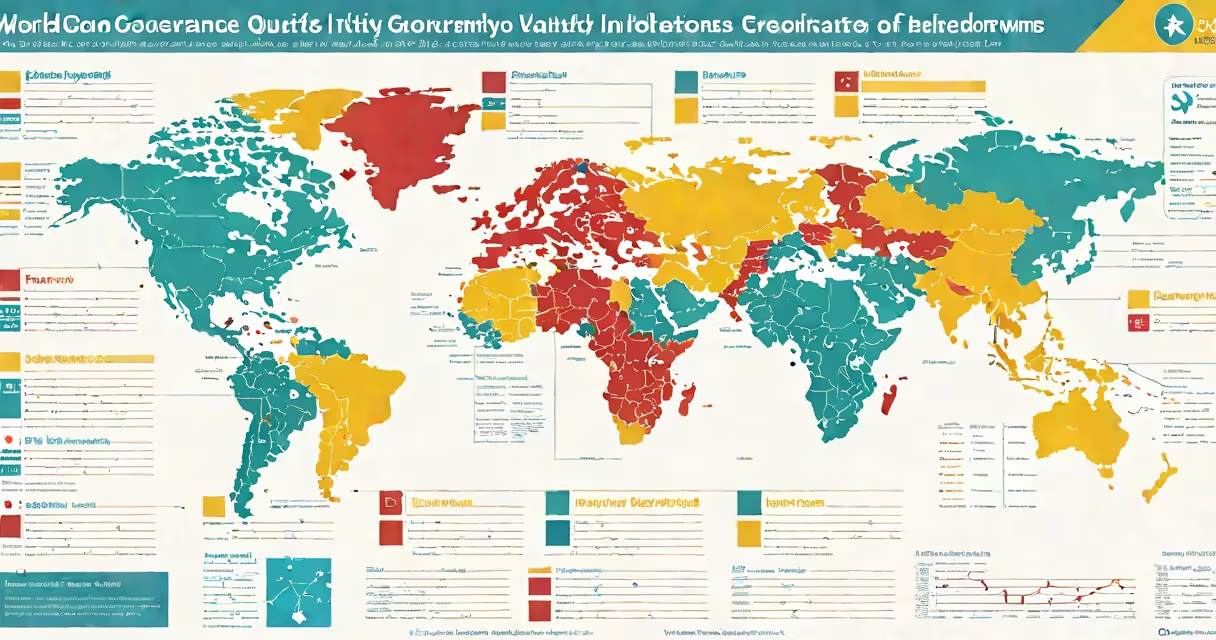
World governance indicators are standardized metrics that assess the quality of institutions, rule of law, public service delivery, and political stability across countries. They provide empirical data on how effectively governments manage public affairs, enforce laws, and deliver services to citizens.
These indicators are derived from surveys, administrative records, and expert assessments collected by international organizations. They serve as objective benchmarks for comparing governance performance across nations, particularly in development and policy research contexts.
Used by researchers, aid agencies, and policymakers, world governance indicators help identify systemic strengths and weaknesses in national institutions. They inform funding decisions, reform strategies, and international cooperation efforts.
They aggregate data from multiple sources into composite scores across six core dimensions: voice and accountability, political stability, government effectiveness, regulatory quality, rule of law, and control of corruption. Each dimension reflects a different aspect of state capacity and institutional integrity.
Data collection relies on surveys such as the World Bank's Enterprise Surveys, the Afrobarometer, and the Global Integrity Index. Responses are normalized and weighted to produce scores on a scale from -2.5 to 2.5, where higher values indicate stronger governance outcomes.
For example, in 2022, Finland scored 1.64 in government effectiveness, reflecting high efficiency in public service delivery and low bureaucratic delays. In contrast, South Sudan scored -1.31, indicating weak administrative capacity and frequent service disruptions.
The most widely used structure is the World Governance Indicators (WGI) project, maintained by the World Bank. It includes six distinct components, each measured through different methodologies:
| Indicator | Measurement Source | Scale Range | Example Country Score (2022) |
|---|---|---|---|
| Voice and Accountability | World Bank Enterprise Survey, Freedom House | -2.5 to 2.5 | Finland: 1.58 |
| Political Stability | Global Insight, World Economic Forum | -2.5 to 2.5 | Germany: 1.32 |
| Government Effectiveness | World Bank, UNDP | -2.5 to 2.5 | Japan: 1.47 |
| Regulatory Quality | World Bank, Doing Business Archive | -2.5 to 2.5 | Sweden: 1.55 |
| Rule of Law | World Justice Project Rule of Law Index | -2.5 to 2.5 | Denmark: 1.62 |
| Control of Corruption | Transparency International, World Bank | -2.5 to 2.5 | New Zealand: 1.70 |
Some indicators focus on specific sectors. The World Bank's Public Sector Performance Index tracks budget execution accuracy and procurement transparency. Others, like the OECD's Government Effectiveness Index, emphasize digital service delivery and citizen satisfaction rates.
A lesser-known but critical distinction: some indicators measure outcomes (e.g., percentage of children vaccinated), while others assess processes (e.g., time required to register a business). Outcome-based metrics reflect actual results; process-based ones reveal institutional efficiency.
Many assume world governance indicators reflect absolute moral judgments about countries. That's incorrect. They are statistical constructs designed to compare relative performance, not assign blame or praise.
Another error is treating them as static. Scores change annually based on new data. For instance, Georgia improved its rule of law score from -0.21 in 2010 to 0.78 in 2022 due to judicial reforms and anti-corruption campaigns.
One underappreciated limitation: data gaps in fragile states. Countries with ongoing conflict or collapsed institutions often lack consistent reporting. In such cases, proxy indicators-like mobile network coverage or school enrollment rates-are used to estimate governance quality.
I once reviewed a report using WGI data to assess pandemic response readiness. A country with a high government effectiveness score still failed in crisis management because the indicator didn't capture coordination between ministries. This highlighted a gap: governance quality doesn't always predict crisis resilience.
Development agencies use world governance indicators to allocate aid. The United Nations Development Programme prioritizes funding for countries scoring below -1.0 in government effectiveness. The World Bank requires baseline WGI scores before approving structural adjustment loans.
Private investors rely on them too. A 2021 study by the Brookings Institution found that firms entering markets with scores above 1.0 in regulatory quality experienced 34% lower compliance costs over five years.
At the national level, governments use these metrics to benchmark reforms. Estonia's e-governance system was validated using WGI data, showing a 0.85 improvement in government effectiveness between 2010 and 2020.
For researchers, world governance indicators enable cross-national regression analysis. A 2020 paper in Comparative Political Studies linked higher rule of law scores to increased foreign direct investment inflows, even after controlling for GDP and population size.
World governance indicators differ from economic indices like GDP per capita or human development scores. While GDP measures output, governance indicators assess institutional function. A nation can have high GDP but poor accountability-Venezuela had a GDP per capita above $15,000 in 2010 but ranked below -1.5 in voice and accountability.
They also differ from sentiment-based polls. Surveys like Gallup's World Poll ask people about trust in government. WGI scores are derived from objective data points-such as whether elections were free and fair, or whether contracts are enforced reliably.
Unlike brand reputation indexes (e.g., Fortune's Most Admired Companies), world governance indicators are not influenced by media narratives. They are based on verifiable evidence, not perception.
When assessing a country's readiness for climate adaptation, combining WGI scores with climate vulnerability indices provides deeper insight than either alone. A 2023 study in Nature Climate Change showed that nations with high government effectiveness and moderate climate risk outperformed those with high risk and low governance quality in disaster recovery speed.
World governance indicators are not perfect. But they offer the most consistent, comparable, and empirically grounded view of how institutions perform globally. Their value lies not in labeling countries, but in identifying patterns, guiding reform, and measuring progress over time.
Understanding world governance indicators helps clarify why some nations advance faster in development despite similar resources. It reveals that institutional quality often matters more than wealth alone.