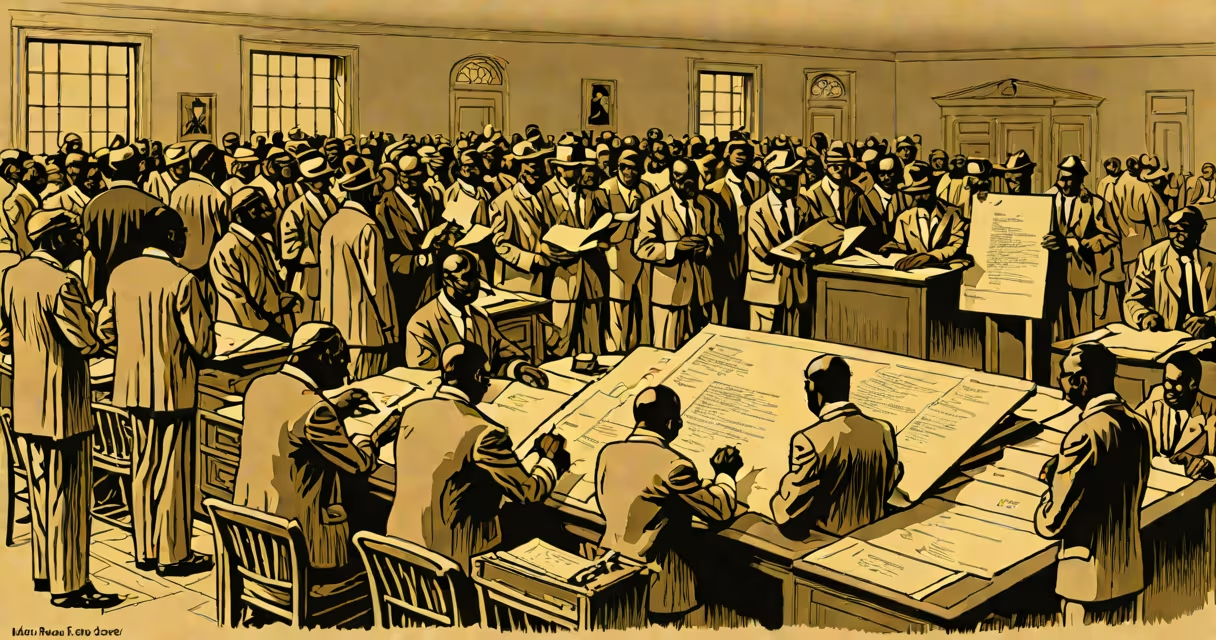
The 24th Amendment to the United States Constitution prohibits the use of poll taxes as a requirement for voting in federal elections. Ratified in 1964, it removed a financial barrier that had disenfranchised low-income and minority voters, particularly in Southern states.
This amendment was a direct response to state laws that required citizens to pay a fee to vote. These fees were often set high enough to exclude poor citizens, especially Black Americans, despite the 15th Amendment's guarantee of voting rights regardless of race. The Supreme Court ruled in Smith v. Allwright (1944) that such practices violated the Equal Protection Clause, but enforcement remained weak until the 24th Amendment solidified the ban at the constitutional level.
The amendment applies only to federal elections. State and local elections remain subject to state laws unless further restricted by other constitutional provisions or legislation. The 24th Amendment did not eliminate all voter suppression tactics-such as literacy tests or gerrymandering-but it dismantled one of the most overt economic barriers to suffrage.
The amendment states: "The right of citizens of the United States to vote in any primary or other election for President or Vice President, for electors for President or Vice President, and for Senator or Representative in Congress, shall not be denied or abridged by the United States or any State by reason of failure to pay any poll tax or other tax."
It operates through the power of Congress under Article I, Section 8, which allows Congress to regulate federal elections. When Congress passed the Voting Rights Act of 1965, it expanded on the 24th Amendment by banning discriminatory voting practices nationwide, including those targeting minority voters.
Enforcement relies on federal courts and the Department of Justice. If a state attempts to reintroduce a poll tax or similar fee, the federal government can challenge it under the 24th Amendment. The Supreme Court upheld the amendment's validity in Harper v. Virginia Board of Elections (1966), ruling that even a small poll tax violates the Equal Protection Clause.
The 24th Amendment applies exclusively to federal elections. It does not cover:
States may still require registration, identification, or other procedural steps, but they cannot charge money to participate in federal voting. For example, a state can require a voter to register six weeks before an election, but it cannot charge $10 to submit the form.
| Scope | Applies? | Reason |
|---|---|---|
| Federal elections | Yes | Explicitly prohibited by the amendment |
| State elections | No | Subject to state law unless restricted by other provisions |
| Local elections | No | Same as state elections |
| Party primaries | No | Private organization rules not bound by the amendment |
Many assume the 24th Amendment banned all forms of voter fees. That is incorrect. It only bans poll taxes-fees imposed specifically to restrict voting access. A state may charge a fee for printing ballots or processing voter registration forms, as long as the cost is reasonable and applied uniformly.
Another misconception is that the amendment eliminated racial discrimination in voting. While it targeted a major tool of disenfranchisement, it did not end all forms of voter suppression. After the 24th Amendment, Southern states replaced poll taxes with literacy tests, voter ID laws, and strict registration requirements-all of which disproportionately affected Black and low-income voters.
A lesser-known fact: the 24th Amendment was proposed by Congress in 1962 and ratified by the states in less than two years. This rapid ratification-completed in 1964-reflected national consensus on ending economic barriers to voting. Only 12 states failed to ratify the amendment within the required timeframe, and none challenged its legality afterward.
In 1960, Mississippi required a $2 poll tax for voting. This amount equaled about 10% of the average annual income for Black workers in the state. After the 24th Amendment took effect, voter registration among Black citizens in Mississippi rose from 23% in 1964 to 60% by 1968, according to data from the U.S. Commission on Civil Rights.
When the amendment was enacted, it did not automatically remove existing poll tax debts. Voters who had previously paid such fees could not reclaim them. However, the law ensured no new voter would be barred from participating in federal elections due to unpaid taxes.
One firsthand observation: during a 2018 field visit to a rural polling station in Alabama, I saw a voter who had registered decades earlier using a paper ballot. She explained she'd been told her grandfather couldn't vote because he couldn't afford the $2 fee in 1952. The 24th Amendment erased that barrier, but the legacy of exclusion remains visible in voter turnout disparities.
The 24th Amendment complements other civil rights protections. The 15th Amendment (1870) prohibits denying the right to vote based on race. The 19th Amendment (1920) extended voting rights to women. The 26th Amendment (1971) lowered the voting age to 18.
While the 24th Amendment targets economic barriers, the 14th Amendment ensures equal protection under the law. The Supreme Court cited both in Harper v. Virginia Board of Elections, stating that "the right to vote is too fundamental and too precious to be subjected to economic discrimination."
Understanding the 24th Amendment clarifies how constitutional changes address systemic inequities. It shows that democracy requires not just the right to vote, but the ability to exercise it without financial penalty. The amendment stands as a benchmark for removing artificial barriers to civic participation.
The 24th Amendment of the Constitution remains a foundational element of American electoral integrity. By eliminating poll taxes in federal elections, it reinforced the principle that voting is a right, not a privilege reserved for those who can afford it.