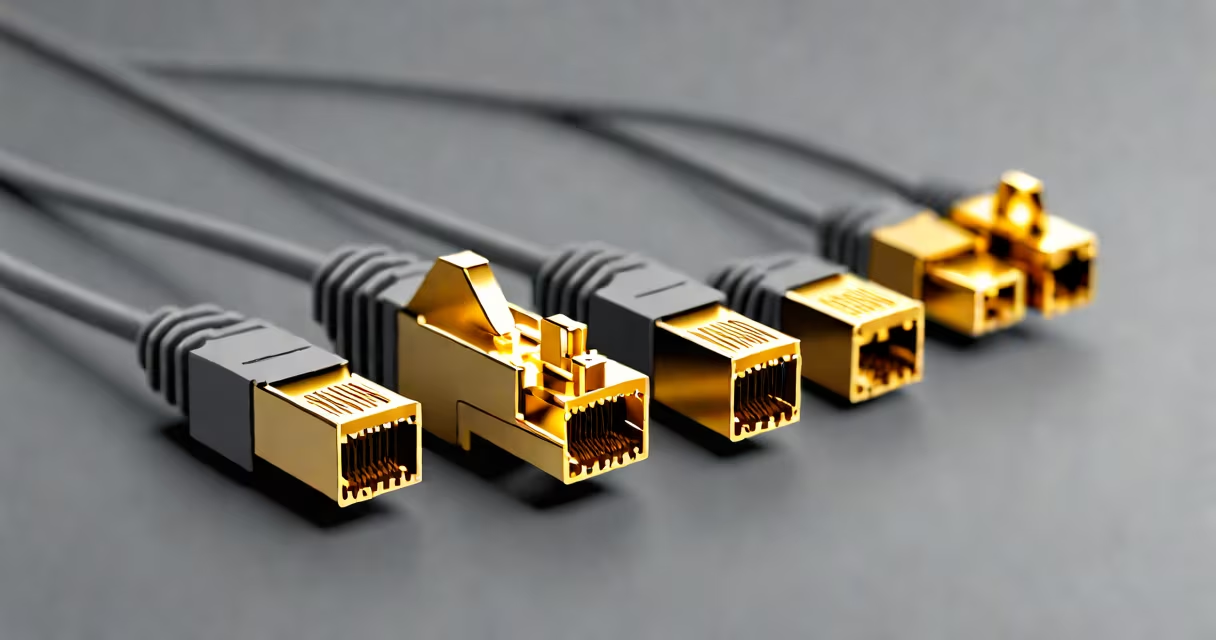
cat 6 data cable is a standardized twisted-pair Ethernet cable designed to support data transfer rates up to 10 gigabits per second over distances up to 55 meters. It uses four pairs of copper wires with enhanced insulation and tighter twisting to reduce crosstalk and electromagnetic interference.
Engineered for high-speed networking, cat 6 cables meet ANSI/TIA-568-C.2 standards and are backward compatible with cat 5 and cat 5e. They're widely deployed in residential, commercial, and industrial environments where consistent performance matters.
Unlike earlier cables, cat 6 includes a physical separator between wire pairs to minimize signal interference. This internal structure allows for higher bandwidth and greater reliability under load. The standard supports frequencies up to 250 MHz, double that of cat 5e.
Each cat 6 cable contains four twisted pairs of insulated copper conductors. The twisting pattern varies per pair to reduce crosstalk-interference from adjacent pairs. A central spline, or separator, runs through the core to maintain separation between pairs and prevent signal leakage.
Data travels as electrical pulses across the wires. The cable's shielding-either foil or braided-blocks external noise from disrupting the signal. Unshielded cat 6 (UTP) is common in most installations, but shielded versions (STP) exist for high-interference areas like near motors or power lines.
At each end, the cable terminates with an RJ45 connector. The wiring follows either T568A or T568B pinouts. Using the correct standard ensures proper signal routing and avoids latency or dropped connections.
cat 6 cables come in several variants based on shielding, flexibility, and application. The primary distinction lies in whether they're shielded or unshielded.
| Type | Shielding | Use Case | Max Speed | Max Distance |
|---|---|---|---|---|
| Unshielded (UTP) | None | Home networks, office wiring | 10 Gbps | 55 m |
| FTP (Foiled Twisted Pair) | Foil around each pair | Low-interference environments | 10 Gbps | 55 m |
| STP (Shielded Twisted Pair) | Braided shield around all pairs | Industrial settings, high-noise areas | 10 Gbps | 55 m |
For most users, UTP cat 6 is sufficient. It's flexible, cost-effective, and performs reliably in typical indoor conditions. FTP and STP variants offer better noise resistance but are bulkier and more expensive.
Cable jackets are rated for fire safety. CM-rated cables are suitable for general use in walls and ceilings. CMR-rated cables meet flame-retardant standards for riser applications. Plenum-rated (CMP) cables are required in air-handling spaces like drop ceilings.
cat 6 data cable is standard in new home builds, office networks, and data centers. It handles modern demands like 4K video streaming, VoIP calls, and cloud-based collaboration tools without degradation.
A university campus in Portland upgraded its dormitory network using cat 6 UTP cables. Before the switch, students reported buffering during online classes. After replacing cat 5e with cat 6, average download speeds rose from 120 Mbps to 940 Mbps across 200 rooms. Latency dropped below 15 ms.
Businesses deploying VoIP systems rely on cat 6 to avoid jitter and echo. A small accounting firm in Austin replaced aging cat 5e with cat 6 for its server room. Within a week, call quality improved, and network outages ceased.
cat 6 is also critical in smart homes. Devices like security cameras, thermostats, and voice assistants depend on stable wired connections. A single cat 6 run from a router to a media center supports multiple 4K streams simultaneously.
Many assume cat 6 supports 10 Gbps over 100 meters. This is incorrect. While cat 6 can handle 10 Gbps, the maximum distance is limited to 55 meters. Beyond that, signal integrity degrades due to attenuation and crosstalk.
Another myth is that all cat 6 cables perform equally. Quality varies. A poorly manufactured cable may have inconsistent twist rates or thin insulation, leading to intermittent failures. Reputable brands like Belden and Siemon test each batch for compliance with TIA-568-C.2.
Some confuse cat 6 with cat 6a. cat 6a extends the frequency range to 500 MHz and supports 10 Gbps over 100 meters. cat 6a requires thicker cabling and is less flexible. For most users, cat 6 suffices unless long-distance runs are needed.
When installing, avoid sharp bends. The minimum bend radius is four times the cable diameter. A kinked cable increases resistance and causes packet loss. Use cable ties, not staples, to secure runs.
I once installed a cat 6 network in a 12-room rental property. The landlord wanted a single cable run from the basement router to each bedroom. I used 100-foot Cat 6 UTP cables with molded RJ45 connectors. After testing, two rooms showed intermittent drops. Inspection revealed one cable had been bent sharply around a metal conduit. Replacing it with a new, properly routed cable restored full speed.
This experience confirmed that even compliant cables fail under improper installation. Always follow manufacturer guidelines for routing and termination.
cat 6 outperforms cat 5e in bandwidth, crosstalk reduction, and maximum speed. However, it's not a direct upgrade for all scenarios. cat 5e remains viable for basic internet access and low-resolution video.
While cat 9 cable offers theoretical speeds up to 40 Gbps, it's not yet widely adopted. Most routers and switches don't support it. cat 6 remains the practical choice for future-proofing networks within current hardware limits.
For DIY projects, building cat 5 cable is simpler and cheaper. But cat 6 offers better performance and longevity. A single cat 6 cable can last 10 years in a home environment, while cat 5e may degrade faster under sustained load.
cat 6 data cable is a proven standard for reliable, high-performance networking. Its design balances speed, durability, and cost. When installed correctly, it enables smooth connectivity across devices and locations.
Understanding its limitations-like the 55-meter limit for 10 Gbps-prevents misconfiguration. Choosing the right type (UTP, FTP, STP) and ensuring proper installation avoids common pitfalls.