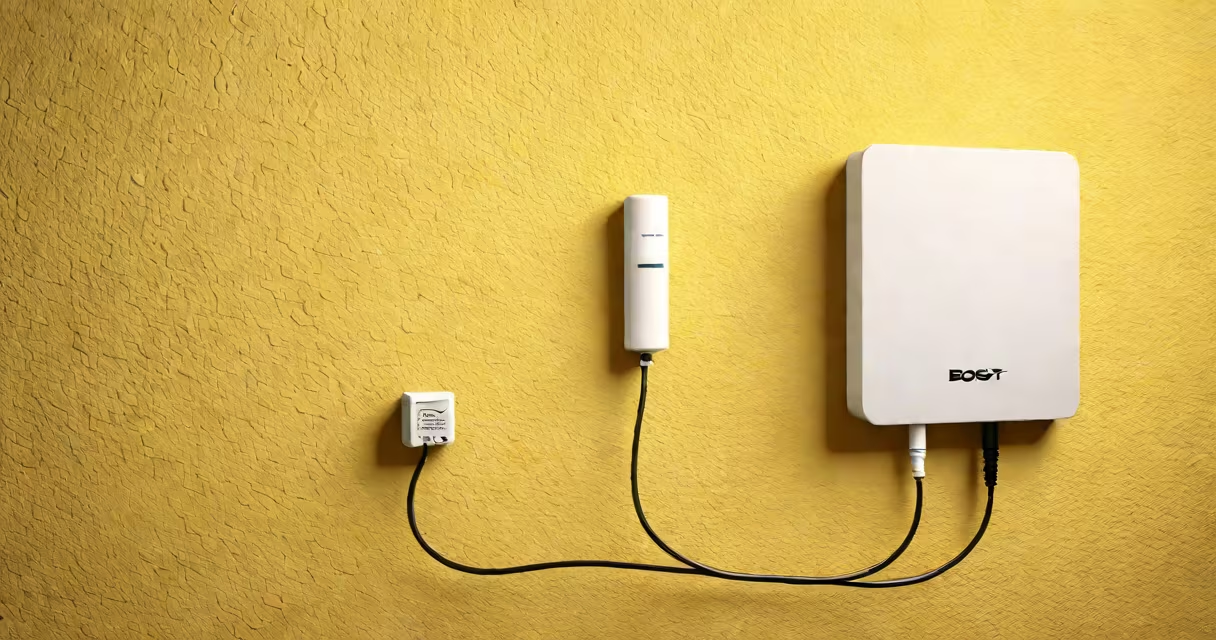
Boost gsm signal refers to increasing the strength and reliability of GSM (Global System for Mobile Communications) cellular signals using hardware devices such as signal amplifiers and repeaters. These tools capture weak external signals, amplify them, and rebroadcast them indoors or in low-coverage areas.
GSM is the most widely used mobile network standard globally, supporting voice calls, SMS, and 2G/3G data. When signal strength drops below -105 dBm, call quality degrades, data speeds slow, and connections drop. Boosting gsm signal restores performance in homes, offices, and remote locations.
The process begins with an external antenna mounted outdoors to receive the weakest available signal from nearby cell towers. That signal travels through coaxial cable to a signal amplifier (also called a repeater or booster). The amplifier increases signal power by 50 to 100 dB, depending on model. The amplified signal then broadcasts via an internal antenna inside the building. This creates a stronger, stable connection for phones and modems.
Signal boosters operate on a closed-loop system. They don't generate new signals-they strengthen existing ones. The external antenna captures the incoming GSM signal from the nearest tower. A low-noise amplifier (LNA) filters out interference and boosts the signal's strength before sending it to the main unit.
The main amplifier stage uses a power amplifier (PA) to increase signal output. Most consumer models support 900 MHz and 1800 MHz bands, which cover most GSM networks. After amplification, the signal is sent to an indoor antenna, usually a panel or omnidirectional antenna, which broadcasts the signal throughout the desired area.
For optimal performance, the external antenna must face the nearest cell tower. Directional antennas (like Yagi or log-periodic) offer better range than omnidirectional models. Proper cable length and quality matter too-using low-loss coaxial cable (e.g., LMR-400) reduces signal attenuation over distance.
Three primary types exist based on deployment scale and intended use:
| Type | Use Case | Typical Coverage | Power Output |
|---|---|---|---|
| Personal | Single room, car, small office | Up to 1,000 sq ft | 20-30 dBm |
| Home/Small Business | Entire home, warehouse, retail space | 1,000-5,000 sq ft | 30-50 dBm |
| Commercial/Industrial | Large buildings, factories, campuses | 5,000-20,000 sq ft | 50-60 dBm |
Personal boosters are portable and plug into USB ports. Home systems typically require mounting the external antenna on a roof or window and running a cable indoors. Commercial units often need professional installation due to higher power levels and regulatory compliance.
Signal boosters must comply with FCC regulations in the U.S. and similar bodies elsewhere. Devices sold legally must include automatic gain control (AGC) to prevent feedback loops and avoid interfering with carrier networks. Unauthorized or modified boosters can cause network congestion and are illegal under FCC Part 15 rules.
Weak gsm signal occurs in rural areas, basements, mountainous terrain, and buildings with thick walls. Concrete, metal framing, and energy-efficient windows block radio waves. In one study by the Federal Communications Commission, 40% of Americans reported poor mobile reception in their homes, especially in regions with sparse tower density.
A real-world example: a homeowner in rural Montana experienced dropped calls and no data during winter storms. The local carrier showed signal strength at -118 dBm. After installing a home-grade GSM booster with a directional outdoor antenna, signal improved to -85 dBm indoors. Calls became clear, and 3G data averaged 1.2 Mbps-up from 0.1 Mbps before.
Signal boosters are ineffective when no signal exists. If the external antenna cannot detect any usable signal (below -110 dBm), amplification won't help. In such cases, relocating the antenna or using a high-gain directional model may be necessary. Also, boosters do not improve network speed beyond the carrier's bandwidth limits.
Many assume that any "signal amplifier" works for GSM. But not all amplifiers are compatible with GSM frequencies. Some models designed for 4G LTE or Wi-Fi fail on 900/1800 MHz GSM bands. Always verify frequency support before purchase.
Another error is placing the indoor antenna too close to the outdoor antenna. This causes feedback, leading to oscillation and signal degradation. The recommended separation is at least 10 feet, ideally with a wall or floor between them. Some systems include isolation panels or shielding to prevent this.
Some users think boosters increase data speed beyond the carrier's plan. They don't. A 2G plan remains 2G even with boosted signal. Speed improvements come from consistent connectivity, not raw bandwidth. If your carrier offers 3G, boosting gsm signal may improve download rates from 100 kbps to 300 kbps-but never reach 4G speeds.
I once installed a booster in a basement apartment with no outdoor access. The tenant insisted on placing the external antenna inside a window. The result was poor signal pickup and constant interference. Only after moving the antenna to the roof did the system stabilize. This shows that placement matters more than device specs.
Signal boosters are not suitable for all situations. In urban areas with dense tower coverage, they may cause interference. Carriers monitor network load and can flag devices causing excessive uplink noise. Illegal boosters have been shut down by carriers like AT&T and Verizon.
Also, boosters don't fix poor network planning. If a building lies in a dead zone due to geographic barriers, a booster may still fail. In such cases, a femtocell (a mini cell tower) or carrier-provided signal solution is better. For example, T-Mobile offers the "T-Mobile Home Internet" service with built-in signal enhancement for rural customers.
Finally, boosters don't replace good network infrastructure. A 2022 report by the GSMA found that 70% of global population coverage now uses 4G or 5G. In these areas, focusing on upgrading to newer devices and plans is more effective than investing in GSM boosters.
If a booster isn't viable, consider alternatives. A femtocell connects to broadband and creates a private cell tower. It supports both voice and data, often improving signal in homes with poor reception. However, it requires a stable internet connection.
Boost gsm signal is not magic-it's engineering. It works best when properly sized, installed, and maintained. Understanding its limits prevents wasted time and money. When used correctly, it brings reliable communication to places where it was once impossible.